Scan Signed Document with SignNow's Secure Solution

Eliminate paper and optimize digital document management for higher productivity and unlimited opportunities. eSign anything from a comfort of your home, quick and feature-rich. Discover the best manner of running your business with airSlate SignNow.

Award-winning eSignature solution

What scan signed document means and when to use it

A scan signed document is a digital copy of a paper document that already contains one or more handwritten signatures, captured by a scanner or mobile camera and converted into a PDF or image file for storage, sharing, or submission. Organizations scan signed documents to preserve original ink signatures, meet record-keeping requirements, or integrate with downstream digital workflows. Scanned signed documents are commonly combined with eSignature platforms like signNow to attach metadata, create audit trails, and ensure files are archived securely while maintaining a verifiable chain of custody for compliance and operational needs.

Why scanning signed documents fits modern workflows

Scanning signed documents preserves physical signatures while enabling digital distribution, searchable storage, and central retention policies without rekeying information or requiring additional in-person steps.

Why scanning signed documents fits modern workflows

Common challenges when you scan signed document

  • Poor image quality can obscure signatures and required fields, complicating verification and record keeping.
  • Inconsistent file formats and sizes cause import errors or prevent automated processing in document systems.
  • Missing metadata or signer identity details weakens audit trails and increases dispute risk.
  • Improper retention or unsecured storage exposes files to data breaches and regulatory noncompliance.

Typical users and how they use scanned signed documents

HR Manager

An HR manager scans signed offer letters, tax forms, and policy acknowledgements to centralize employee records. Scanned files are attached to personnel files in document management systems and supplemented with eSignature workflows when additional approvals are required.

Loan Officer

A loan officer scans signed closing documents and borrower disclosures to create a complete digital loan file. Scanned copies are indexed, stored securely, and paired with system-generated audit metadata for later review or regulatory inspections.

Organizations and roles that commonly scan signed documents

Teams across HR, legal, finance, healthcare, and education frequently scan signed documents to digitize records and integrate signatures into electronic workflows.

  • Human resources teams scanning offer letters, onboarding forms, and policy acknowledgments for secure digital retention.
  • Legal and contracts teams archiving executed agreements and exhibits for centralized access and auditability.
  • Healthcare and educational administrators complying with patient or student records retention and privacy rules.

Scanned signed documents bridge paper-based execution with electronic management, enabling teams to maintain originals while leveraging digital controls and audit capabilities.

Additional features to improve scanned signed document handling

Leverage specialized tools and integrations to reduce manual steps and improve the governance of scanned signed documents across systems.

Version control

Maintains clear history of file versions and edits so scanned signed documents are traceable through every upload, annotation, or redaction without losing the original capture or audit trail.


Integration connectors

Prebuilt connectors to storage and CRM systems enable automatic routing and indexing of scanned signed documents into the correct records and business processes.

Conditional workflows

Automated rules route scanned documents for review, approval, or archival based on metadata, document type, or signer attributes to reduce manual triage.

Bulk processing

Batch upload and processing capabilities let teams ingest multiple scanned files at once, apply OCR and tags, and add audit metadata in a single operation.

Redaction and annotations

Secure redaction removes sensitive data on scanned files while annotations capture reviewer notes without altering the original image for compliance.

Secure sharing links

Time-limited and access-restricted links allow secure distribution of scanned signed documents without exposing permanent copies or broad folder permissions.

be ready to get more

Choose a better solution

Core tools to manage scanned signed documents effectively

Use these features to preserve authenticity, streamline indexing, and integrate scanned signed documents into secure workflows without rekeying data.

OCR and indexing

Optical character recognition converts scanned text into searchable content and enables automatic indexing by names, dates, or contract numbers for rapid retrieval across document stores.

Audit trail

A tamper-evident audit log records uploads, views, and downloads with timestamps and actor identities to support compliance and resolve disputes reliably.

Redaction tools

Redaction capabilities remove or mask sensitive information on scanned documents before distribution, ensuring compliance with privacy requirements such as HIPAA and FERPA.

Retention policies

Configurable retention settings enforce automatic archival or deletion rules for scanned signed documents to meet legal and organizational recordkeeping obligations.
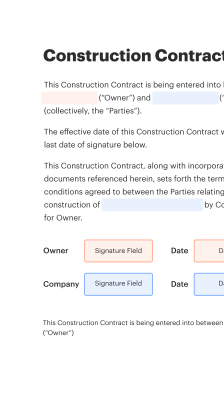
How scanning integrates with eSignature platforms like signNow

Scanning a signed document creates a digital source file that integrates with eSignature platforms for storage, audit, and combined electronic workflows.

  • Import: Upload the scanned PDF into the platform.
  • Attach metadata: Add signer names, dates, and tags for indexing.
  • Combine with eSign: Use scanned pages alongside electronic signature fields.
  • Store securely: Archive with retention policies and audit logs.
Collect signatures
24x
faster
Reduce costs by
$30
per document
Save up to
40h
per employee / month

Step-by-step: how to scan signed document for digital workflows

Follow these core steps to capture, verify, and store a scanned signed document reliably.

  • 01
    Capture: Use a flatbed scanner or phone camera at high resolution.
  • 02
    Save as PDF: Convert images to PDF for consistency and searchability.
  • 03
    Verify legibility: Confirm every signature and date are clearly visible.
  • 04
    Upload and index: Assign metadata before archiving in the document system.
be ready to get more

Why choose airSlate SignNow

  • Free 7-day trial. Choose the plan you need and try it risk-free.
  • Honest pricing for full-featured plans. airSlate SignNow offers subscription plans with no overages or hidden fees at renewal.
  • Enterprise-grade security. airSlate SignNow helps you comply with global security standards.
illustrations signature

Typical workflow settings for scanned signed document processing

Configure these settings to automate ingestion, verification, and retention of scanned signed documents within an eSignature or document management environment.

Setting Name Configuration
Reminder Frequency 48 hours
OCR Auto-Tagging Enabled
Retention Period 7 years
Access Roles Viewer, Editor
Audit Logging Level Full

Supported platforms and basic requirements for scanning and uploading

Scanning and processing signed documents works across common desktop and mobile environments with minimal technical requirements.

  • Desktop: Windows, macOS supported
  • Browsers: Chrome, Edge, Safari
  • Mobile: iOS and Android apps

For reliable uploads, ensure devices run supported OS versions, use recommended browsers or the native mobile app, and verify scanner drivers or camera permissions are configured; these steps reduce failures and improve capture quality.

Security controls relevant for scanned signed documents

Encryption in transit: TLS 1.2+ encryption
Encryption at rest: AES-256 storage encryption
Access controls: Role-based permissions
Multi-factor authentication: Optional MFA for accounts
Document watermarking: Configurable visible watermarks
Audit logging: Comprehensive event logs

Industry examples of scanning signed documents

Two practical examples show how scanned signed documents are used in everyday operations across sectors.

Healthcare intake forms

A clinic scans patient consent and intake forms at the point of care to create a digital record

  • scanned files are attached to the electronic health record for clinician access
  • this reduces physical storage and speeds retrieval during treatment

Leading to faster care coordination and auditable patient consent records.

Real estate closings

A title company scans fully executed closing documents after in-person signatures to produce a complete digital closing package

  • scanned documents are verified and indexed by loan number
  • the package is uploaded to the lender portal for funding

Resulting in a single, searchable record that supports audits and post-closing reviews.

Best practices for scanning signed documents securely and accurately

Adopt standard procedures to reduce errors, protect data, and preserve evidentiary value when scanning signed documents.

Use consistent scanning settings and formats
Standardize resolution, color settings, and file format (PDF/A where possible) to ensure legibility and long-term preservation across archival systems and downstream processes.
Validate signatures and add metadata at upload
Verify all signature areas are present and add signer names, signing dates, and context metadata to support indexing, retrieval, and any future legal validation needs.
Apply encryption and access controls
Restrict access with role-based permissions and encrypt stored files to meet organizational security policies and regulatory requirements such as HIPAA for protected health information.
Keep originals where required and document chain of custody
Retain physical originals when legally necessary and document handling steps, custody transfers, and storage locations to preserve evidentiary integrity.

FAQs and troubleshooting for scan signed document workflows

Common questions and issues when scanning signed documents, plus practical solutions for capture, upload, and verification steps.

Quick comparison: scanned signed document support across vendors

This concise table compares core scanned signed document capabilities for leading eSignature platforms with signNow listed first.

Platform signNow (Recommended) DocuSign Adobe Sign
HIPAA compliance
ESIGN / UETA validity
Built-in OCR
Bulk upload support
be ready to get more

Get legally-binding signatures now!

Risks and potential penalties from improper scanning

Invalid signature: Legal challenge risk
Data breach: Regulatory fines possible
Noncompliance: Contract enforcement issues
Retention lapse: Records destruction risk
Poor chain of custody: Evidentiary disputes
Misfiled documents: Operational delays

Representative pricing and packaging for scanned signed document workflows

Pricing varies by plan and features; below are representative entry, business, and enterprise level descriptors for common eSignature providers, with signNow first.

Plan / Price signNow (Featured) DocuSign Adobe Sign HelloSign PandaDoc
Entry monthly price From $8 per user/month From $10 per user/month From $9.99 per user/month From $15 per user/month From $19 per user/month
Business monthly price From $15 per user/month From $25 per user/month From $24.99 per user/month From $25 per user/month From $30 per user/month
Enterprise pricing Custom quotes available Custom quotes available Custom quotes available Custom quotes available Custom quotes available
API access Included on API plans Available on API plans Available on API plans Available on higher plans Available on higher plans
Bulk send support Included on business tiers Available add-on Available add-on Included on business tiers Included on business tiers

Simplify complex workflows

Create, execute, and manage workflows of any complexity, electronically from virtually anywhere. Scalable eSignature capabilities allow you to share documents with the right people in the correct order and define roles for each recipient. Execute document workflows faster and easier than ever before.

Automate document management

Optimize complex signing processes with airSlate SignNow’s powerful features to enhance your business. Control your automated eSignature workflows to ensure they're running at peak performance with instant notifications and reminders.

Optimize in team collaboration

Bring teams together in a secure, shared environment. Manage documents, use form templates and notifications to create more efficient cross-organization collaboration. Free your employees from having to spend time on repetitive activities so that they can focus on valuable, business-critical tasks.

Integrate into your existing systems

Run your projects with industry-leading integration. Collect Salesforce, Microsoft Teams, and SharePoint all in one business flow. Connect your software to a single system for endless possibilities and more productivity.

Remain compliant with industry-leading data security

Feel safe with the knowledge that your information is protected by the most recent in encryption security. airSlate SignNow is GDPR and eIDAS compliant and provides you awareness into your eSigning experience with court-admissible audit trails. Set up user access permissions and rights to control who has access to what.


walmart logo
exonMobil logo
apple logo
comcast logo
facebook logo
FedEx logo
be ready to get more

Get legally-binding signatures now!