Service Contract Management Software for Retail Trade

Streamline your document processes and enhance efficiency with airSlate SignNow’s user-friendly, cost-effective eSigning solution.

Award-winning eSignature solution

What service contract management software for retail trade does

Service contract management software for retail trade centralizes creation, execution, tracking, and renewal of service and maintenance agreements between retailers and vendors. It standardizes contract templates for warranties, equipment servicing, and vendor support, captures signatures digitally, and retains a searchable record of signed agreements. The software often includes automated reminders for renewals, version control, role-based access, and reporting to help stores reduce missed renewals, clarify SLA obligations, and simplify audits across multiple locations in the United States.

Why retailers adopt service contract management software

Retailers use contract management tools to reduce manual paperwork, accelerate vendor onboarding, and maintain consistent SLA compliance across stores. The software improves visibility into contract timelines and obligations while lowering administrative cost and signing delays.

Why retailers adopt service contract management software

Common operational challenges addressed

  • Scattered paper contracts across stores create retrieval delays and inconsistent terms across locations.
  • Manual signature processes slow vendor activation and cause missed service windows for critical equipment.
  • Lack of renewal tracking results in accidental lapses or unintended auto-renewals with unfavorable terms.
  • Unclear role permissions increase risk of unauthorized contract edits or improper approvals.

Representative user profiles

Store Manager

A store manager uses the system to retrieve signed service agreements during on-site repairs, confirm warranty coverage, and check scheduled maintenance dates. They need simple search, read-only access for most contracts, and clear renewal alerts to coordinate local vendor visits and avoid service interruptions.

Procurement Lead

A procurement lead drafts standard service contract templates, negotiates master service agreements, and approves vendor onboarding. They require template controls, clause libraries, role-based approvals, and reporting to monitor spend, compliance, and contract lifecycle across all retail locations.

Typical retail teams that use this software

Retail operations, facilities, procurement, and store management commonly rely on contract management tools to coordinate vendor relationships and service delivery.

  • Store managers who need quick access to active service agreements and contact details for local vendors.
  • Procurement and category managers who negotiate terms and manage vendor obligations across chains.
  • Facilities and maintenance teams responsible for equipment warranties, service schedules, and emergency repairs.

Cross-functional use improves uptime, enforces consistent terms, and simplifies compliance for multi-location retail businesses.

Advanced features for enterprise retail operations

For larger retailers, additional capabilities help scale contract processes, integrate systems, and analyze risk across many locations.

Bulk Send

Send the same service agreement to hundreds of vendors or store managers concurrently, tracking individual responses and completion status to accelerate rollout of uniform contracts.


API integration

Connect contract data to POS, procurement, and ERP systems to sync vendor records, renewal dates, and invoice triggers for automated downstream processing.

Conditional fields

Dynamic document fields adjust content based on prior inputs, ensuring regional clauses and store-specific details populate correctly without manual edits.

Advanced reporting

Custom reports show active contracts, upcoming renewals, spend by vendor, and SLA compliance metrics to support procurement decisions and budgeting.

Document retention controls

Policy-driven retention and disposition rules meet corporate governance needs and support defensible deletion schedules for obsolete agreements.

Single sign-on

Integrate with SSO providers to simplify user access while maintaining centralized authentication and session policies for corporate IT teams.

be ready to get more

Choose a better solution

Essential features for retail contract management

Key capabilities focus on efficiency, compliance, and operational continuity for multi-location retailers managing service agreements.

Template library

Centralized templates enforce consistent clauses (warranty, SLA, liability) across stores and vendors, reducing negotiation time and ensuring every location uses approved language before routing for signatures.

Automated reminders

Configurable alerts notify procurement and store managers of upcoming renewals, expirations, and service windows to avoid lapses and unexpected auto-renewals that could increase costs.

Audit trail

A full, tamper-evident history records who viewed, edited, and signed each contract with timestamps and IP data to support audits and dispute resolution in the United States.

Role controls

Granular permissions separate drafting, approval, and signing duties so stores have necessary read access while legal and procurement retain edit and approval privileges.
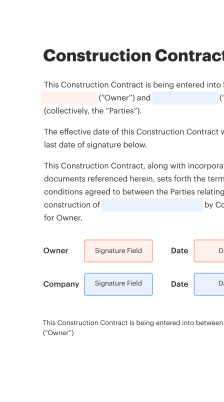
How day-to-day contract workflows operate

A simplified flow describes typical contract creation, approval, signing, and storage in a retail context.

  • Draft: Create or select an approved template
  • Review: Route to procurement or legal for approval
  • Sign: Collect electronic signatures from parties
  • Store: Archive with searchable metadata and audit trail
Collect signatures
24x
faster
Reduce costs by
$30
per document
Save up to
40h
per employee / month

Quick setup steps for retail teams

A short checklist to get a retail location or corporate procurement team started with contract management functionality.

  • 01
    Upload templates: Import existing master service agreements
  • 02
    Configure roles: Assign store and corporate permissions
  • 03
    Set reminders: Define renewal and escalation timing
  • 04
    Enable eSignature: Activate electronic signing for users
be ready to get more

Why choose airSlate SignNow

  • Free 7-day trial. Choose the plan you need and try it risk-free.
  • Honest pricing for full-featured plans. airSlate SignNow offers subscription plans with no overages or hidden fees at renewal.
  • Enterprise-grade security. airSlate SignNow helps you comply with global security standards.
illustrations signature

Recommended workflow settings for retail contract lifecycles

These configuration items reflect default practices for retail contract lifecycles, balancing timely renewals with approval controls.

signNow configuration example DocuSign configuration example
Default reminder frequency in hours Send primary reminder at 720 hours before expiry and follow-up at 168 hours
Escalation rule for overdue signatures Escalate to procurement lead after 72 hours uncompleted
Approval chain length and order Two-step approval: store manager then procurement approver
Template lock and editing permissions Only legal can edit master templates to prevent unauthorized changes
Automatic archive and retention period Archive upon completion and retain for seven years per policy

Supported platforms and device guidance

The software should work on standard desktop browsers, mobile devices, and tablets to support in-store and corporate use cases.

  • Desktop browsers: Chrome, Edge, Safari supported
  • Mobile OS: iOS and Android apps available
  • Offline signing: Limited offline capture supported

For best results, keep browsers and mobile apps up to date, enable TLS support, and verify mobile authentication options for remote vendor signing and store-based workflows.

Security and access controls

Encryption at rest: AES-256 encryption
Encryption in transit: TLS 1.2+ protocols
Multi-factor authentication: MFA for users
Role-based access: Granular permissions
Audit logging: Immutable logs
Data residency options: US-based storage

Retail use cases and outcomes

Two concise retail scenarios show how contract management reduces delays and enforces service obligations.

Regional chain equipment maintenance

A regional retailer standardized HVAC and refrigeration service contracts across 120 stores, using templates to ensure consistent SLA clauses and approved pricing

  • Template enforcement reduced negotiation time per store and ensured identical warranty terms across locations
  • Centralized renewal alerts cut missed renewals by half and streamlined budget forecasting

Resulting in reduced emergency repairs and lower maintenance spend across the chain.

Third-party logistics agreements

A national retailer consolidated third-party logistics and last-mile delivery contracts into a single repository with role-based approvals and automated signature routing

  • The system ensured each carrier contract included the required insurance and service-level clauses
  • Automated reminders and reporting provided procurement visibility into upcoming expirations and cost changes

Leading to improved carrier compliance and clearer cost management across distribution centers.

Best practices for secure and accurate contract handling

Implement consistent governance, controls, and training to reduce risk and ensure accurate contract execution across retail operations.

Standardize approved templates and clauses
Maintain a central template library curated by legal and procurement to ensure every store uses consistent terms, preserves required liability and warranty language, and avoids unauthorized clause changes that can create exposure.
Enforce role-based approvals and separation of duties
Configure workflows so drafting, approval, and signature responsibilities are separated; require procurement or legal approval for high-value or high-risk service agreements to reduce unauthorized commitments.
Enable retention and audit controls aligned to policy
Apply document retention schedules and secure archival policies to comply with corporate governance and to preserve records needed for dispute resolution or regulatory review.
Train store and procurement staff on workflows
Provide targeted training and quick-reference guides so store managers and procurement teams understand how to find contracts, trigger renewals, and escalate missing signatures to avoid service gaps.

FAQs about service contract management software for retail trade

Common questions cover legal validity, signature methods, integration, and troubleshooting for retail deployments.

Feature availability comparison for retail contracts

A concise comparison of core capabilities relevant to retail service contract workflows across two widely used eSignature providers.

Feature or Contract Requirement Overview signNow (Recommended) DocuSign
Legal eSignature validity for U.S. contracts
Bulk Send capability for mass vendor rollout
Template library with role-based locks
API for integration with POS and ERP REST API REST API
be ready to get more

Get legally-binding signatures now!

Key retention and deadline policies to set

Retailers should apply clear timelines for contract actions, retention, and review to maintain compliance and operational continuity.

Renewal notification lead time:

Notify 90 days before contract expiration

Signature completion SLA:

Require execution within 7 days of routing

Contract review cadence:

Annual review for master agreements

Document retention period:

Retain signed contracts seven years

Dispute record retention:

Keep dispute documentation for ten years

Operational risks and penalties to consider

Service downtime: Lost revenue
Contract disputes: Legal fees
Data breaches: Regulatory fines
Noncompliance: Penalties
Unauthorized changes: Liability exposure
Missed renewals: Automatic charges

Pricing and plan comparison for contract workflows

Typical per-user or per-account pricing examples and plan characteristics to evaluate total cost of ownership for retail deployments.

Vendor and plan header signNow (Recommended) Adobe Acrobat Sign DocuSign PandaDoc HelloSign
Entry-level plan cost and billing From $8 per user per month billed annually From $14.99 per month for individuals From $10 per user per month billed annually From $19 per user per month with annual billing From $15 per user per month billed annually
Enterprise plan availability and focus Custom enterprise plans with volume discounts and advanced controls Enterprise plans focused on document workflows and PDF tools Enterprise solutions emphasizing integrations and compliance Enterprise packages for sales and contract lifecycle Enterprise solutions for document workflows and eSignatures
Included advanced features Bulk Send, API access, audit trail, SSO options included on select plans Advanced PDF tools, e-sign, and enterprise connectors on higher tiers Advanced workflow, reporting, and large-scale APIs on premium tiers Document analytics and CRM integrations on business tiers Team management, SSO, and APIs available on business plans
Support and onboarding options Email support with paid priority and onboarding for enterprise customers Phone and chat for higher-tier plans plus enterprise onboarding Priority support and dedicated onboarding for enterprise accounts Customer success and onboarding on business and up Email and priority phone support on select plans
Contract limits and storage Generous storage with optional retention controls and export tools Storage limits vary by plan with Adobe Document Cloud Storage and envelope limits depend on enterprise agreement Document limits tied to plan and account type Storage and API usage limits per plan tier
walmart logo
exonMobil logo
apple logo
comcast logo
facebook logo
FedEx logo
be ready to get more

Get legally-binding signatures now!