Sign Invite with SignNow's Secure eSignature Solution

Eliminate paperwork and optimize digital document managing for increased productivity and endless possibilities. Discover the best way of doing business with airSlate SignNow.

Award-winning eSignature solution

What sign invite is and how it fits eSignature workflows

sign invite is a document delivery and signing mechanism within an eSignature platform that lets senders package documents, assign signing roles, and invite recipients to review and sign electronically. It streamlines the exchange by combining recipient routing, field placement, and notification controls into a single shareable invitation. In U.S. contexts sign invite workflows are commonly configured to support sequential or parallel signing, reminder schedules, and basic authentication so transactions can meet ESIGN and UETA validity requirements when properly completed.

Why sign invite matters for routine document execution

A sign invite centralizes document distribution, reduces manual handoffs, and standardizes recipient instructions to lower signing errors and speed execution while preserving an electronic record of the process.

Why sign invite matters for routine document execution

Common signing challenges addressed by sign invite

  • Inconsistent recipient instructions cause incomplete forms and require additional follow-up, delaying agreements and approvals.
  • Manual routing of paper or email attachments increases administrative overhead and risks lost or out-of-sequence signatures.
  • Lack of a verifiable audit trail makes it hard to demonstrate execution history for compliance or dispute resolution.
  • Difficulty enforcing signing order or required fields leads to incorrect or unsupported contract states.

Representative user profiles for sign invite

Legal Counsel

In-house counsel configures sign invite templates, enforces signing order and authentication, and reviews audit trails to ensure documents meet ESIGN and UETA standards for enforceability.

HR Manager

An HR manager uses sign invite to send onboarding packets, track required employee signatures, automate reminders, and store completed forms with access controls for compliance and retention.

Typical teams and roles that use sign invite

Legal, HR, sales, and operations teams use sign invite to standardize execution processes and reduce administrative friction.

  • Legal teams for contract execution and retention workflows.
  • HR teams for onboarding, I-9s, and policy acknowledgements.
  • Sales and account management for order forms and agreements.

Organizations of all sizes adopt sign invite where repeatable signature workflows and clear recipient responsibilities improve throughput and recordkeeping.

Primary features that support effective sign invite use

A robust sign invite capability typically combines template management, recipient controls, authentication options, audit logging, bulk distribution, and integrations to support repeatable signing workflows across teams.

Template Library

Create reusable sign invite templates with pre-placed fields, role definitions, and messaging to reduce setup time and enforce document consistency across repeated transactions.


Recipient Routing

Define sequential or parallel signing order, add CC recipients, and control who must sign or only receive copies to match business process requirements.

Authentication Controls

Offer email verification, SMS codes, or single sign-on options to provide appropriate identity assurance based on transaction risk and compliance needs.

Audit Trail

Maintain detailed event logs that record timestamps, IP addresses, and actions taken by each participant for evidentiary support and compliance.

Bulk Send

Dispatch the same sign invite to many recipients with individualized tokens or links while tracking each response separately for high-volume workflows.

Integrations

Connect sign invite events with storage, CRM, and document systems to automate filing, status updates, and downstream processing.

be ready to get more

Choose a better solution

Common integrations used with sign invite

Integrations extend sign invite utility by connecting signature events to storage, document creation, and business systems used daily by teams.

Google Workspace

Embed sign invite workflows with Google Drive and Docs to send documents directly from storage, preserve document versions, and update status in the originating folder.

CRM systems

Link sign invite events to CRM records so signed contracts update opportunity stages, attach signed documents, and trigger downstream sales processes.

Cloud Storage

Automate storage of completed documents to SharePoint, Dropbox, or other repositories to centralize retention and access control for recordkeeping.

API connectivity

Use the platform API to programmatically generate sign invites, track envelope status, and retrieve completed documents for custom workflows.
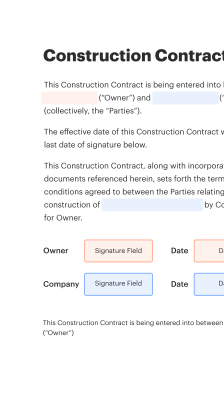
How sign invite works step by step

This outline explains the recipient journey and sender controls when using sign invite for electronic execution.

  • Create Invite: Assemble documents and set recipient order.
  • Notify Recipients: Send an email or SMS invitation.
  • Recipient Action: Open, review, and complete required fields.
  • Completion: System records signatures and finalizes the document.
Collect signatures
24x
faster
Reduce costs by
$30
per document
Save up to
40h
per employee / month

Quick setup steps for a sign invite

Follow these practical steps to prepare, configure, and send a sign invite for a typical single-document transaction.

  • 01
    Upload Document: Add the PDF or supported file to the workspace.
  • 02
    Assign Roles: Set signers and recipients with their roles.
  • 03
    Place Fields: Add signature, date, and required fields.
  • 04
    Send Invite: Dispatch the invite with optional reminders.

Managing audit trails and records for sign invite transactions

Follow these steps to ensure each sign invite transaction produces a complete, reviewable audit trail and stored records that meet internal policies and external requirements.

01

Enable Logging:

Turn on detailed event capture.
02

Store Copies:

Archive signed PDFs securely.
03

Preserve Metadata:

Keep timestamps and IPs.
04

Version Control:

Avoid post-sign edits.
05

Access Controls:

Limit who can view records.
06

Retention Policy:

Apply consistent retention settings.
be ready to get more

Why choose airSlate SignNow

  • Free 7-day trial. Choose the plan you need and try it risk-free.
  • Honest pricing for full-featured plans. airSlate SignNow offers subscription plans with no overages or hidden fees at renewal.
  • Enterprise-grade security. airSlate SignNow helps you comply with global security standards.
illustrations signature

Typical workflow configuration settings for sign invite

Below are common settings and recommended default values to establish reliable sign invite workflows for routine use.

Workflow Setting Display Field Name Configuration Value
Email Reminder Frequency and Schedule 48 hours, three reminders
Signature Order Enforcement Setting Sequential by role
Authentication Requirement for Recipients Email verification default
Document Expiration Interval Setting 30 days
Completed Document Storage Location Centralized cloud folder

Supported platforms and technical requirements

sign invite works on modern browsers and mobile devices but specific requirements affect performance and feature availability.

  • Desktop browsers: Chrome, Edge, Firefox supported
  • Mobile OS support: iOS and Android apps available
  • Minimum browser version: Recent stable releases required

For reliable rendering and feature parity use the latest stable browser versions or the provider's mobile app; enable cookies and TLS 1.2+ for secure connections and consistent signing experiences across devices.

Security and authentication controls associated with sign invite

Encryption at rest: AES-256 level encryption
Encryption in transit: TLS 1.2 or higher
Access controls: Role-based permissions
Authentication options: Email, SMS, SSO
Audit logging: Detailed event records
Document integrity: Tamper-evident seals

Industry examples showing sign invite in practice

These case summaries describe typical implementations of sign invite across business functions and the specific value delivered in each scenario.

Employment Onboarding

A mid-size company uses sign invite to distribute new-hire packets and compliance forms in a single bundle with defined signer roles

  • Pre-populated fields reduce manual data entry
  • Employees complete forms faster with guided fields

Resulting in consistent completion and simplified HR recordkeeping.

Sales Contract Execution

A sales organization sends proposal and contract packages via sign invite to multiple stakeholders with sequential signing order

  • Automated reminders reduce follow-up emails
  • Combined documents ensure all terms are returned together

Leading to shorter sales cycles and clearer audit trails.

Best practices for secure and accurate sign invite usage

Adopt these procedural and configuration practices to reduce errors, support compliance, and maintain reliable records when using sign invite.

Use pre-configured templates for common documents
Standardize fields and roles in templates to avoid placement errors, ensure required fields are enforced, and reduce the time needed to assemble common document sets for repetitive signing processes.
Select appropriate authentication for transaction risk
Assess the sensitivity of the transaction and require higher-strength authentication, such as SMS codes or SSO, for agreements with elevated legal or privacy requirements to strengthen evidentiary value.
Retain complete audit trails with secured storage
Ensure audit logs and completed documents are stored in secure, access-controlled repositories with defined retention policies to support compliance and downstream retrieval needs.
Test workflows before wide rollout
Run test sign invites through each intended signing path, with different roles and device types, to validate behavior, field validation, and integration outcomes before sending live transactions to external parties.

Frequently asked questions and common troubleshooting for sign invite

These FAQs address routine issues senders and recipients encounter with sign invite and provide concise troubleshooting steps and explanations.

Comparing signNow sign invite, Adobe Sign, and paper processes

This concise comparison highlights practical differences across signNow sign invite workflows, a major eSignature provider, and traditional paper signing in common criteria.

Signing Method Comparison Across Three Options signNow (Recommended) Adobe Sign Paper
Legally enforceable Varies
Audit trail available
Remote signing supported
Turnaround speed Fast Fast Slow
be ready to get more

Get legally-binding signatures now!

Risks and compliance considerations for sign invite use

Improper authentication: Weak evidence
Missing audit trail: Admissibility issues
Data exposure: Breach risk
Retention lapses: Noncompliance fines
Incorrect routing: Invalid execution
Unauthorized access: Privacy violations

Plan and feature comparison across popular eSignature providers

The table below compares typical plan names and feature availability among signNow and other widely used eSignature vendors; signNow is listed first as Featured where noted.

Plan and Feature Pricing signNow (Featured) DocuSign Adobe Sign Dropbox Sign PandaDoc
Entry-level plan name Business plan available Personal plan available Individual plan available Essentials plan available Free eSign plan available
Free tier availability Limited free tier for eSignatures No free tier for many features Trial available, limited free use Free tier for basic eSign Free eSign with limits
Bulk Send availability Bulk Send supported in higher tiers Available in Business Pro tiers Available via enterprise features Available in business plans Available in Business tier
Advanced authentication options Email, SMS, SSO options Email, SMS, phone, ID check Email, phone, enterprise SSO Email, SSO available Email, SSO available
API access API available with paid plans API available for paid accounts API for enterprise customers API with paid plans API included in paid tiers
Enterprise support level Standard and enterprise support options Enterprise success plans offered Enterprise support available Business and enterprise support Dedicated enterprise support available

Simplify challenging workflows

Generate, perform, and control workflows of any complexity, digitally from virtually anywhere. Scalable electronic signature capabilities ensure you can exchange documents with the right people in the right way and define roles for each receiver. Stream document workflows faster and easier than ever before.

Automate document management

Optimize intricate signing tasks with airSlate SignNow�s highly effective features to enhance your company. Take control of your automated signature workflows to guarantee they're running at peak functionality with quick notifications and alerts.

Enhance in team communication

Join teammates together in a safe, shared workplace. Handle documents, use form templates and notices to deliver better cross-company collaboration. Relieve your staff from having to spend time on repeating routines so that they can concentrate on beneficial, business-critical projects.

Integrate into your existing network

Work your jobs with best-in-class integration. Collect Salesforce, Microsoft Teams, and SharePoint all in one business thread. Link up your applications to a single unit for unlimited opportunities and higher productiveness.

Stay compliant with industry-leading data security

Feel confident with the knowledge that your information remains secure by the most up-to-date in encryption security. airSlate SignNow is GDPR and eIDAS compliant and provides you visibility into your eSigning process with court-admissible audit trails. Configure user authorization and rights to manage who has access to what.


walmart logo
exonMobil logo
apple logo
comcast logo
facebook logo
FedEx logo
be ready to get more

Get legally-binding signatures now!