Signature Catalog for Secure eSignatures

Get rid of paper and optimize digital document managing for higher productivity and limitless possibilities. Experience the perfect way of doing business with airSlate SignNow.

Award-winning eSignature solution

What a signature catalog is and how it fits into eSignature workflows

A signature catalog centralizes reusable signature components, standardized signer roles, and preconfigured signature blocks for frequent document types. Catalogs reduce repetitive setup by storing verified signature entries, role definitions, and conditional placement rules that can be inserted into agreements, forms, and templates. In regulated U.S. environments a catalog supports consistent application of authentication, audit captures, and retention policies. When integrated with an eSignature platform such as signNow, a signature catalog helps teams maintain version control, streamline approvals, and limit manual errors across contract lifecycles while preserving legal and technical evidence required by ESIGN and UETA.

Why organizations use a signature catalog

A signature catalog saves time and reduces variability by reusing verified signature components and role assignments across documents, improving consistency and simplifying compliance for recurring agreement types.

Why organizations use a signature catalog

Common challenges addressed by a signature catalog

  • Inconsistent signature placement and role definitions cause delays and require repeated manual edits across similar documents.
  • Version drift when signature blocks are copied manually leads to compliance gaps and audit difficulties.
  • Manual keystrokes to recreate signatures increase risk of incorrect authentication or missing metadata.
  • Scaling approvals across teams becomes complex without reusable templates and centralized signer role management.

Sample user roles for a signature catalog

Contract Manager

A Contract Manager configures catalog entries for common agreement types, maintains approved signature blocks, and ensures each entry includes required signer roles and authentication methods. They coordinate with legal to update versions and monitor usage across teams to keep templates compliant.

HR Administrator

An HR Administrator applies the catalog to onboarding and payroll documents, selects predefined signature blocks for managers and employees, and enforces access controls and retention rules to meet internal policies and applicable regulations like HIPAA when handling protected information.

Typical users and teams that benefit from signature catalogs

Teams that handle recurring agreements, regulated documents, or high-volume signing workflows gain the greatest benefit from a centralized signature catalog.

  • Legal and contracts teams managing standard NDAs, SOWs, and vendor agreements.
  • Human resources teams issuing offer letters, tax forms, and onboarding documents.
  • Sales and account management teams sending recurring quotes or commission agreements.

Centralized catalogs reduce repetitive setup and help cross-functional teams apply consistent authentication and retention policies.

Expanded feature set for robust signature catalog management

Beyond core templates a full catalog solution supports governance, integrations, and reporting to scale across teams and systems.

Central Repository

A single searchable store for signature blocks and role definitions that ensures teams use approved entries and reduces duplicate work when creating similar documents across departments.


Template Linking

Link catalog entries directly to document templates so updates to the catalog propagate predictably while preserving historical versions for already-signed agreements.

Role Enforcement

Define and enforce signer roles within entries to control who is eligible to sign specific fields, helping maintain proper approval sequencing and compliance.

Bulk Processing

Apply catalog entries in bulk-send or batch workflows, allowing consistent signature application across many recipients while tracking individual transaction metadata and outcomes.

Integration Connectors

Prebuilt connectors to CRM, document generation, and storage systems let you insert catalog entries automatically during document creation and lifecycle events.

Reporting and Exports

Detailed reports on catalog usage, signature events, and audit logs support compliance reviews and operational metrics for continuous improvement.

be ready to get more

Choose a better solution

Core features to expect in a signature catalog

The most useful catalog features focus on reusability, traceability, and secure insertion into documents across teams and systems.

Catalog Templates

Store prebuilt signature blocks and role definitions that can be applied to multiple templates, reducing setup time and ensuring consistent legal language and metadata across recurring document types.

Bulk Send

Attach catalog entries to bulk or mass-send processes so identical signature blocks apply automatically, enabling efficient distribution and consistent audit evidence for high-volume campaigns.

Role-based Access

Assign creation and usage permissions to specific roles or groups, ensuring only authorized personnel can modify catalog entries or apply them to sensitive documents.

API Integration

Expose catalog operations via API to programmatically insert entries into generated documents, enabling automated workflows with CRM or document generation systems.
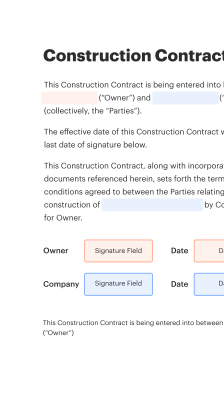
How a signature catalog integrates into document workflows

A catalog entry becomes a reusable building block inserted during template composition or at send time to standardize roles and signature placement.

  • Create entry: Define block, role, and meta.
  • Insert where needed: Add block to templates or documents.
  • Apply authentication: Attach required verification methods.
  • Track usage: Monitor via audit logs and reports.
Collect signatures
24x
faster
Reduce costs by
$30
per document
Save up to
40h
per employee / month

Quick setup: creating a signature catalog entry

A short four-step sequence gets a reusable signature catalog entry ready for repeated use across templates and documents.

  • 01
    Upload document: Import the base template file.
  • 02
    Define signature block: Create named signature component with role.
  • 03
    Set authentication: Choose email, SMS, or identity verification.
  • 04
    Save to catalog: Store entry with version notes.

Operational checklist for rolling out a signature catalog

A six-point grid helps coordinate technical setup, governance, and training for a catalog deployment.

01

Establish owners:

Assign admins and reviewers.
02

Define naming:

Create consistent conventions.
03

Set access rules:

Apply role permissions.
04

Integrate systems:

Connect CRM and storage.
05

Train users:

Provide focused sessions.
06

Audit usage:

Schedule recurring checks.
be ready to get more

Why choose airSlate SignNow

  • Free 7-day trial. Choose the plan you need and try it risk-free.
  • Honest pricing for full-featured plans. airSlate SignNow offers subscription plans with no overages or hidden fees at renewal.
  • Enterprise-grade security. airSlate SignNow helps you comply with global security standards.
illustrations signature

Recommended workflow settings for signature catalog use

Standardize workflow defaults to ensure catalog entries apply consistently when documents are generated or sent.

Feature Value
Reminder Frequency 48 hours
Signature Expiry 90 days
Authentication Default Email verification
Version Control Mode Require approval
Audit Log Retention 7 years

Device and browser requirements for using signature catalogs

Basic platform compatibility ensures catalog features work consistently across desktop and mobile environments.

  • Desktop browsers: Chrome, Edge, Safari
  • Mobile support: iOS and Android apps
  • API clients: RESTful HTTPS calls

For secure and reliable operation use kept-up-to-date browsers and the provider's mobile apps; ensure TLS-capable networking and follow any organizational device policies.

Security and protection controls relevant to signature catalogs

Audit trail: Comprehensive event log
Encryption at rest: AES-256 standard
Encryption in transit: TLS 1.2+ connections
Access controls: Role-based permissions
Multi-factor auth: Optional two-step login
Document watermarking: Visible tamper deterrent

Industry examples showing signature catalog use

Two concise case examples illustrate practical catalog applications across common U.S. industries.

Healthcare consent templates

A hospital standardized consent forms into a catalog entry with predefined clinician and patient signature blocks, conditional fields for procedure details, and configured authentication methods

  • Template enforces role placement and required medical disclosures
  • Reduces patient intake time and ensures consistent audit metadata capture

Resulting in faster processing and clearer compliance records for HIPAA audits.

Sales contract bundles

A mid-sized software firm created a catalog of sales contract blocks with preset approver roles, default payment terms, and standard signature fields

  • Blocks include automated reminders and expiry settings
  • Speeds proposal turnaround and reduces revision cycles

Leading to shorter sales cycles and more predictable revenue recognition processes.

Best practices for managing signature catalogs

Adopt consistent controls and versioning to keep catalogs accurate, auditable, and aligned with legal requirements.

Use clear naming and versioning conventions
Name entries with role, document type, and version to avoid confusion. Include changelogs and effective dates so teams can confirm they use the correct, approved block when composing or sending documents.
Limit edit rights and review changes
Restrict catalog modification to a small group and require legal or compliance review for substantive changes. Maintain an approval workflow to ensure updates are intentional and documented.
Include required authentication metadata
Embed authentication requirements and signer provenance in each catalog entry. Specify methods like email verification, SMS codes, or identity checks to ensure legal validity and consistent audit records.
Regularly audit usage and retention
Run periodic reports to track which catalog entries are used and where. Verify retention settings meet organizational policies and legal obligations, and remove or archive obsolete entries.

FAQs and troubleshooting for signature catalogs

Common questions address legal validity, permissions, template updates, and integration behavior when using a signature catalog.

Feature availability: signNow compared to a leading competitor

A focused comparison shows how a catalog-related feature set aligns across two major U.S.-focused eSignature vendors.

Feature or Requirement Column Header signNow (Recommended) DocuSign
Reusable signature blocks
Role-based permissions
Bulk send with templates
HIPAA compliance option Available Available
be ready to get more

Get legally-binding signatures now!

Retention and lifecycle milestones for catalog-managed documents

Define retention and archival checkpoints to meet legal, regulatory, and operational requirements for signed documents generated from a signature catalog.

Immediate archive after signing:

Store final executed copy within 24 hours.

Retention for financial records:

Keep seven years minimum.

Retention for employment records:

Maintain for six years typical.

HIPAA document retention:

Follow covered entity policy.

Periodic review schedule:

Review entries annually.

Risks and compliance consequences to consider

Noncompliance fines: Monetary penalties
Invalid contracts: Enforceability risk
Data breaches: Exposure liability
Regulatory audits: Investigation costs
Operational delays: Lost productivity
Reputational harm: Client trust loss

Pricing snapshot across five eSignature vendors

Representative plan and feature comparisons can help evaluate cost and capability tradeoffs for catalog-hosting functionality.

Pricing and Plans signNow (Featured) DocuSign Adobe Sign PandaDoc Dropbox Sign
Starting price (per user/month) $5 monthly per user $10 monthly per user $14 monthly per user $19 monthly per user $15 monthly per user
Advanced workflow support Workflow templates and catalogs included Workflow builder available Workflow integrations included Advanced automations available Basic workflows supported
API access included Yes on business plans Yes on professional plans Yes on enterprise Yes on business plans Yes on developer plans
HIPAA-compliant offering Available with BAA Available with BAA Available with BAA Available with contract Available with BAA
Free trial 7-day trial typical 30-day trial typical 14-day trial typical 14-day trial typical 14-day trial typical

Make simpler challenging workflows

Create, perform, and manage workflows of any difficulty, digitally from near any place. Scalable eSignature capabilities enable you to share papers with the right users the correct way and assign roles for each receiver. Execute document workflows faster and simpler than ever before.

Automate document managing

Enhance sophisticated signing processes with airSlate SignNow�s highly effective tools to boost your business. Take control of your automatic signature workflows to guarantee they're running at maximum performance with fast notifications and reminders.

Enhance in team communication

Get teammates together in a protected, shared environment. Manage paperwork, use form templates and notifications to produce more efficient cross-organization interaction. Free your workers from having to hang out on recurring activities to enable them to focus on valuable, business-critical activities.

Integrate into your existing systems

Manage your projects with market-leading integration. Assemble Salesforce, Microsoft Teams, and SharePoint in one business stream. Link your software to a single unit for endless possibilities and higher efficiency.

Stay compliant with best-in-class data protection

Feel confident with the knowledge that your information remains secure by the latest in encryption security. airSlate SignNow is GDPR and eIDAS compliant and provides you exposure into your signing process with court-admissible audit trails. Configure user access permissions and rights to control who has access to what.


walmart logo
exonMobil logo
apple logo
comcast logo
facebook logo
FedEx logo
be ready to get more

Get legally-binding signatures now!