Stamp Signed Request with SignNow

Remove paperwork and optimize document managing for more productivity and endless possibilities. Experience a better way of doing business with airSlate SignNow.

Award-winning eSignature solution

What a stamp signed request is and how it works

A stamp signed request is a document workflow action that applies a visible or embedded authenticity mark after a signature is completed, confirming signing time, signer identity, and status. It can be a graphic stamp, PDF annotation, or cryptographic endorsement added automatically by the eSignature system. Organizations use this feature to create a clear, auditable indicator that a document was signed and finalized. In platforms such as signNow the stamp can be configured to include timestamps, signer metadata, and unique transaction identifiers to support recordkeeping and downstream processing.

Why a stamp signed request matters for document integrity

A stamp signed request provides immediate visual assurance and machine-readable metadata that a document was signed and finalized, improving trust and recordkeeping.

Why a stamp signed request matters for document integrity

Common challenges when implementing stamped signature workflows

  • Inconsistent stamp placement can obscure text or signature fields.
  • Confusion over whether the stamp is decorative or legally meaningful.
  • Integration complexity when stamping must occur across multiple systems.
  • Ensuring stamps meet compliance and retention policies adds administrative overhead.

Representative user profiles for stamped signing workflows

Corporate Counsel

Corporate counsel uses stamped signed requests to preserve an unambiguous final version of executed contracts. They rely on embedded metadata and consistent visual stamps to support litigation readiness, confirm execution dates, and verify signer identity across multiple jurisdictions while keeping chain-of-custody records central to corporate governance.

HR Manager

An HR manager stamps signed employee documents to ensure each file shows an execution timestamp and signer details. This practice simplifies onboarding, audit responses, and compliance with record retention policies, while making it easy to retrieve and present fully executed personnel documents when required.

Typical users and teams that rely on stamp signed request

Legal, HR, finance, and compliance teams often require stamped signatures to maintain clear evidence of finalized agreements.

  • Legal departments needing court-ready visual evidence and metadata.
  • HR teams recording signed employee documents and acknowledgements.
  • Finance groups validating approved invoices and payment authorizations.

Operational and audit teams use stamped records to streamline reviews and to support regulatory inspections or internal audits.

Core capabilities related to stamp signed request

Key features help administrators and users implement stamped signing with appropriate security, customization, and automation controls.

Custom stamp templates

Create branded or standardized stamp designs that include selectable metadata fields such as signer name, email, timestamp, and transaction ID, and apply placement and opacity rules to prevent obscuring document content.


API-driven stamping

Control stamping from external systems using REST APIs to trigger stamp application after signature events, supporting automated pipelines and integrations with CRMs or document management systems.

Audit log integration

Link each stamped document to a detailed audit trail that records authentication methods, IP addresses, event timestamps, and any changes made during the signing workflow for compliance and forensic review.

Conditional stamping

Apply different stamps based on workflow conditions, such as signer role, document type, or legal jurisdiction, enabling tailored evidence for varied business processes.

Mobile stamping

Support stamps applied when signatures are completed using mobile apps, ensuring that stamped outputs are consistent regardless of device and remain compatible with mobile PDF viewers.

Retention tagging

Automatically add retention metadata to stamped documents for archive classification, enabling enforcement of organizational and regulatory retention schedules while simplifying retrieval.

be ready to get more

Choose a better solution

Integration points for stamp signed request

Stamping typically connects to content and storage systems so finalized, stamped documents are archived consistently and accessible from common business tools.

Google Docs

Integrate stamping to convert signed Google Docs into stamped PDFs and automatically sync finalized documents back to Drive while retaining signer metadata for search and retrieval.

CRM systems

Embed stamping into CRM workflows so completed sales contracts or onboarding forms are saved to the contact or opportunity record, preserving execution evidence and improving handoffs.

Dropbox

Configure automatic delivery of stamped, signed PDFs to specified Dropbox folders for centralized retention and shared team access with versioned file histories.

Custom APIs

Use platform APIs to trigger stamping as part of a broader automation pipeline, ensuring stamped documents are produced at the correct workflow stage and passed to downstream systems.
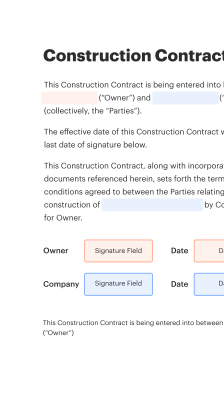
How a stamp signed request is applied in the flow

This sequence describes where stamping occurs relative to signature capture and finalization in typical eSignature systems.

  • Drafting: Prepare document and signature fields.
  • Signing: Signer completes required fields.
  • Stamping: System adds stamp upon completion.
  • Storage: Final PDF with stamp saved.
Collect signatures
24x
faster
Reduce costs by
$30
per document
Save up to
40h
per employee / month

Quick steps to configure a stamp signed request

Follow these core steps to enable stamping in your signing workflow and ensure consistent, auditable output.

  • 01
    Select template: Choose the document template to use.
  • 02
    Enable stamp: Turn on stamp at completion.
  • 03
    Customize fields: Add timestamp and signer metadata.
  • 04
    Test and deploy: Run sample signing and verify output.

Managing the audit trail for stamped transactions

Follow these steps to ensure stamped documents are accompanied by complete, tamper-evident audit trails.

01

Capture events:

Log every workflow action
02

Record identity:

Store signer details
03

Timestamp actions:

Record trusted times
04

Hash documents:

Preserve integrity
05

Archive artifacts:

Save logs with files
06

Review regularly:

Schedule audit checks
be ready to get more

Why choose airSlate SignNow

  • Free 7-day trial. Choose the plan you need and try it risk-free.
  • Honest pricing for full-featured plans. airSlate SignNow offers subscription plans with no overages or hidden fees at renewal.
  • Enterprise-grade security. airSlate SignNow helps you comply with global security standards.
illustrations signature

Typical workflow settings for stamp signed request automation

Recommended default settings that help ensure consistent stamping behavior across automated signing workflows.

Setting Name Configuration
Stamp Trigger Event On completion
Reminder Frequency 48 hours
Default Stamp Template Standard with metadata
Destination Folder Central archive
Retention Tagging Record type-based

Platform compatibility for stamp signed request

stamp signed request features are supported across modern desktop and mobile platforms; confirm specific client requirements before deploying at scale.

  • Desktop browsers: Chrome, Edge, Safari
  • Mobile apps: iOS and Android
  • PDF support: Standard PDFs

For enterprise rollouts verify browser versions, mobile OS compatibility, and PDF rendering behaviors; test stamping on representative documents to ensure consistent visual and metadata results across platforms.

Security controls relevant to stamp signed request

Audit trail: Immutable event log
Timestamping: Trusted server time
Signer authentication: Multi-factor options
Document hashing: Integrity verification
Access controls: Role-based permissions
Encryption: At-rest and in-transit

How different teams apply a stamp signed request

Two short case examples show how stamping supports common business processes while preserving compliance-ready records.

Case Study 1

A mid-sized leasing company automates stamping on lease agreements to show executed status and signature timestamp

  • Applies a standardized graphic and embedded metadata to each completed lease
  • Reduces manual file labeling and improves retrieval for audits

Leading to faster tenant onboarding and clearer audit trails for compliance reviews.

Case Study 2

A university uses stamped signed requests for student consent forms to combine visible confirmation with secure metadata

  • Integrates stamping into the signature completion event for each form
  • Ensures consistent proof of consent and simplifies record retention across departments

Resulting in streamlined FERPA-compliant document management and faster responses to records requests.

Best practices to ensure accurate stamp signed requests

Adopt consistent policies and technical controls to keep stamped documents reliable, compliant, and easy to audit.

Standardize stamp content and placement
Define a single stamp template that includes essential metadata fields such as timestamp, transaction ID, and signer name. Consistent placement reduces the chance of obscuring document text and makes automated processing or human review faster and more reliable across large document sets.
Link stamping to completion events
Ensure the stamp is applied only after the final signature event and any required identity verification are complete. This prevents premature stamping, maintains integrity of the audit trail, and ensures the stamp reflects the true final state of the document.
Retain both stamped and original files
Keep a copy of the pre-stamped source and the stamped final PDF in your archive. Preserving both versions supports investigations, satisfies legal requests, and allows reprocessing if metadata or retention rules change later.
Document stamping policies for audits
Publish internal procedures describing when stamps are used, what fields they include, and how retention is handled. Clear documentation helps compliance teams and external auditors understand your workflow and reduces risk during inspections.

FAQs About stamp signed request

Common questions and answers about stamping behavior, compliance, and troubleshooting in stamped signature workflows.

Feature availability comparison for stamp signed request

Availability and core technical differences for stamping and finalization features across leading eSignature providers in the U.S. market.

Capability signNow (Recommended) DocuSign Adobe Sign
Automated stamping
Custom metadata fields
API stamping control
Server-side timestamping Trusted server Trusted server Trusted server
be ready to get more

Get legally-binding signatures now!

Document retention and stamping deadlines

Retention schedules determine how long stamped documents and their associated audit logs must be preserved to meet legal and operational needs.

Short-term retention window:

30 to 90 days for transactional backups

Standard corporate retention:

7 years for most corporate records

Regulated records retention:

Varies by regulation, often 6 to 10 years

Student records (FERPA):

As required by institutional policy

Health records (HIPAA):

Follow HIPAA retention guidelines

Risks and penalties from improper stamping practices

Noncompliance: Regulatory fines possible
Evidence gaps: Disputed signatures risk
Data exposure: Improper sharing
Operational delay: Rework and audits
Contract disputes: Possible legal costs
Retention failures: Record loss risk

Representative monthly pricing and plan comparison

Typical starting monthly prices (per user) and plan characteristics for leading eSignature platforms; actual rates and tiers may vary by contract and promotions.

Pricing (monthly) signNow (Recommended) DocuSign Adobe Sign HelloSign PandaDoc
Entry tier price $8 per user $10 per user $14.99 per user $15 per user $19 per user
Business tier price $15 per user $25 per user $29.99 per user $25 per user $49 per user
Enterprise availability Yes Yes Yes Yes Yes
API access included Available Add-on or higher tier Included Included Included
Bulk sending capability Yes Yes Yes Yes Yes

Simplify complicated workflows

Create, perform, and manage workflows of any complexity, electronically from virtually anywhere. Scalable eSignature functionality allow you to share documents with the right users the right way and determine roles for every receiver. Perform document workflows faster and simpler than ever before.

Automate document management

Improve complicated signing tasks with airSlate SignNow�s highly effective capabilities to boost your company. Manage your automated signature workflows to make sure they're running at maximum performance with fast notices and reminders.

Enhance in team collaboration

Bring teammates together in a secure, shared environment. Manage documents, use form templates and notifications to create better cross-organization interaction. Relieve your staff from having to hang out on repeating actions to enable them to center on valuable, business-critical tasks.

Integrate into your current systems

Work your jobs with market-leading integration. Assemble Salesforce, Microsoft Teams, and SharePoint in one business stream. Link your applications to a single unit for countless opportunities and more productiveness.

Stay compliant with industry-leading data security

Feel safe understanding that your information remains secure by the most recent in encryption security. airSlate SignNow is GDPR and eIDAS compliant and offers you exposure into your eSigning experience with court-admissible audit trails. Configure user access permissions and roles to manage who has access to what.


walmart logo
exonMobil logo
apple logo
comcast logo
facebook logo
FedEx logo
be ready to get more

Get legally-binding signatures now!