Tax Invoice Format for Retail Trade

Effortlessly send and eSign your documents using our user-friendly solution. Experience cost-effective efficiency tailored for retail businesses.

Award-winning eSignature solution

What the tax invoice format for retail trade is and why it matters

A tax invoice format for retail trade is a standardized document used by retailers to record sales, itemize taxable goods or services, and provide required tax details to customers and tax authorities. It typically includes seller and buyer information, invoice number, date, item descriptions, quantities, unit prices, discounts, tax rates and totals, and payment terms. Using a consistent format supports accurate bookkeeping, simplifies sales tax reporting, and helps ensure invoices meet legal and audit requirements under U.S. state and federal regulations.

When a consistent invoice format becomes essential

Standardized tax invoice formats reduce errors, speed reconciliation, and support regulatory reporting across retail locations and online channels.

When a consistent invoice format becomes essential

Common challenges retailers face with invoice formatting

  • Inconsistent fields across POS systems cause misreported tax amounts and reconciliation delays.
  • Missing buyer or tax ID information can trigger audit questions and reporting gaps.
  • Multiple tax jurisdictions and varied rates increase complexity for automated invoice generation.
  • Manual invoice edits introduce transcription errors and slow down end-of-day closing processes.

Typical user roles and responsibilities

Store Manager

Store Managers need clear invoice formats to verify daily totals, apply correct discounts, and resolve customer queries quickly while ensuring receipts match POS records for deposit and reconciliation.

Accounting Lead

Accounting Leads require invoice consistency to map sales to the general ledger, prepare state sales tax returns, and supply auditors with complete transaction trails and supporting documentation.

Who relies on a correct tax invoice format in retail

Retail managers, accountants, and compliance teams use standardized invoice formats to ensure accurate sales tax treatment and consistent recordkeeping.

  • Retail store managers responsible for daily sales and cash reconciliation.
  • Accounting teams performing monthly sales tax filings and ledger reconciliation.
  • Compliance officers monitoring multi-state tax rules and audit readiness.

Consistent formats benefit finance teams and customers by reducing disputes and simplifying returns and audits.

Expanded capabilities for larger retail operations

Larger retailers benefit from advanced features that automate compliance, integrate with enterprise systems, and scale across locations.

Bulk Invoicing

Generate and distribute large batches of customer invoices for recurring orders, wholesale accounts, or end-of-day consolidated statements while maintaining unique invoice identifiers and tax calculations.


Role-Based Access

Control who can edit templates, approve invoices, and export records with fine-grained permissions aligned to accounting and store roles, reducing risk of unauthorized changes.

API Integration

APIs enable seamless exchange of invoice data with ERPs, tax engines, CRM systems, and fulfillment platforms to keep records synchronized and automate downstream processes.

Digital Signatures

Support for secure digital signatures ensures authenticity for invoices that require formal sign-off or when issuing supplier credit memos and vendor-facing documents.

Retention Automation

Policy-driven retention and disposal schedules keep invoice archives compliant with state and federal recordkeeping requirements while optimizing storage costs.

Localization

Localized templates adapt currency, date formats, language, and tax presentation for stores operating across states or serving international customers online.

be ready to get more

Choose a better solution

Core tools for effective retail tax invoice formatting

Key features support accurate invoicing across point-of-sale, ecommerce, and back-office systems while preserving auditability and security.

Custom Templates

Template customization lets retailers include required fields such as seller tax IDs, exemption codes, item tax classifications, and branded receipt elements while preserving consistent layout and validation rules for every sale.

Tax Calculation Engine

A built-in tax engine applies jurisdiction-specific rates and item-level taxability rules, supports compound taxes and exemption handling, and updates rates centrally to prevent manual errors.

POS & Ecommerce Sync

Real-time synchronization between POS terminals and online stores ensures invoices use the same format, pricing, and tax logic, preventing discrepancies and simplifying consolidated reporting.

Export & Audit Reports

Structured export formats and audit reports provide CSV or PDF summaries for accounting systems and auditors, including invoice metadata and change logs for each transaction.
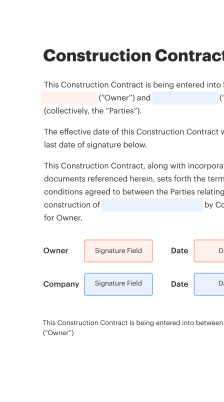
How digital tax invoice templates streamline retail operations

A template-driven process reduces manual entry and ensures consistent fields and calculations across channels.

  • Template Selection: Choose format per channel
  • Auto-population: Pull customer and product data
  • Validation: Check tax rules automatically
  • Delivery: Send digital receipt to buyer
Collect signatures
24x
faster
Reduce costs by
$30
per document
Save up to
40h
per employee / month

Quick step-by-step: preparing a tax invoice for retail trade

Follow these essential steps to create a compliant retail tax invoice that works for point-of-sale and online channels.

  • 01
    Identify Parties: Record seller and buyer details
  • 02
    Assign Invoice ID: Use sequential unique numbers
  • 03
    List Items: Include description, qty, price
  • 04
    Calculate Taxes: Apply correct jurisdiction rates
be ready to get more

Why choose airSlate SignNow

  • Free 7-day trial. Choose the plan you need and try it risk-free.
  • Honest pricing for full-featured plans. airSlate SignNow offers subscription plans with no overages or hidden fees at renewal.
  • Enterprise-grade security. airSlate SignNow helps you comply with global security standards.
illustrations signature

Suggested workflow settings for automated tax invoices

Configure workflow settings to automate invoice generation, notifications, and retention while aligning with retail processes.

Setting Name Configuration
Invoice Numbering Pattern Store-YYMM-Seq
Reminder Frequency 48 hours
Auto-Send Receipts On payment
Tax Rate Update Schedule Daily sync
Retention Period 7 years

Device and platform considerations for tax invoice formatting

  • Mobile: Responsive display
  • Desktop: Full-feature editor
  • POS Terminals: Offline support

Test invoice templates on representative devices used by your staff and customers, verify print and email outputs, and confirm offline synchronization to prevent data loss during network interruptions.

Security controls relevant to retail tax invoices

Access Controls: Role-based sign-on
Encryption: Data encrypted at rest
Transport Security: TLS for data in transit
Audit Logs: Immutable event trail
Document Watermarks: Tamper-evident marks
Retention Policies: Configurable retention

Retail scenarios showing invoice format value

Two brief case examples show how a standardized tax invoice format resolves common retail problems across physical and online sales.

Single-Store Retailer

A neighborhood apparel shop updated its receipt template to include itemized sales tax and vendor tax ID information.

  • This change simplified daily cash reconciliation.
  • Customers received clearer receipts reducing return disputes.

Resulting in faster month-end close and fewer customer inquiries.

Multistate Chain

A regional grocery chain adopted a centralized invoice format across 25 locations to capture taxable vs exempt items accurately.

  • Centralized templates ensured uniform tax treatment.
  • Corporate accounting reconciled state filings faster.

Leading to reduced audit risk and smoother multi-state sales tax reporting.

Best practices to ensure secure, accurate retail tax invoices

Adopt consistent processes and controls to reduce errors, speed reconciliation, and maintain compliance with tax authorities.

Maintain single source of truth for tax rates and product taxability
Centralize tax rates and product classifications in one authoritative service, update rates promptly when jurisdictions change, and ensure POS and ecommerce systems reference the same dataset to avoid mismatches during checkout and reporting.
Use sequential, non-duplicated invoice numbering
Establish automatic, sequential invoice numbering to prevent duplicates or gaps, which simplifies audit trails and ensures regulators can trace every transaction reliably.
Preserve immutable audit trails and document histories
Keep tamper-evident logs that record who created, viewed, edited, or exported each invoice, including timestamps and IP or device details for robust audit evidence.
Implement role-based approvals for invoice adjustments
Require managerial or accounting approval for refunds, credit memos, or manual tax overrides to maintain internal control and reduce risk of improper adjustments.

FAQs About tax invoice format for retail trade

Answers to common questions about formatting, legal requirements, and technical setup for retail tax invoices.

Feature availability comparison for retail invoicing

A concise feature matrix comparing capabilities relevant to tax invoice formatting and distribution across providers.

Criteria signNow (Recommended) DocuSign Adobe Sign
Mobile Signing
Bulk Send
API Access
HIPAA Support Optional Optional Optional
be ready to get more

Get legally-binding signatures now!

Record retention and reporting timelines for retail invoices

Key retention and reporting deadlines retailers should track to remain compliant and audit-ready.

Daily Sales Reconciliation:

Complete by next business day

Monthly Sales Tax Filing:

File by state deadline each month

Quarterly Reports:

Prepare within 30 days of quarter end

Audit Document Retention:

Retain for minimum 3-7 years

Invoice Archival:

Archive after processing, retain per policy

Risks and penalties from poor invoice practices

Underreported Tax: Fines
Missing Records: Audit exposure
Customer Disputes: Chargebacks
Compliance Failures: Penalties
Data Breaches: Legal risk
Operational Delays: Lost revenue

Pricing snapshot for eSignature solutions used with invoices

High-level pricing and plan features to consider when integrating eSignatures into retail invoice workflows.

Plan / Vendor signNow (Recommended) DocuSign Adobe Sign Dropbox Sign PandaDoc
Starting Price Free tier available; paid plans from $8/user/mo Plans from $10/user/mo Plans from $14.99/user/mo Free tier; paid from $12/user/mo Plans from $19/user/mo
Free Tier Availability Yes Limited trials Limited trials Yes Limited trials
Per-User Monthly $8/user/mo $10/user/mo $15/user/mo $12/user/mo $19/user/mo
API Included Yes Yes Yes Yes Yes
Enterprise Support Options Available Available Available Available Available
walmart logo
exonMobil logo
apple logo
comcast logo
facebook logo
FedEx logo
be ready to get more

Get legally-binding signatures now!