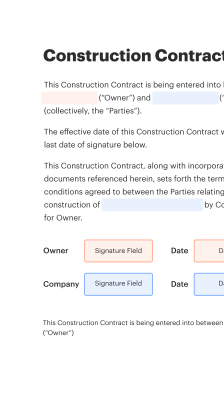
Test Signature Verification with SignNow

Eliminate paperwork and automate document management for increased efficiency and unlimited possibilities. eSign anything from your home, quick and accomplished. Discover a greater way of doing business with airSlate SignNow.

Award-winning eSignature solution

What test signature verification means in digital signing

test signature verification refers to the technical and procedural checks performed to confirm that a digital signature applied to a document is authentic, unaltered, and attributable to the claimed signer. In practice this includes validating cryptographic signatures or audit-log evidence, verifying signer identity via authentication methods, and ensuring document integrity since signing. Organizations use test signature verification during pilot deployments, integration testing, or compliance audits to confirm workflows behave as expected before production use. For U.S. contexts this process often aligns with ESIGN and UETA expectations for intent, consent, and reliable recordkeeping.

Why run test signature verification before full deployment

Testing signature verification reduces legal and operational risk by confirming identity checks, cryptographic validity, and audit-trail completeness. It helps detect configuration errors, ensures interoperability with third-party systems, and documents compliance steps required by ESIGN and UETA.

Why run test signature verification before full deployment

Common challenges when testing signature verification

  • Incomplete or inconsistent audit data makes verification inconclusive and delays sign-off.
  • Misconfigured authentication methods can cause false negatives for otherwise valid signatures.
  • File format changes after signing break cryptographic validation and appear as tampering.
  • Third-party integrations that alter metadata can invalidate signatures without clear error messages.

Typical team roles involved in verification testing

Compliance Lead

The Compliance Lead defines test acceptance criteria tied to ESIGN, UETA, HIPAA, or industry rules, documents test cases, reviews audit trails, and signs off on legal readiness for production deployment.

IT Administrator

The IT Administrator configures authentication methods, manages API keys and certificates, runs integration tests with CRMs and storage systems, and troubleshoots cryptographic validation errors during test cycles.

Who commonly performs test signature verification

Legal, compliance, IT, and application teams typically coordinate test signature verification activities before and during deployment.

  • Compliance teams verifying policy alignment and record retention requirements for signed documents.
  • IT and security teams confirming cryptographic and authentication configurations work across platforms.
  • Business owners validating signer workflows and user experience in pre-production environments.

Coordinated testing across those groups produces reliable, auditable outcomes and minimizes deployment disruption.

be ready to get more

Choose a better solution

Core features to evaluate during verification testing

When testing, focus on the features that affect signature validity, traceability, user authentication, and document integrity across systems.

Audit Trail

A complete, time-stamped log of signer actions and system events that supports legal review, shows chain of custody, and contains details needed to validate each signature.

Authentication Options

Multiple signer authentication methods including email, SMS, SAML/SSO, and multi-factor authentication, enabling configurable identity assurance levels for different document types.

Document Integrity

Cryptographic hashing and signature containers that detect post-signing changes, preserving original signed content and flagging any subsequent modification attempts.

API Reporting

Programmatic access to signature status, audit logs, and validation endpoints to automate test verification and integrate checks into continuous delivery pipelines.

How test signature verification usually operates

Verification testing runs through a small number of representative flows that mirror real-world use, capturing evidence and identifying failures early.

  • Initiate flow: Create the envelope or document.
  • Authenticate signer: Apply configured identity checks.
  • Apply signature: Complete signing actions in test mode.
  • Run verification: Check signature validity and records.
Collect signatures
24x
faster
Reduce costs by
$30
per document
Save up to
40h
per employee / month

Quick test signature verification checklist

Follow these steps to perform structured tests that confirm signatures are valid, auditable, and compliant before rollout.

  • 01
    Prepare documents: Use production-like PDFs and templates.
  • 02
    Configure auth: Set intended signer authentication methods.
  • 03
    Sign in test: Execute end-to-end signing flows.
  • 04
    Validate logs: Confirm audit trail and cryptographic hashes.

Steps to verify audit trail and signature evidence

Use the following step grid to confirm that audit entries and cryptographic evidence meet verification requirements.

01

Record timestamp:

Confirm UTC time stamps exist
02

Signer identity:

Validate auth method recorded
03

Hash check:

Match document hash values
04

Event sequence:

Confirm logical event order
05

Metadata capture:

Verify device and IP data
06

Export logs:

Produce immutable audit exports
be ready to get more

Why choose airSlate SignNow

  • Free 7-day trial. Choose the plan you need and try it risk-free.
  • Honest pricing for full-featured plans. airSlate SignNow offers subscription plans with no overages or hidden fees at renewal.
  • Enterprise-grade security. airSlate SignNow helps you comply with global security standards.
illustrations signature

Typical workflow settings to configure for verification tests

Set and document workflow configuration values that affect signing, authentication, and retention prior to running verification tests.

Setting Name Configuration
Reminder Frequency 48 hours
Signature Authentication SAML and SMS
Audit Logging Level Full
Document Retention 7 years
Encryption Mode AES-256

Supported platforms and test environment requirements

Ensure test environments mirror production platforms and device types to capture platform-specific signature behaviors and compatibility issues.

  • Desktop browsers: Chrome, Edge, Safari
  • Mobile OS: iOS and Android
  • APIs and SDKs: REST API, mobile SDKs

Maintain version parity between test and production, and include typical integrations like CRMs and cloud storage to validate end-to-end signature verification.

Security controls to check during test verification

Authentication Mode: Password, SAML, MFA
Certificate Validation: Chain and expiry checks
Data Integrity: Hash verification
Audit Trail: Time-stamped records
Access Controls: Role-based limits
Encryption: TLS and at-rest

Practical examples of test signature verification in use

Two concise case examples show how test signature verification supports compliance and operations across industries.

Healthcare consent testing

A hospital pilot validates that patient consent forms capture authenticated signatures and an immutable audit trail for each transaction.

  • Uses multi-factor authentication for patient identity confirmation.
  • Ensures HIPAA-aligned access controls and secure storage of signed records.

Resulting in documented evidence for audits and reduced risk during regulatory review.

Real estate contract validation

A brokerage runs pre-production tests to confirm purchase agreements remain cryptographically intact after routing.

  • Tests include embedded timestamps and signer email verification.
  • Provides clear chain-of-custody and rapid retrieval for closing teams.

Leading to fewer closing delays and stronger admissibility of signed documents.

Best practices for accurate test signature verification

Adopt structured procedures and documentation to make verification testing repeatable, auditable, and aligned with legal requirements.

Define acceptance criteria for verification outcomes
Specify pass/fail conditions including required audit fields, acceptable authentication methods, timestamp formats, and hash validation results so testers know when a test is conclusive.
Use production-like data and templates
Test with real document structures, field types, and metadata to surface formatting or parsing issues that could affect signature validity in production.
Log and archive test artifacts consistently
Store signed test documents, associated audit trails, and configuration snapshots in secure retention locations to support repeatability and future audits.
Coordinate cross-functional test runs
Bring compliance, legal, IT, and business stakeholders into test cycles to validate policy alignment, technical behavior, and user experience before launch.

Troubleshooting common verification issues

These troubleshooting entries address frequent problems encountered during test signature verification and offer practical remediation steps.

Feature comparison: signature verification capabilities

A concise comparison of verification-related capabilities across major eSignature platforms focused on status, authentication, and audit features.

Feature signNow (Recommended) DocuSign Adobe Sign
Audit Trail Availability
Multi-factor Authentication
API Validation Endpoints
Time-stamp Authority Support Enterprise option Enterprise option Enterprise option
be ready to get more

Get legally-binding signatures now!

Retention, backups, and retention timelines to verify

Define retention and backup checkpoints during testing to ensure signed records remain accessible and defensible over required legal timelines.

Short-term retention:

90 days backup checks

Standard retention:

7 years archival storage

Legal hold readiness:

Immediate preservation capability

Backup frequency:

Daily incremental backups

Disaster recovery:

90-day restoration SLA

Risks and penalties if verification fails

Contract disputes: Lost evidence
Regulatory fines: Compliance breaches
Data exposure: Unauthorized access
Operational delays: Process rework
Reputational harm: Client distrust
Financial loss: Remediation costs

Pricing snapshot for verification-capable plans

High-level pricing and plan distinctions that affect verification features, compliance support, and enterprise options across providers.

Plan / Vendor signNow (Recommended) DocuSign Adobe Sign HelloSign PandaDoc
Entry-level price Starts at $8/user/month billed annually Starts at $10/user/month billed annually Included with Acrobat Pro $14.99/month Starts at $15/user/month billed annually Starts at $19/user/month billed annually
Enterprise options Custom enterprise plans with BAA and SSO Enterprise with advanced compliance features Enterprise contracts and BAA options Business plans with SSO Enterprise with advanced workflows
Bulk send support Included on certain tiers Available on higher tiers Available with Acrobat/Sign integrations Available on business plans Available with paid plans
Payment processing Integrated payment add-ons Marketplace integrations Third-party connectors Native pay integration Native payment features
HIPAA/BAA support Available via BAA on qualifying plans Available via BAA on qualifying plans Available via BAA for enterprise Limited availability Limited availability

Simplify complex workflows

Create, execute, and manage workflows of any complexity, electronically from virtually anywhere. Scalable eSignature capabilities allow you to share documents with the right people in the correct order and define roles for each recipient. Execute document workflows faster and easier than ever before.

Automate document management

Optimize complex signing processes with airSlate SignNow’s powerful features to enhance your business. Control your automated eSignature workflows to ensure they're running at peak performance with instant notifications and reminders.

Optimize in team collaboration

Bring teams together in a secure, shared environment. Manage documents, use form templates and notifications to create more efficient cross-organization collaboration. Free your employees from having to spend time on repetitive activities so that they can focus on valuable, business-critical tasks.

Integrate into your existing systems

Run your projects with industry-leading integration. Collect Salesforce, Microsoft Teams, and SharePoint all in one business flow. Connect your software to a single system for endless possibilities and more efficiency.

Stay compliant with industry-leading data security

Feel confident with the knowledge that your data is protected by the most up-to-date in encryption security. airSlate SignNow is GDPR and eIDAS compliant and offers you awareness into your signing procedure with court-admissible audit trails. Configure user authorization and roles to control who has access to what.


walmart logo
exonMobil logo
apple logo
comcast logo
facebook logo
FedEx logo
be ready to get more

Get legally-binding signatures now!