Tuition Receipt Template for Higher Education

Watch your invoice workflow turn fast and effortless. With just a few clicks, you can execute all the necessary actions on your tuition receipt template for Higher Education and other important files from any device with web connection.

Award-winning eSignature solution

What a tuition receipt template for higher education is and why it matters

A tuition receipt template for higher education is a standardized digital or printable document that records student tuition payments, itemizes charges, and provides proof of payment for students, families, and institutional records. Templates ensure consistent data fields for student identification, term, program, payment method, amounts, and remaining balances. When used within an electronic document platform they support version control, repeatable issuance, and secure distribution. Proper templates reduce manual entry errors, speed reconciliation for bursar and financial aid offices, and provide clear documentation for audits, tax needs, and student inquiries.

Why consistent tuition receipts improve institutional operations

Standardized tuition receipt templates streamline recordkeeping, reduce disputes, and support compliance with student privacy and financial reporting requirements across departments.

Why consistent tuition receipts improve institutional operations

Common challenges that templates address

  • Inconsistent receipt formats across departments create reconciliation delays and reporting gaps that increase administrative workload.
  • Manual data entry causes transcription errors in student IDs, amounts, and term codes that complicate audits.
  • Distributing paper receipts or unsecured PDFs risks privacy breaches and makes retrieval slow for students and staff.
  • Lack of template version control leads to outdated fields and inconsistent legal language across issued receipts.

Typical users and their responsibilities

Bursar Manager

Manages billing and payment processing for the institution, maintains receipt templates for consistent issuance, reconciles daily transactions, and coordinates with accounting for ledger updates and audit responses.

Financial Aid Counselor

Prepares financial aid disbursement documentation, verifies tuition payments against awards, issues receipts to students and third-party funders, and ensures record retention for compliance and appeals.

Departments and roles that rely on tuition receipt templates

Bursar, financial aid, registrar, and accounting teams all use tuition receipt templates to standardize transactions and reporting.

  • Bursar offices issuing official proof of payment for tuition and fees.
  • Financial aid teams documenting disbursements and student contribution amounts.
  • Registrar and student services providing receipts for enrollment verification and third-party payers.

Templates also support external partners such as scholarship administrators and employers that need verifiable payment records.

Essential features for effective tuition receipt templates

Implementing these capabilities ensures templates meet administrative, security, and reporting needs while supporting student access and audit readiness.

Custom fields

Add institution-specific fields such as program codes, scholarship line items, and departmental chargebacks for precise accounting and reporting.


Conditional logic

Show or hide sections based on payment type, residency status, or scholarship awards to keep receipts accurate and relevant.

Prebuilt validation

Enforce numeric formats for amounts, required fields for student identifiers, and date constraints to prevent entry errors.

Bulk issuance

Generate and send receipts for many students at once while preserving individualized data and audit trails for each document.

Template versioning

Maintain version history so teams can track changes, revert to previous templates, and ensure legal text consistency.

Searchable archive

Index receipts by student ID, term, and transaction date to support rapid retrieval for audits and student requests.

be ready to get more

Choose a better solution

Integrations and template customization options

Integrations and template controls let institutions automate data flow, reduce duplicate entry, and tailor receipts for specific programs or third-party payers.

Google Docs

Use Google Docs for template drafting and collaborative editing, then export a finalized layout to the receipt system to preserve institutional language and formatting.

CRM integration

Connect with CRM and student information systems to auto-populate student and payer details, ensuring consistent billing records across teams and reducing manual reconciliation.

Cloud storage

Automatically archive issued receipts to cloud storage providers for long-term retention and disaster recovery while preserving access controls.

Template library

Maintain a catalog of templates for different payer types, scholarships, and billing cycles to ensure rapid deployment and consistent issuance across departments.
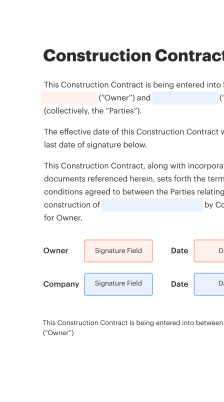
How the template works within an electronic workflow

Templates act as standardized document shells that populate data, guide signing, and trigger downstream actions when integrated into a digital workflow.

  • Populate data: Auto-fill student and billing fields.
  • Require sign: Designate approvals or acknowledgements.
  • Distribute: Email or portal delivery to recipients.
  • Archive: Securely store finalized receipts.
Collect signatures
24x
faster
Reduce costs by
$30
per document
Save up to
40h
per employee / month

Quick setup steps for a tuition receipt template

Follow these core steps to create and deploy a reusable tuition receipt template that meets institutional and regulatory needs.

  • 01
    Identify fields: List required data elements and legal language.
  • 02
    Design layout: Arrange fields for readability and scanning.
  • 03
    Add controls: Set required fields and validation rules.
  • 04
    Publish: Save template and assign distribution permissions.

Audit trail and transaction record steps

A clear sequence for capturing audit information helps ensure each receipt has verifiable metadata for compliance and dispute resolution.

01

Generate:

Create receipt with populated fields.
02

Record user:

Log who issued the receipt.
03

Timestamp:

Capture issuance date and time.
04

Hash:

Store cryptographic fingerprint of document.
05

Store:

Archive final PDF and metadata.
06

Retrieve:

Provide audited access logs on request.
be ready to get more

Why choose airSlate SignNow

  • Free 7-day trial. Choose the plan you need and try it risk-free.
  • Honest pricing for full-featured plans. airSlate SignNow offers subscription plans with no overages or hidden fees at renewal.
  • Enterprise-grade security. airSlate SignNow helps you comply with global security standards.
illustrations signature

Recommended workflow settings for automated receipt issuance

Configure these workflow settings to automate reminders, approvals, and archival of tuition receipts while retaining control over timing and access.

Setting Name Default Configuration
Reminder Frequency 48 hours
Approval Routing Bursar then Finance
Bulk Send Window End of day
Archive Retention Period 7 years
Access Expiration 365 days

Device and platform considerations for creating and issuing templates

Templates should be manageable on desktop for administrators and accessible on mobile for students and third parties.

  • Desktop: Full template editing
  • Mobile: Receipt viewing and signing
  • Tablet: Review and partial edits

Ensure the chosen platform supports responsive viewing, secure mobile delivery, and preserves layout integrity across devices so receipts remain legible and legally admissible regardless of how recipients access them.

Security and authentication features to include

Encryption: TLS and at-rest encryption
Access controls: Role-based permissions
Audit logs: Immutable activity records
Two-factor auth: MFA for users
Document locking: Prevent edits after issue
User verification: Identity checks

Real-world examples of template use

Two representative case summaries show how institutions implement templates for daily operations and exceptional workflows.

Public University

A large public university adopted a digital tuition receipt template to standardize payments across multiple campuses and auxiliary units.

  • Template fields included student ID, enrollment term, program code, itemized tuition and fees, and payment method to simplify reconciliation.
  • The format allowed automated import into the general ledger and reduced manual corrections by staff.

Resulting in faster month-end close and clearer student account statements.

Private College

A private college integrated a customizable receipt template with its student information system to issue receipts for scholarships and third-party sponsorships.

  • The template captured sponsor details, award breakdowns, and net student responsibility fields.
  • Automated distribution emailed receipts to students and sponsors and archived copies for compliance.

Leading to fewer billing disputes and more transparent reporting for donors and auditors.

Best practices for secure and accurate tuition receipts

Adopt these practices to reduce errors, protect student data, and maintain audit-ready receipt records across the institution.

Define standardized data fields and validation rules
Create a canonical list of required fields with validation patterns for student IDs, dates, and currency. Enforce required fields to avoid incomplete receipts and ensure consistent imports into accounting and reporting systems.
Implement role-based access and approval workflows
Limit template editing and issuance to authorized roles with an approval step for manual corrections. Role segregation reduces fraud risk and helps demonstrate administrative controls during reviews.
Archive receipts with searchable metadata and retention policies
Store finalized receipts alongside indexed metadata such as student ID, term, and transaction ID. Apply consistent retention schedules to meet legal and institutional requirements and support efficient retrieval.
Regularly review templates for regulatory and policy alignment
Schedule periodic audits of template language and fields to ensure compliance with FERPA, institutional policies, and any state-specific financial disclosure requirements, updating templates as needed.

FAQs and troubleshooting for tuition receipt templates

Common questions and answers address setup, distribution, security, and compliance considerations to help teams manage templates effectively.

Feature comparison: signNow versus major eSignature providers

This concise comparison highlights availability and technical details for key features relevant to tuition receipt templates and institutional workflows.

Criteria signNow (Recommended) DocuSign Adobe Sign
HIPAA Support
FERPA Compliance Tools Role controls Role controls Role controls
Bulk Send Capacity Up to 5,000 Up to 1,000 Up to 2,000
Audit Trail Detail Full metadata Full metadata Full metadata
be ready to get more

Get legally-binding signatures now!

Key retention and statutory deadlines to track

Track these common deadlines to align receipt retention and availability with auditing, tax, and student record obligations.

Year-end financial reconciliation:

Complete by fiscal year close for accurate ledgers.

Tax reporting window:

Retain documentation for annual tax filings.

Audit documentation period:

Keep receipts accessible during scheduled audits.

Student record retention:

Match retention to institutional student records policy.

Data subject request timeframe:

Respond to access requests within institutional timelines.

Regulatory and operational risks from poor receipt handling

Privacy breach: Student data exposure
Compliance gaps: FERPA violations
Audit failures: Missing documentation
Financial errors: Reconciliation discrepancies
Fraud risk: Unauthorized changes
Legal exposure: Dispute liabilities

Pricing and plan comparison across providers

Pricing details vary by contract and deployment; the table shows baseline plan characteristics for institutional purchasing comparisons.

Plan / Vendor signNow (Recommended) DocuSign Adobe Sign OneSpan Sign PandaDoc
Free Trial 14 days 30 days 14 days 30 days 14 days
Starting Price $8/user/month $10/user/month $9.99/user/month Contact sales $19/user/month
Enterprise Discounts Volume discounts available Volume discounts Volume-based pricing Contract pricing Volume discounts
Signature Limits Unlimited on plans Tiered limits Tiered limits Custom limits Tiered limits
Integration scope API + common CRMs Extensive APIs Adobe ecosystem Banking-grade APIs CRM and docs APIs
walmart logo
exonMobil logo
apple logo
comcast logo
facebook logo
FedEx logo
be ready to get more

Get legally-binding signatures now!