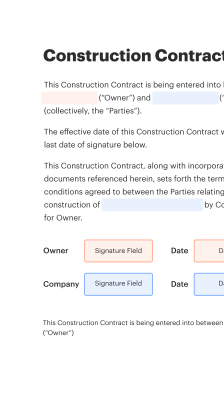
Wet Mark: Understanding Its Impact in Document Management

Eliminate paperwork and improve document management for higher efficiency and countless opportunities. Discover a better manner of doing business with airSlate SignNow.

Award-winning eSignature solution

What a wet mark is and why it matters

A wet mark refers to a physical ink impression or hand-applied signature on a paper document, typically created with pen, stamp, or embossing. Wet marks are the traditional evidence of consent on contracts, notarized forms, and many regulated records; they often carry chain-of-custody considerations, visible ink characteristics, and contextual metadata such as date and witness. In modern processes organizations scan or photograph wet marks to create digital records, combine them with electronic signatures, or retain originals for legal or regulatory reasons depending on jurisdiction and industry obligations.

Why understanding wet marks is useful

Recognizing the role of wet marks helps organizations decide when a physical signature is legally or operationally necessary and when scanned or electronic signatures meet requirements under ESIGN and UETA in the United States.

Why understanding wet marks is useful

Common challenges with wet marks

  • Risk of forgery or alteration when documents are transported or stored without controls.
  • Physical storage costs and space constraints for long-term retention of original documents.
  • Legibility problems from low-contrast ink, smudges, or poor scanning techniques.
  • Slower turnaround time for agreements requiring in-person signing and notarization.

Typical user roles handling wet marks

Contract Manager

Manages agreements lifecycle, coordinates signatories, and decides whether originals must be retained. Responsible for documenting chain of custody, scanning procedures, and ensuring scanned wet marks are associated with appropriate metadata for legal admissibility.

Field Agent

Collects wet signatures onsite, verifies identity visually, and uploads high-resolution scans. Ensures forms are complete and transmits originals to central records or arranges secure courier for retention when required.

Who commonly relies on wet marks

Wet marks remain common in workflows where original ink signatures, notarization, or witnessed signing provide evidentiary weight or regulatory compliance.

  • Real estate closings and mortgage documents that require original signatures for recordation.
  • Legal filings, court exhibits, and certain corporate minutes that prefer inked originals.
  • Healthcare and research consent forms when original patient signatures are archived.

Organizations often pair wet marks with digital processes to retain originals while speeding downstream approvals and record access.

Advanced capabilities for organizations managing wet marks

Larger organizations benefit from features that scale secure wet mark workflows and connect them to enterprise systems for governance and automation.

Batch scanning

Process many wet-signed documents quickly with consistent scanning settings and automatic indexing for large-volume intake.

Tamper-evidence tagging

Apply indicators to scanned files showing subsequent modifications or signs of digital tampering.

Role-based access

Control who can view, retrieve, or requisition original wet documents in archives.

Integration connectors

Link scanned wet marks to ERPs, CRMs, and contract repositories for end-to-end lifecycle management.

Audit reporting

Generate reports on custody, access, and scan actions for compliance reviews.

Notary workflow

Coordinate in-person notarization steps and track notarized originals alongside digital records.

be ready to get more

Choose a better solution

Features that support wet mark management

Tools should help capture, verify, and retain wet-marked documents while integrating with digital workflows for auditability and compliance.

High-resolution scanning

Scanning at 300+ DPI with color capture preserves ink detail, enabling forensic comparison and ensuring legibility when originals are archived or shared digitally.

Metadata annotation

Attach signer identity, timestamp, scan quality, and custody notes to each scanned wet mark to support chain-of-custody records and streamline audits.

Notarization support

Coordinate notarization steps and store notarized wet originals alongside digital copies to meet regulatory or lender requirements without breaking the digital workflow.

Hybrid signature handling

Allow scanned wet marks to coexist with electronic signatures, indicating which pages contain original ink and which pages are electronically executed.

How wet marks integrate into hybrid digital workflows

Hybrid workflows combine physical signatures with digital systems so documents remain legally defensible while benefiting from electronic processes for routing and storage.

  • Sign physically: Signer applies ink signature on a printed document.
  • Digitize quickly: Scan or photograph immediately after signing to preserve state.
  • Attach to record: Upload scan to document management with metadata.
  • Retain originals: Keep paper originals according to retention policy.
Collect signatures
24x
faster
Reduce costs by
$30
per document
Save up to
40h
per employee / month

Step-by-step: handling a wet mark from signing to storage

A concise workflow helps ensure integrity: prepare the form, capture a clear wet signature, document chain of custody, and store both digital and physical records appropriately.

  • 01
    Prepare document: Ensure form fields and witness requirements are complete before printing.
  • 02
    Capture signature: Use high-quality pen and unobstructed surface for legible ink impression.
  • 03
    Scan and tag: Scan at high resolution and attach metadata for traceability.
  • 04
    Store original: Place in secure, access-controlled physical storage with inventory tracking.

How to maintain an audit trail for wet mark transactions

An audit trail for wet-marked documents should capture identity, timestamps, custody actions, and any scans or reproductions linked to the original.

01

Record signer:

Capture signer name and ID used at signing.
02

Timestamp signing:

Note exact date and time of physical signing event.
03

Log scans:

Document who scanned and when the scan occurred.
04

Track transfers:

Log any movement of the original document.
05

Store metadata:

Attach contextual details to digital copies.
06

Retain audit logs:

Keep logs per retention policy for review.
be ready to get more

Why choose airSlate SignNow

  • Free 7-day trial. Choose the plan you need and try it risk-free.
  • Honest pricing for full-featured plans. airSlate SignNow offers subscription plans with no overages or hidden fees at renewal.
  • Enterprise-grade security. airSlate SignNow helps you comply with global security standards.
illustrations signature

Workflow settings to manage wet mark processes

Configure clear workflow settings that define scanning, custody, notifications, and retention so wet-marked documents are handled consistently and auditable.

Workflow Setting Name and Details Header Configured value or default setting applied
Reminder Frequency for returns Every 48 hours until the signed document is returned and scanned
Required notarization flag Set true when notarization is mandated by transaction rules
Scan quality enforcement Block uploads below minimum DPI or low contrast thresholds
Chain of custody logging Record handler, date, and action for every transfer
Retention period assignment Apply retention rule based on document type and jurisdiction

Platform and device requirements for capturing wet marks

Use devices and scanning apps that produce clear, high-resolution images and support metadata capture for later verification.

  • Mobile camera: 12 MP or higher recommended
  • Dedicated scanner: Flatbed or sheet-feed at 300+ DPI
  • Document app: Supports OCR and metadata tagging

Ensure mobile capture workflows validate image clarity before upload, require signer identification where necessary, and synchronize scans with the organization’s document repository for auditability and retention.

Security considerations for wet marks

Chain of custody: Records transfer history of original documents.
High-resolution imaging: Captures ink texture and detail for verification.
Secure storage: Protects physical files against loss.
Access controls: Limits who can view originals.
Tamper monitoring: Detects physical or digital alterations.
Metadata tagging: Associates scans with signer and date.

Industry examples showing wet mark use

Practical examples illustrate when wet marks matter and how organizations handle hybrid workflows that involve both physical and digital records.

Real Estate Closing

A title company requires original wet signatures on closing documents to satisfy county recording office rules and maintain lender compliance.

  • The company scans each signed page at high resolution and timestamps the scan for digital recordkeeping.
  • Digital copies are emailed to stakeholders while originals go to secure physical storage with a documented chain of custody.

Resulting in preserved legal evidence and faster distribution of transaction documents for downstream processing.

Clinical Consent Forms

A medical research site obtains wet-marked consent from participants before procedures where regulations mandate original signatures.

  • Staff notarize or witness the signature where protocol requires.
  • Scans are uploaded to the electronic research record with subject and visit metadata for audit readiness.

Leading to documented participant consent that satisfies both regulatory review and secure electronic archiving requirements.

Best practices for secure and accurate wet mark handling

Apply consistent procedures to reduce risk, maintain evidence, and ensure scanned wet marks are admissible and useful in business processes.

Establish a documented chain-of-custody process
Record every transfer of the original signed document, including who handled it, when it moved, where it was stored, and any scans produced. Consistent logging reduces disputes and supports evidentiary needs.
Use standardized scanning and file naming
Create scanning guidelines for resolution, color settings, and file formats, and apply consistent filenames and metadata to link scans to the correct case or contract for quick retrieval.
Limit access and monitor storage
Protect physical archives with controlled access, surveillance, and environmental protections. Periodically audit access logs and reconcile stored originals against digital indexes.
Combine wet marks with digital controls
When practical, supplement physical signatures with digital acknowledgments, timestamps, or audit logs so hybrid records provide both human and machine-readable proof of execution.

FAQs About wet mark

Common questions address admissibility, when originals are required, and how to integrate wet marks into digital systems while maintaining compliance and evidentiary value.

Quick capabilities comparison: wet mark and hybrid support

Compare vendor capabilities for handling scanned wet marks, audit trails, and regulatory support to inform integration and retention decisions.

Feature and Vendor Comparison Header signNow (Recommended) DocuSign
Legal recognition under US electronic signature laws ESIGN and UETA support ESIGN and UETA support
Audit trail and tamper-evidence capabilities Detailed, timestamped logs Detailed, timestamped logs
HIPAA support and PHI safeguards Available with compliance controls Available with controls
API and developer integration options Comprehensive REST API Comprehensive REST API
be ready to get more

Get legally-binding signatures now!

Retention and deadlines for wet mark records

Retention schedules vary by document type and regulation; organizations must set retention periods that satisfy legal, tax, and industry requirements.

Tax and accounting documents retention:

Keep originals seven years or according to IRS guidance, if applicable.

Employment and personnel records retention:

Follow federal and state rules, commonly three to seven years.

Healthcare records retention requirements:

HIPAA and state law often require longer retention, typically six years or more.

Real estate closing documents retention:

Retain originals for lender or title insurance requirements, often indefinitely.

Litigation hold procedures:

Suspend destruction and preserve originals when litigation or audits are anticipated.

Risks and penalties tied to mishandled wet marks

Contract disputes: Disallowed or questioned signatures.
Regulatory fines: Noncompliance with retention laws.
Evidence rejection: Court may reject tampered originals.
Data breaches: Unauthorized access to physical files.
Operational delays: Slower processing and approvals.
Increased costs: Storage, courier, and handling fees.

Subscription and plan comparison across signature vendors

Plan structures vary by vendor; compare entry-level availability, core features, API access, advanced compliance, and enterprise support when evaluating hybrid wet mark workflows.

Subscription Plans and Vendor Columns signNow (Recommended) DocuSign Adobe Sign Dropbox Sign PandaDoc
Entry-level plan and intended users Business plan for small teams and basic workflows Personal plan for individual users Individual plan for solo professionals Essentials plan for individuals and small teams Essentials plan with basic templates and e-sign
Core signing features included Unlimited document sending with team features and basic templates Basic sending with limited envelopes per month Core signing plus mobile apps and templates Simple signing and inbox integration Document creation and e-sign capabilities
API access availability and limits API access in Business or Enterprise tiers with developer support API in higher tiers with rate limits API access via business plans and enterprise options API available on business tiers API access on mid and upper tiers
Advanced compliance and security options HIPAA-ready controls, SOC reports, and enterprise encryption options Compliance add-ons and SOC reports available Enterprise compliance with Adobe PDF standards and controls Security certifications and enterprise controls available Security features and GDPR support in business plans
Enterprise support and onboarding services Dedicated onboarding, SSO, and account management for enterprise customers Enterprise success and support packages Enterprise-level onboarding and account teams Enterprise onboarding available in advanced plans Customer success and enterprise implementation options
Document retention and archival features Long-term archival options and export controls in advanced plans Archive exports and legal hold features available Document retention tools and e-discovery support Retention and retrieval features in paid tiers Archival and data export for compliance

Simplify complex workflows

Prepare, perform, and manage workflows of any complexity, electronically from virtually anywhere. Scalable eSignature capabilities allow you to share contracts with the right users the correct order and assign roles for every signee. Stream document workflows faster and simpler than ever before.

Automate document managing

Improve sophisticated signing processes with airSlate SignNow�s highly effective tools to improve your company. Control your automatic signature workflows to ensure they're running at maximum functionality with immediate notifications and reminders.

Enhance in team collaboration

Join teammates together in a secure, shared workspace. Manage documents, use form templates and notices to deliver more effective cross-company interaction. Relieve your employees from having to hang out on repeated routines so that they can give attention to valuable, business-vital duties.

Integrate into your current network

Work your tasks with best-in-class integration. Assemble Salesforce, Microsoft Teams, and SharePoint all in one business thread. Connect your applications to a single unit for countless opportunities and higher productivity.

Remain compliant with industry-leading data safety

Feel confident with the knowledge that your information remains secure by the most up-to-date in encryption security. airSlate SignNow is GDPR and eIDAS compliant and provides you exposure into your signing procedure with court-admissible audit trails. Set up user access permissions and roles to control who has access to what.


walmart logo
exonMobil logo
apple logo
comcast logo
facebook logo
FedEx logo
be ready to get more

Get legally-binding signatures now!