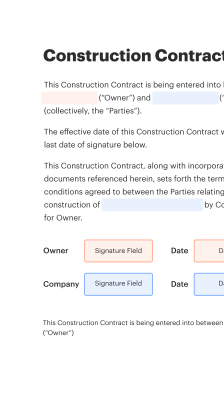
Wet Sign Solutions with SignNow
What a wet sign is and why it matters
Legal status and practical considerations for wet sign
Wet signatures continue to have evidentiary value in many legal and administrative contexts, but they carry practical limitations compared with digital alternatives for speed, tracking, and storage.
Common operational challenges with wet sign workflows
- Time delays from printing, in-person signing, and return shipping create slow approval cycles for routine agreements.
- Physical storage consumes space and increases risk of loss, damage, or misplacement over time.
- Verification is manual and can be inconclusive if handwriting is illegible or lacks corroborating ID checks.
- Reproducing or distributing originals requires scanning, which can introduce quality, indexing, and version control issues.
Typical roles handling wet sign documents
Contract Manager
A Contract Manager coordinates signature collection, maintains original paper files, and manages distribution of scanned copies. They ensure that executed originals meet internal retention policies and that counterparties receive certified copies for their records, often documenting chain-of-custody.
Clinic Administrator
A Clinic Administrator collects patient consent forms and maintains originals for compliance. They balance accessibility and confidentiality, coordinating secure storage, indexation of physical records, and conversion to electronic copies where permitted under HIPAA.
Organizations that still depend on wet sign
Public and private organizations that require original signatures for filings, legal records, or notary validation commonly rely on wet sign processes.
- Real estate closings and mortgage lenders for document originals and escrow records.
- Government agencies and courts for certified, notarized physical filings and records.
- Healthcare providers for certain paper consent forms and medical record originals.
Many organizations combine wet signing with digitization and policy controls to retain legal originals while gaining efficiencies through electronic workflows.
Choose a better solution
Core tools to manage wet sign processes alongside digital systems
Template Library
Predefined document templates reduce preparation errors by standardizing signature blocks, witness lines, and notary fields. Templates ensure consistent layout so originals meet filing and recording requirements when printed for wet signing.
Audit Trail
A detailed, timestamped log for scanned copies documents who captured the image, when it was uploaded, and any access or sharing events. This aids evidentiary support when originals are referenced later.
In-Person Signing
Support for capturing signatures at a physical event or office with an official witness or notary present, and immediate scanning to attach an electronic record to the workflow.
Access Controls
Role-based permissions limit who can view or download scanned originals, and encryption protects stored images to reduce unauthorized disclosure risks.
From paper to digital: the typical wet sign flow
-
In-person signing: Signers apply ink signatures on paper
-
Notarization: Notary validates identity and seal
-
Document capture: Scan or photograph a high-quality copy
-
Electronic storage: Store scanned copy with metadata and access controls
How to complete a wet sign transaction correctly
-
01Prepare document: Ensure clear signature blocks and required fields
-
02Verify identity: Check government ID before signing
-
03Sign and witness: Apply ink signature and obtain witnesses or notary
-
04Store original: Securely file original and scan a copy
Why choose airSlate SignNow
-
Free 7-day trial. Choose the plan you need and try it risk-free.
-
Honest pricing for full-featured plans. airSlate SignNow offers subscription plans with no overages or hidden fees at renewal.
-
Enterprise-grade security. airSlate SignNow helps you comply with global security standards.
Practical workflow settings to manage wet sign documents
| Setting Name | Configuration |
|---|---|
| Signature Routing | In-person then upload |
| Reminder Frequency | 48 hours |
| Authentication Level | ID check required |
| Retention Period | 7 years |
| Audit Trail Capture | Enabled always |
Equipment and system requirements for converting wet sign into digital records
Basic hardware and software requirements ensure high-quality capture and secure storage of wet-signed documents.
- Scanner or camera: High-resolution capture
- Secure storage: Encrypted cloud or on-site
- Document viewer: PDF reader with annotations
Ensure devices are configured for consistent resolution and retention workflows, and combine physical controls with electronic protections such as encryption, access restrictions, and documented retention policies.
Practical examples where wet sign remains relevant
Real Estate Closing
A buyer and seller execute title transfer documents in person at closing to produce original signed deeds and mortgage documents
- local county recording often requires original signatures
- title companies require notarized originals to validate transfers
Resulting in legally recordable documents and clear property title transfer for public records and lender requirements.
Healthcare Consent
A patient signs a paper consent form for a surgical procedure that must be retained in the medical chart
- clinician verifies patient identity in person
- the original is stored in the medical record while a scanned copy is used for care coordination
Ensures compliance with HIPAA recordkeeping while preserving the authoritative original for audits and legal review.
Best practices for secure and reliable wet sign handling
FAQs About wet sign
- Is a wet signature legally binding in the U.S.?
Yes. A handwritten wet signature is generally legally binding in the United States when it reflects the signer's intent. Electronic alternatives are also enforceable under ESIGN and UETA when requirements are satisfied, but certain filings and notarizations may still require an original wet signature under statute or regulation.
- When is a wet signature still required?
Wet signatures are often required for documents that must be recorded with government agencies, original deeds, certain court filings, or where statute or contractual language explicitly requires an original. Organizations should consult legal counsel to confirm whether an original is necessary for a specific transaction.
- How should I verify identity for a wet sign?
Verify identity by checking a government-issued photo ID and documenting the verifier's name. For higher-assurance needs, use notarization or an independent witness. Record verification details in the file metadata when scanning the original to maintain an evidentiary trail.
- What are best practices for scanning wet-signed documents?
Scan at consistent high resolution, save in PDF/A where possible, apply standardized file names and metadata, and store in encrypted, access-controlled repositories. Capture who scanned the document and when to maintain chain-of-custody for later review.
- Can scanned wet signatures be used in place of originals?
Scanned copies often suffice for day-to-day operations and review, but they may not replace originals for certain legal or regulatory processes. Maintain originals according to retention policies, and consult counsel before relying solely on scanned copies in disputes.
- How do compliance standards affect wet sign handling?
Regulations such as HIPAA or sector-specific rules may dictate confidentiality, retention, and access controls for signed records. Maintain physical security for originals, implement electronic protections for scanned copies, and ensure procedures align with applicable laws and institutional policies.
Feature availability: wet sign capture and digital controls
| Feature | signNow (Recommended) | DocuSign | Adobe Acrobat Sign |
|---|---|---|---|
| Capture Wet Signature | |||
| Audit Trail Included | |||
| HIPAA-ready Options | |||
| API Access |
Get legally-binding signatures now!
Operational risks and penalties tied to wet sign use
High-level pricing and plan characteristics
| Plan / Vendor | signNow (Recommended) | DocuSign | Adobe Acrobat Sign | HelloSign | PandaDoc |
|---|---|---|---|---|---|
| Entry-level plan name | Business | Personal | Individual | Essentials | Essentials |
| Free tier available | Limited free trial | Trial only | Trial only | Free tier | Free trial |
| API access availability | Included with Business plans | Developer plan available | Enterprise/API plans | Business plans add API | API on Business tier |
| Annual billing discount | Yes for annual | Yes for annual | Yes for annual | Yes for annual | Yes for annual |
| Enterprise support options | Dedicated support available | Enterprise support tiers | Enterprise SLAs | Business customer support | Enterprise plans available |
Make simpler challenging workflows
Prepare, perform, and maintain workflows of any complexity, electronically from virtually anywhere. Scalable eSignature functionality enable you to share papers with the right users the right sequence and assign roles for every signee. Stream document workflows faster and simpler than ever before.
Automate document flow
Improve complex signing procedures with airSlate SignNow�s powerful features to improve your business. Take control of your automatic eSignature workflows to guarantee they're running at maximum efficiency with quick notices and alerts.
Optimize in team collaboration
Join teammates together in a protected, shared workspace. Handle paperwork, use form templates and notices to deliver more efficient cross-company communication. Relieve your staff from having to hang out on repetitive actions to enable them to center on beneficial, business-essential activities.
Integrate into your existing systems
Manage your jobs with best-in-class integration. Assemble Salesforce, Microsoft Teams, and SharePoint in one business thread. Link up your software to a single system for endless opportunities and more productiveness.
Stay compliant with best-in-class data safety
Feel confident understanding that your information is protected by the latest in encryption security. airSlate SignNow is GDPR and eIDAS compliant and offers you visibility into your signing process with court-admissible audit trails. Configure user authorization and rights to control who has access to what.