



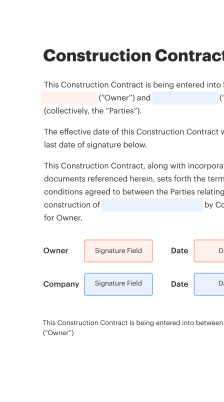
Work Bill Format for Efficient Documentation

Empower your business with airSlate SignNow to send and eSign documents effortlessly. Experience an easy-to-use, cost-effective solution that boosts productivity.

Award-winning eSignature solution

What a work bill format is and when to use it

A work bill format is a standardized document used to record labor, materials, rates, taxes, and payment terms for a specific job or service engagement. It combines line-item descriptions, quantities, unit prices, subtotals, tax calculations, and a final total in a consistent layout that simplifies review and payment. Organizations use a formal format to reduce disputes, speed approvals, and make bookkeeping straightforward. Digital variants can include fields for signatures, timestamps, and metadata to support audit trails and automate downstream accounting or invoicing processes.

Why a standard work bill format matters

Standardizing work bill format improves billing accuracy, reduces payment delays, and provides a clear record for audits and client communication while supporting automated processing and legal defensibility.

Why a standard work bill format matters

Common challenges when managing work bill formats

  • Inconsistent field labels and order cause reviewer confusion and frequent manual corrections during reconciliation and approvals.
  • Missing or incomplete line-item details create disputes over scope, quantities, and unit pricing between parties.
  • Manual calculations and nonstandard tax handling increase arithmetic errors and slow accounting close processes.
  • Paper-based signatures and physical delivery delay approvals and complicate retention, search, and auditability.

Typical users and roles interacting with work bill formats

Field Technician

A Field Technician completes work on site and fills line-item details, parts used, and time spent. They need an easy-to-use format for rapid data capture and a clear signature area for client approval at completion, with the option to attach photos or notes for verification.

Billing Manager

A Billing Manager validates entries, applies taxes and discounts, and sends final work bills for signature and payment. They require reliable templates, audit trails, and integration with accounting systems to ensure timely invoicing and accurate revenue recognition.

Who typically uses a work bill format

Professionals across small businesses and enterprises rely on standardized work bill formats to bill clients, record job details, and track payments efficiently.

  • Service providers such as contractors, technicians, and maintenance teams that bill by task or hour.
  • Accounting and finance teams that need consistent records for reconciliation and tax reporting.
  • Client-facing project managers who need clear, auditable proof of completed work and costs.

Clear formats reduce disputes and administrative overhead while improving traceability across billing and collections workflows.

be ready to get more

Choose a better solution

Core features to include in a modern work bill format

A robust work bill format includes template controls, conditional fields, authentication options, and integrations to support accurate billing and secure approvals.

Template Library

Reusable templates standardize layouts for different job types, include preconfigured fields for taxes and discounts, and allow version control so billing teams maintain a single authoritative format across projects and offices.

Conditional Fields

Field logic shows or hides items based on service type or value thresholds, reducing entry errors and ensuring only relevant billing lines appear to the client and accounting teams.

Authentication Options

Support for password, SMS, and multi-factor authentication ensures signer identity is verified, which strengthens enforceability and provides confidence in downstream auditing and compliance checks.

System Integrations

Connectors to accounting, CRM, and cloud storage automate posting, reconciliation, and archival, reducing manual data entry and improving record consistency across systems.

How a digital work bill format flows through a process

A streamlined digital flow moves the document from creation to signing and archival with visibility at each stage.

  • Create template: Define required fields and layout once.
  • Fill details: Complete job-specific entries or auto-fill.
  • Send for signature: Email or mobile request to signers.
  • Archive and integrate: Store final document and sync records.
Collect signatures
24x
faster
Reduce costs by
$30
per document
Save up to
40h
per employee / month

Step-by-step: complete a work bill format

Follow a concise sequence to ensure each work bill is complete, accurate, and ready for signature and processing.

  • 01
    Gather job data: Collect time, materials, and job notes.
  • 02
    Populate line items: Enter quantities, unit prices, and descriptions.
  • 03
    Apply taxes and discounts: Calculate applicable taxes and adjustments.
  • 04
    Obtain signature: Capture client approval and timestamp.
be ready to get more

Why choose airSlate SignNow

  • Free 7-day trial. Choose the plan you need and try it risk-free.
  • Honest pricing for full-featured plans. airSlate SignNow offers subscription plans with no overages or hidden fees at renewal.
  • Enterprise-grade security. airSlate SignNow helps you comply with global security standards.
illustrations signature

Typical workflow settings when automating work bill formats

Key workflow settings control reminders, signing order, expiration, and template behavior when automating distribution and approvals.

Setting Name Configuration
Reminder Frequency 48 hours
Signing Order Sequential
Auto-Expire After 30 days
Template Versioning Enabled
Approval Steps Two-level approval

Platform and device requirements for using a digital work bill format

Ensure the devices and browsers used to create, send, and sign work bills meet compatibility and security standards for reliable operation.

  • Desktop browsers: Chrome, Edge, Safari
  • Mobile platforms: iOS and Android supported
  • Connectivity needs: Internet required; offline signing limited

For enterprise deployments verify corporate firewall settings and SSO compatibility; ensure mobile app versions are updated for security patches and functionality, and confirm cloud storage providers meet organizational retention and backup policies.

Security controls for electronic work bill formats

Encryption at rest: AES-256 encryption
Encryption in transit: TLS 1.2+
Access controls: Role-based permissions
Authentication methods: Password and 2FA
Audit logging: Detailed event records
Document watermarking: Visible tamper indicators

Industry examples showing work bill format value

Two practical examples illustrate how standard work bill formats reduce disputes, speed payment, and integrate with operational systems.

Construction Project Billing

A general contractor issues line-item work bills for labor, materials, and subcontractor charges using a standardized template that captures change orders and retainage

  • Clear change-order fields
  • Faster approval cycles and fewer disputes

Leading to reduced invoice disputes and improved project cashflow through auditable records and faster client signoff.

Healthcare Home Services

A home health agency documents visits, billable procedures, and supplies in a consistent work bill format that includes payer codes and service durations

  • EHR-compatible fields
  • Improved claim accuracy and fewer rejected claims

Resulting in faster reimbursements and lower administrative costs due to fewer corrections and denials.

Best practices for secure and accurate work bill formats

Apply consistent controls and validation to minimize errors and protect data while keeping workflows efficient for staff and clients.

Standardize fields and labels across templates
Use a single agreed-upon template for each service type, standardize field names and units of measure, and enforce required fields. This reduces reviewer confusion, accelerates automated processing, and cuts reconciliation work during month-end close.
Validate numeric inputs and calculations
Apply automatic validation rules for quantities, rates, and totals and use calculated fields for subtotals and taxes to prevent manual arithmetic errors and avoid billing disputes.
Keep an immutable audit trail
Record every edit, signer action, and timestamp in a tamper-evident audit log to improve compliance, simplify audits, and support dispute resolution with verifiable evidence.
Retain signed records with retention policies
Define retention periods aligned with tax and regulatory requirements, store signed work bills in encrypted cloud storage, and plan secure deletion or archival to meet legal obligations and minimize risk.

FAQs About work bill format

Answers to common questions about preparing, signing, and troubleshooting work bill formats to ensure accuracy and legal compliance.

Quick capability comparison for common work bill format needs

Compare availability and technical support for core features that affect legal validity, bulk workflows, template management, mobile use, and auditability.

Feature and Compliance Comparison Criteria signNow (Recommended) DocuSign Adobe Sign
Legally binding in US under ESIGN/UETA
Bulk Send and mass distribution support
Template management and reuse limits Unlimited Limited by plan Unlimited
Native mobile app availability across platforms
be ready to get more

Get legally-binding signatures now!

Risks and penalties from poor work bill format practices

Late payments: Cashflow impact
Billing disputes: Revenue delays
Regulatory fines: Compliance exposure
Data breaches: Customer harm
Lost records: Audit failures
Invalid signatures: Enforceability risk

Pricing and plan comparison affecting work bill format workflows

High-level pricing and feature distinctions can affect total cost of ownership and which features are available for automating work bill formats.

Pricing and Feature Comparison signNow (Featured) DocuSign Adobe Sign PandaDoc Dropbox Sign
Starting monthly price $8 per user $10 per user $14 per user $19 per user $15 per user
Trial or free offering Free trial available Free trial available Free trial available Free plan available Free plan available
Advanced authentication options 2FA, SMS, ID verification 2FA, SMS, ID verification 2FA, knowledge-based 2FA, SMS 2FA, SMS
API access and developer support Available with API keys Available, enterprise tiers Available on paid plans Available on paid plans Available on paid plans
Template and bulk features included Templates and Bulk Send included Templates, Bulk Send available Templates included Templates and workflows Templates included
walmart logo
exonMobil logo
apple logo
comcast logo
facebook logo
FedEx logo
be ready to get more

Get legally-binding signatures now!