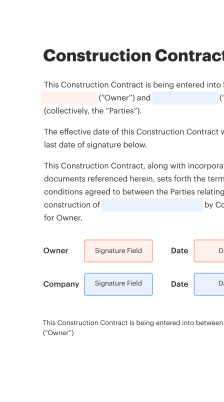
Configurer L'authentification à Deux Facteurs Et Signer

Essayez la méthode plus intelligente pour faire avancer votre organisation grâce à l'automatisation. Collaborez et dirigez des équipes, configurez l'authentification à deux facteurs et signez en ligne.

Solution eSignature primée

What setup dual factor authentication and sign means for document workflows

Setup dual factor authentication and sign refers to configuring an eSignature workflow so that signers must verify their identity with two separate authentication factors before applying a legally binding signature. This typically combines something the signer knows (password or access code) with something the signer has (SMS one-time code, authenticator app, or hardware token). For organizations using signNow, the process integrates authentication steps into sending and signing flows, preserves cryptographic signature data, and attaches an immutable audit trail to each document to support legal validity and compliance in the United States.

Why add dual factor authentication to signing

Dual factor authentication reduces the risk of unauthorized signatures and strengthens document admissibility by linking a second verification step to signer identity during the signing process.

Why add dual factor authentication to signing

Common challenges when you setup dual factor authentication and sign

  • User friction can increase if authentication steps are poorly explained, causing slower completion rates and more abandoned transactions.
  • Phone number or email changes create verification failures when delivery of one-time codes or links fails for the signer.
  • Integration complexity arises for legacy systems that require API updates or new configuration to support second-factor methods.
  • Regulatory mapping may be required for sector-specific rules, increasing administrative overhead to demonstrate compliant processes.

Typical user roles for setup dual factor authentication and sign

Compliance Officer

A compliance officer configures authentication policies, documents procedures, and verifies that dual factor methods meet internal controls and external regulatory requirements. They assess audit records, retention schedules, and enforcement across teams to maintain legal defensibility and reduce organizational risk.

IT Administrator

An IT administrator implements authentication settings, integrates identity providers or SMS gateways, and manages API keys and user provisioning for signNow. They support troubleshooting, maintain system logs, and ensure secure communication channels for second-factor delivery.

Which teams typically require dual factor authentication for signing

Financial, legal, HR, and healthcare teams often require enhanced signer verification when handling sensitive or regulated documents.

  • Legal departments that must ensure signer identity for contracts and litigation purposes.
  • Healthcare administrators sending PHI that must comply with HIPAA safeguards and access controls.
  • Finance teams approving high-value transactions or banking authorizations with strict audit expectations.

Organizations prioritize dual factor authentication where stronger identity proof, documented consent, and forensic audit trails reduce risk and support compliance.

Additional signNow capabilities supporting two-factor signing

Complementary features that help organizations administer, scale, and monitor two-factor authentication within signing workflows.

Template enforcement

Apply two-factor requirements to reusable templates so security settings are consistently applied across recurring form types and sender accounts for predictable compliance.

Team policies

Configure organization-wide policies that mandate authentication levels for user groups, enabling centralized control and streamlined onboarding for teams with regulatory obligations.

Reporting dashboard

Generate reports on authentication success rates, failed verifications, and signer completion times to monitor security posture and operational performance.

Integrations

Connect with identity providers, CRM systems, and storage platforms to synchronize user data and streamline verification steps within existing business processes.

Local retention controls

Set retention parameters and export options to meet internal records management and legal hold requirements for signed documents and logs.

Developer tools

Use SDKs and API documentation to embed two-factor signing into custom applications and automate enforcement across digital services.

soyez prêt à en obtenir plus

Choisissez une meilleure solution

Key signNow features relevant to setup dual factor authentication and sign

signNow provides a focused set of features to implement two-factor verification, integrate identity checks, and maintain detailed forensic logs for each signed document.

Authentication Options

Multiple verification choices include SMS one-time codes, email access codes, and integration with authenticator apps to meet different security and usability needs during signing.

Audit Trail

An immutable, time-stamped audit log captures authentication events, IP addresses, and signature actions to support audits and dispute resolution with clear event sequencing.

API Access

RESTful API endpoints enable programmatic enforcement of two-factor methods, allowing organizations to embed signNow authentication into custom applications and automations.

Role Permissions

Granular user roles let administrators control who can require two-factor authentication for senders, including team-level policy enforcement and delegation.

How the dual factor signing flow operates

This overview explains the sequence from sender configuration to signer's verification and final signature capture.

  • Sender config: Enable second-factor requirement per envelope
  • Delivery: Send link with verification prompt
  • Signer verify: Enter code or approve via app
  • Signature applied: System records sign and audit data
Collecter les signatures
24x
plus rapide
Réduire les coûts de
$30
par document
Économisez jusqu'à
40h
par employé / mois

Quick setup steps to enable dual factor authentication in your signing process

Follow these concise steps to configure two-factor verification and integrate it with your document sending and signing flow.

  • 01
    Select documents: Choose templates or uploads to send
  • 02
    Choose signer: Add recipient and contact details
  • 03
    Enable 2FA: Select SMS or authenticator app
  • 04
    Send and monitor: Track completion and audit trail

Audit trail steps for dual factor authenticated signatures

Key actions that ensure a complete, defensible audit trail for every two-factor authenticated signing event.

01

Capture event:

Record authentication timestamp
02

Log IP:

Store signer IP address
03

Store code delivery:

Record SMS or app delivery
04

Signature binding:

Link signature to authentication
05

Timestamping:

Apply secure time stamps
06

Export records:

Provide downloadable audit logs
soyez prêt à en obtenir plus

Pourquoi choisir airSlate SignNow

  • Essai gratuit de 7 jours. Choisissez le forfait dont vous avez besoin et essayez-le sans risque.
  • Tarification honnête pour des forfaits complets. airSlate SignNow propose des abonnements sans frais supplémentaires ni frais cachés lors du renouvellement.
  • Sécurité de niveau entreprise. airSlate SignNow vous aide à respecter les normes de sécurité mondiales.
illustrations signature

Typical configuration settings when enabling dual factor authentication and sign

Reference settings for common workflow configurations; adapt values to match organizational policies and regulatory needs.

Setting Name Configuration
Authentication Method SMS or App
Signature Routing Mode Sequential
Reminder Frequency 48 hours
Retention Policy 90 days
Audit Trail Enabled

Supported platforms for dual factor authentication and signing

signNow supports web browsers, iOS and Android apps, and API integrations that enable two-factor verification across desktop and mobile signing experiences.

  • Desktop browsers: Modern TLS-capable browsers
  • Mobile apps: iOS and Android native apps
  • APIs: REST API endpoints

Ensure recipients use up-to-date browsers or app versions and verify SMS delivery capabilities or authenticator app setup to avoid verification failures during the signing process.

Security controls involved in dual factor authentication and signing

Two-factor options: SMS codes or authenticator apps
Access controls: Role-based permissions
Transport security: TLS encryption
Data at rest: Encrypted storage
Audit logging: Tamper-evident records
Certificate support: Digital signing certificates

Industry examples for setting up dual factor authentication and sign

Two practical case examples show how dual factor authentication is applied across different workflows and compliance contexts.

Healthcare enrollment forms

A hospital sends enrollment forms containing protected health information to patients for signature using signNow integrated with SMS one-time codes

  • Patients receive a secure link and an SMS code to confirm identity before signing
  • This second factor limits unauthorized access and documents patient consent

Ensures HIPAA-compliant access control and a clear audit trail for regulatory review.

Loan closing authorization

A regional bank routes loan closing documents to borrowers and requires an authenticator app code plus a password before signature

  • Borrowers confirm identity with app-generated codes and review loan terms before applying signatures
  • The dual factor reduces fraud risk on high-value disbursements and records the authentication steps

Leading to stronger evidentiary support for the bank during audits or disputes.

Best practices when you setup dual factor authentication and sign

These practical recommendations balance security, usability, and compliance for consistent deployment of dual factor signing workflows.

Choose appropriate second-factor methods based on risk
Assess the sensitivity and legal implications of documents to decide between SMS, authenticator apps, or certificate-based authentication, ensuring methods align with organizational risk tolerances and accessibility needs.
Document authentication policy and user guidance
Create clear instructions for recipients describing why verification is required, how to complete second-factor steps, and where to get support to reduce completion friction and abandoned transactions.
Log and preserve audit records securely
Ensure that all authentication events, codes, timestamps, and IP details are captured in an immutable audit trail and retained according to internal retention policies and regulatory requirements.
Test and monitor authentication flows regularly
Perform periodic end-to-end testing, monitor failure rates and support tickets, and adjust delivery methods or configuration to address real-world signer issues promptly.

FAQs About setup dual factor authentication and sign

Common questions and answers to resolve issues and clarify configurations when implementing two-factor verification for signing.

Feature comparison for dual factor authentication across eSignature platforms

A concise comparison of key authentication and integration capabilities to help technical teams evaluate options for two-factor signing.

Feature / Criteria signNow DocuSign Adobe Acrobat Sign
Multi-factor Authentication
Bulk Send support
API Access REST API REST API REST API
HIPAA Attestation Available Available Available
soyez prêt à en obtenir plus

Obtenez des signatures juridiquement contraignantes dès maintenant !

Risks and penalties if authentication is not configured correctly

Unauthorized signatures: Fraud exposure
Regulatory fines: Monetary penalties
Contract disputes: Legal challenges
Data breaches: Privacy violations
Loss of trust: Reputational harm
Operational delays: Workflow disruption

Pricing and plan comparison for implementing dual factor authentication

High-level plan differences across common eSignature vendors, including availability of authentication features and API access at different pricing tiers.

Plan / Vendor signNow (Recommended) DocuSign Adobe Acrobat Sign HelloSign PandaDoc
Starting Price (monthly) $8 $10 $14 $15 $19
Free Tier No Limited No Yes No
API Included Yes Paid Add-on Yes Paid Add-on Yes
Document Limits Unlimited Unlimited Unlimited Limited Unlimited
Advanced Authentication Options SMS, App, Certificates SMS, App Certificates SMS, App SMS, App

Comment configurer l'authentification à deux facteurs et Signer ?

Configurez l'authentification à deux facteurs et Signer avec airSlate SignNow et améliorez votre compétitivité sur le marché.

De nos jours, les organisations sur le marché sont familières avec des menaces de concurrence accrues. Même si elles disposent de services et de produits exclusifs, cela ne garantit pas un succès impressionnant. L'argent ne peut être réalisé que si vos procédures internes sont parfaitement organisées et que le flux de travail est efficace. Par conséquent, les entreprises optent souvent pour des logiciels qui cherchent à automatiser les activités routinières, donnant ainsi du temps au personnel pour se concentrer sur des changements innovants.

Si votre entreprise implique de signer des contrats avec des clients, vous commencerez sûrement à rechercher la meilleure solution de signature électronique innovante. L'une d'elles est airSlate SignNow - un programme exclusif avec de nombreuses fonctionnalités, facilement adaptable à vos besoins. Vos entreprises et clients pourront signer des accords, des documents et autres papiers en ligne en beaucoup moins de temps, d'argent et d'efforts investis. En utilisant SigNow, vous pouvez montrer à quel point vous valorisez vos clients, car cela permet de rendre plusieurs processus plus rapides et plus pratiques.


walmart logo
exonMobil logo
apple logo
comcast logo
facebook logo
FedEx logo
être prêt à en obtenir plus

Obtenez dès maintenant des signatures juridiquement contraignantes !