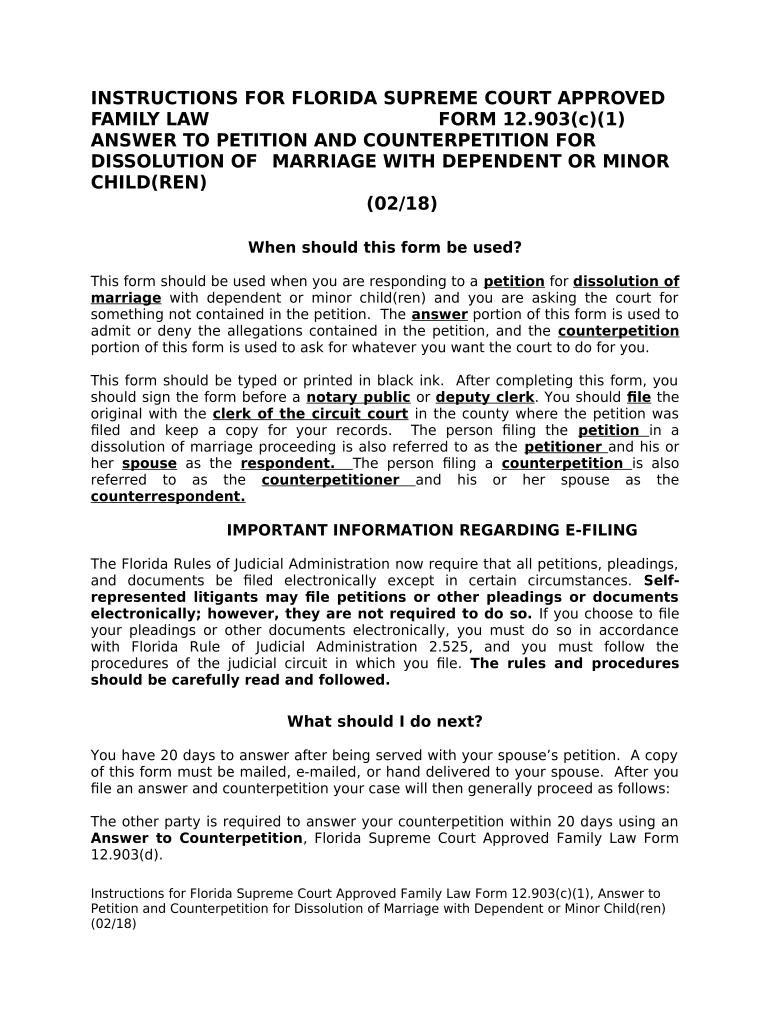
Florida Answer to Petition and Counterpetition for Dissolution of Marriage with Dependent or Minor Child(ren)
What this Florida Answer to Petition and Counterpetition document is
Why completing a proper Answer matters
A correctly prepared answer preserves your legal rights, prevents default judgments, and lets the court consider your positions on custody, support, and property division. It also creates a procedural record for discovery, hearings, and settlement negotiations.
Who typically completes this Answer
The Answer is used by parties, attorneys, and court-appointed representatives to record and respond to allegations in child-involved divorce cases.
- Self-represented respondent who needs to preserve parental and financial positions and avoid default judgments.
- Family law attorney preparing a legally framed response, defenses, and proposed parenting arrangements for a client.
- Guardian ad litem or attorney for the child providing formal positions or objections in contentious custody matters.
Choice of preparer affects whether additional pleadings, discovery, or supporting affidavits accompany the Answer before hearings or mediation.
Key signer and preparer roles
Respondent Parent
A respondent parent prepares or signs the Answer to assert denials, counterclaims, and proposed timesharing arrangements. Accurate personal, child, and financial information is required because courts rely on the Answer to set temporary orders and frame custody disputes.
Family Law Attorney
An attorney drafts precise pleadings, advises on affirmative defenses, prepares supporting affidavits, and manages service and filing. Legal counsel also coordinates temporary relief motions, discovery requests, and compliance with local family court procedures.
Consequences of errors or omission
Common pitfalls to avoid
- Missing filing or service deadlines because respondents assume an informal response will suffice; official filing preserves defenses and prevents default.
- Incomplete financial disclosures or missing affidavits, which can delay temporary support orders and negatively affect credibility with the court.
- Vague parenting proposals that lack specific schedules or decision-making language, making enforcement and mediation more difficult.
- Not checking local court rules for required formats, signature or verification language, and required attachments leading to clerk rejections or objections.
Step-by-step: preparing and filing the Answer
-
01Review Petition: Read each allegation and note language for admissions or denials
-
02Draft Responses: Respond paragraph-by-paragraph; state affirmative defenses if any
-
03Attach Exhibits: Include financial affidavits and proposed parenting plans
-
04File and Serve: File with clerk and serve opposing counsel per rules
How filing and service generally proceed
-
Prepare Document: Finalize Answer, exhibits, and signature blocks
-
File with Clerk: Submit to county family court clerk for docketing
-
Serve Parties: Provide copies to petitioner and counsel following service rules
-
Proceed to Case Events: Case management, temporary orders, or mediation scheduled
Digital workflow configuration for online completion
| Field | Configuration |
|---|---|
| Document Name | Answer and Counterpetition |
| Signature Method | Wet signature or ESIGN-compliant eSignature |
| Authentication | Email link, SMS code, or platform MFA |
| Retention | Store signed PDF with audit trail |
File formats and integration considerations
Choose formats and integrations that meet court filing requirements and preserve the signed record.
- Formats: PDF and DOCX accepted for preparation
- Integrations: Google Workspace, NetSuite, Box supported
- Authentication: Use email or SMS signer verification
Maintain the final signed PDF and audit trail in secure storage and export in court-acceptable formats when required.
Timing and deadlines to watch for
Answer Deadline:
Refer to the summons; failure to answer risks default
Temporary Relief Motions:
File promptly if emergency custody or support is needed
Discovery Deadlines:
Respond within court-ordered or agreed timeframes
Case Management Dates:
Attend required scheduling conferences and mediation
Final Hearing Window:
Depends on local docket and case complexity
Key milestones in a child-involved dissolution
Filing and Service
Petition filed and respondent formally served
Answer Filed
Respondent files Answer to preserve rights
Temporary Orders
Court may enter temporary custody or support
Final Resolution
Settlement, trial, or final decree entered
How this Answer compares with a general civil Answer
| Criteria | Florida Family Law Answer | General Civil Answer |
|---|---|---|
| Child-related provisions | included | not applicable |
| Financial disclosures | required | varies by case |
| Parenting plan | expected | rarely required |
| Service specifics | family rules apply | civil procedure applies |
eSignature vendor pricing comparison for completing and signing the Answer
| signNow | DocuSign | Adobe Sign | PandaDoc | HelloSign | |
|---|---|---|---|---|---|
| Starting Price | $8/user/mo | $15/user/mo | $14/user/mo | $19/user/mo | $15/user/mo |
| Free Trial | 7-day free trial | Varies by vendor | Varies by vendor | Yes, limited | Yes, limited |
| Bulk Send | Yes | Yes | Yes | Yes | No |
| Audit Trail | Yes | Yes | Yes | Yes | Yes |
| HIPAA Compliant | Yes | Yes | Yes | No | No |
| Envelope Cap | No envelope cap | 100 envelopes/user/year | Varies | Varies | Varies |
Real-world scenarios where the Answer matters
Contested Custody
A respondent files a detailed Answer and proposed parenting plan to oppose the petitioner’s custody request
- The Answer lists denials and requests temporary shared parenting
- The court uses the Answer and attached affidavits to set emergency temporary custody and schedule evaluations before mediation or trial.
Support Dispute
A respondent answers to contest income calculations and requests discovery of financial records
- The Answer includes affirmative defenses and a request for accounting
- The court orders production, considers temporary child support based on verified figures, and uses the Answer as the baseline for negotiations.
Practical tips for accurate and efficient completion
Frequently asked questions about filing the Answer
-
When must I file the Answer?
Check the summons or local clerk instructions for the precise deadline. Missing a court-ordered deadline can lead to a default judgment against you or loss of the right to contest claims.
-
What if I miss the deadline?
You may request relief from the court, but relief is discretionary and often requires demonstrating excusable neglect. Timely action and legal counsel improve chances to avoid default consequences.
-
Can I sign the Answer electronically?
Electronic signatures are generally recognized under ESIGN and UETA, but some courts or filings may require wet signatures or notarization; verify local family court rules before relying solely on eSignatures.
-
Do I need to attach a parenting plan?
Many Florida courts expect a proposed parenting plan when minor children are involved. Even if not required, a specific plan helps courts assess timesharing and decision-making proposals.
-
How should I serve the Answer?
Serve the petitioner and counsel according to Florida service rules—typically by eService if allowed, mail, or personal service—and file proof of service with the clerk.
-
Is notarization required for the Answer?
Not all Answers require notarization, but some attachments (financial affidavits) often require verification or notarized signatures. Check local rules and the document checklist before filing.