Establishing secure connection…Loading editor…Preparing document…

Act of Donation

This template is fully customizable. Edit the text, fill out the fields, and send it for signature. Give it a try!
Act of Donation

What an Act of Donation Is and when it applies

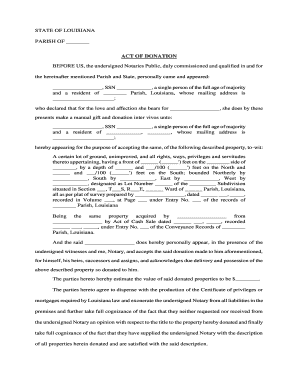
An Act of Donation is a written legal instrument used to transfer ownership of property or other assets from a donor to a donee without monetary consideration. It documents the donor’s intent, identifies parties, describes the donated items, and sets any conditions or reserved rights. For real property transfers the instrument may require notarization and county recording; for personal or intellectual property it clarifies title and usage rights. Draft precisely to avoid ambiguity about description, effective date, signatures, and supporting proof of title or authority.

Why a clear Act of Donation matters

A properly drafted Act of Donation creates a clear, signed record of a gratuitous transfer, reducing later disputes and helping donees prove ownership. It aligns parties on conditions, supports any required registration or recording, and documents facts relevant to tax and regulatory review.

Why a clear Act of Donation matters

Who commonly prepares and signs an Act of Donation

Typical users include private donors, nonprofit organizations, estate administrators, and public entities arranging charitable or gratuitous transfers.

  • Private individuals donating personal property or collectibles to charities or family members for stewardship or sentimental reasons.
  • Nonprofit organizations receiving gifts of equipment, software, or real property to support operations or community programs.
  • Estate executors, trustees, or administrators documenting transfers under a decedent’s plan or as part of settlement distributions.

Typical signers and their roles

Individual Donor

An individual donor executes the act to transfer specific items or assets without payment. Provide full legal name, government ID when requested, and a detailed description of donated property to avoid identity or title disputes during later verification.

Organization Representative

An authorized corporate or nonprofit representative signs on the entity’s behalf and should attach proof of authority such as a board resolution. Confirm signatory authority to prevent challenges to the donation’s validity or later title claims.

Core elements to include in a professional Act of Donation

Including these elements reduces ambiguity, supports recording where required, and helps third parties (tax authorities, registrars, courts) verify the transfer and the donor’s intent.

Description of Gift

Provide a precise, itemized description of the donated property or asset, including serial numbers, parcel legal description, or IP identifiers. Ambiguous descriptions create title and enforcement problems.
Parties Identified

List full legal names and legal status (individual, corporation, nonprofit) for donor and donee. Include addresses and contact details to support notices and future title verification.

Consideration Statement

State explicitly that the transfer is gratuitous and that no monetary consideration is exchanged, or state any nominal consideration. Avoid vague terms such as 'for good cause' without clarification.

Effective Date

Record the date the donation takes effect. For real property, the effective date can affect priority against third-party claims and determine when obligations or occupancy rights begin.

Signatures & Dates

All required signatories must sign and date. Identify signatory titles and add sign blocks for witnesses when state law requires them to validate the transfer.

Notarization & Witnesses

Include a notary acknowledgement and witness blocks where state law or the type of asset requires them. For deeds, many states mandate notarization and some require one or two witnesses.

Step-by-step: preparing and executing an Act of Donation

Follow these sequential steps to prepare, sign, and finalize an Act of Donation with minimal risk and clear proof of transfer.

  • 01
    Draft: Prepare a precise description and include parties, effective date, and conditions.
  • 02
    Verify Authority: Confirm donor or representative has authority to transfer the asset.
  • 03
    Sign and Notarize: Execute signatures and obtain notarization and witness attestations when required.
  • 04
    Record or Deliver: Record with the county recorder if real property or deliver certified copy to the donee.

Where to file, send, and preserve the executed Act

After signing, route the executed Act of Donation to recipients and public offices as appropriate and retain certified copies for all parties and advisors.

  • County Recorder: Record original when donation transfers real property to perfect title publicly.
  • Donee Records: Deliver a certified copy to the donee for custody and proof of ownership.
  • Donor Files: Retain an executed copy with supporting title evidence and proof of authority.
  • Tax Advisor: Send documentation to the donor’s tax advisor if gift reporting may be required.

Recommended online workflow settings for eCompletion

Configure fields, signer authentication, and storage before sending to ensure signatures are attributable and records are preserved according to legal requirements.

Field Configuration
Document format Use PDF/A or PDF to preserve formatting and support long-term retention.
Signer authentication Choose email link plus SMS code or stronger KBA for high-value transfers.
Audit trail Enable timestamping, IP logging, and certificate of completion for provenance.
Integrations Connect to cloud storage and ERPs for centralized retention and recordkeeping.

Technical requirements for digital signing and recordkeeping

Typical technical considerations include supported file formats, signer authentication levels, and integrations to store or record the executed Act of Donation.

  • File formats: PDF, DOCX, PDF/A supported
  • Integrations: Salesforce, NetSuite, Google Workspace, Box
  • Authentication: Email link, SMS code, KBA, SSO

Typical timelines and deadlines to track

Be mindful of recording windows, tax reporting deadlines for substantial gifts, and retention requirements that affect how long you must preserve executed copies and related evidence.

Effective date:

Document states when rights and obligations begin.

Recording window:

Record real property promptly to protect priority against third parties.

Gift tax filing:

If required, Form 709 is due by the federal income tax deadline.

Original retention:

Keep original executed copies with title or transfer evidence.

Notary record keeping:

Notaries may retain journals or audio‑video for RON sessions per state rules.

Key milestones from draft to recorded transfer

Track these numbered milestones to confirm the Act is prepared, signed, authenticated, and recorded when necessary.

01

Draft final text

Complete precise descriptions and identify parties before signature routing.

02

Confirm authority

Obtain proof of signatory authority, corporate resolutions, or trustee powers.

03

Execute and authenticate

All signatures obtained, notarization and witnesses completed where required.

04

Record and distribute

File with recorder if required and share certified copies with stakeholders.

Common preparation errors to avoid

  • Vague property descriptions that omit serial numbers, parcel legal descriptions, or other identifying data and therefore create uncertainty about what was transferred.
  • Failing to confirm the donor’s authority or failing to attach corporate or trustee authorization, which can render the transfer susceptible to challenge.
  • Skipping required notarization or witness attestations for deeds and other instruments, causing recording offices or courts to suspend recognition of the transfer.
  • Not maintaining executed originals and supporting title evidence, which complicates defense against creditor claims or later title disputes.

Potential legal and practical consequences of a defective Act

Invalid Transfer: Transfer may be voided
Title Disputes: Third-party claims may arise
Tax Reporting: Gift tax or reporting obligations
Probate Delay: Estate settlement complications
Notary Defects: May require re‑execution
Privacy Exposure: Personal data could be exposed

Security and compliance considerations for managing the Act

Encryption: TLS 1.2/1.3 in transit
At‑rest encryption: AES-256 encryption at rest
Certifications: ISO 27001 and SOC 2 Type II
HIPAA support: BAA available for PHI handling
Audit trail: Detailed timestamps and logs
Access controls: SSO, role-based permissions

How an Act of Donation compares with related document types

These short comparisons highlight when to use an Act of Donation instead of alternatives such as deeds, bills of sale, or wills.

Document Type Primary use Typical formalities
Act of Donation gratuitous transfer written, signature, often notarize
Deed real property transfer notary and recording required
Bill of Sale sale of personal property receipt, signatures
Gift Agreement donor conditions attached detailed terms, possible trustee

Representative eSignature vendor comparison for completing the Act of Donation

Compare starting price, trial options, bulk send, audit trail, HIPAA compliance, and envelope caps across vendors. signNow is listed first per vendor ordering rules.

signNow DocuSign Adobe Sign PandaDoc HelloSign
Starting Price $8/user/mo $15/user/mo $14/user/mo $19/user/mo $15/user/mo
Free Trial 7-day free trial Varies Varies Varies Varies
Bulk Send Yes Yes Yes Yes No
Audit Trail Yes Yes Yes Yes Yes
HIPAA Compliant Yes Yes Yes No No
Envelope Cap No cap 100 envelopes/user/year Varies by plan Varies by plan Varies by plan

Example scenarios showing how Acts of Donation are used

Two practical examples demonstrate common donation transactions and the documentation needed to finalize transfers.

Nonprofit Equipment Gift

A hospital receives donated imaging equipment described by make, model, and serial numbers

  • Donor signs an Act naming the hospital as donee
  • The agreement includes a delivery date, a transfer of title clause, and donor contact information so the nonprofit can register assets and meet maintenance or certification requirements.

Real Property Donation

A homeowner donates a small parcel to the municipality with a full legal description

  • Parties execute a notarized Act of Donation
  • The document is recorded at the county recorder, includes a municipal acceptance clause, and the donee obtains title for public use while the donor retains no future claims.

Frequently asked questions about Acts of Donation

Answers to common questions about validity, e-signatures, notarization, tax reporting, corrections, revocation, and who should sign.


Need help? Contact support

be ready to get more
Join over 28 million airSlate SignNow users