Claimant Identity
Full legal name and contact details of the claimant or filing agent, including mailing address and email for service and follow-up by title examiners or opposing parties.
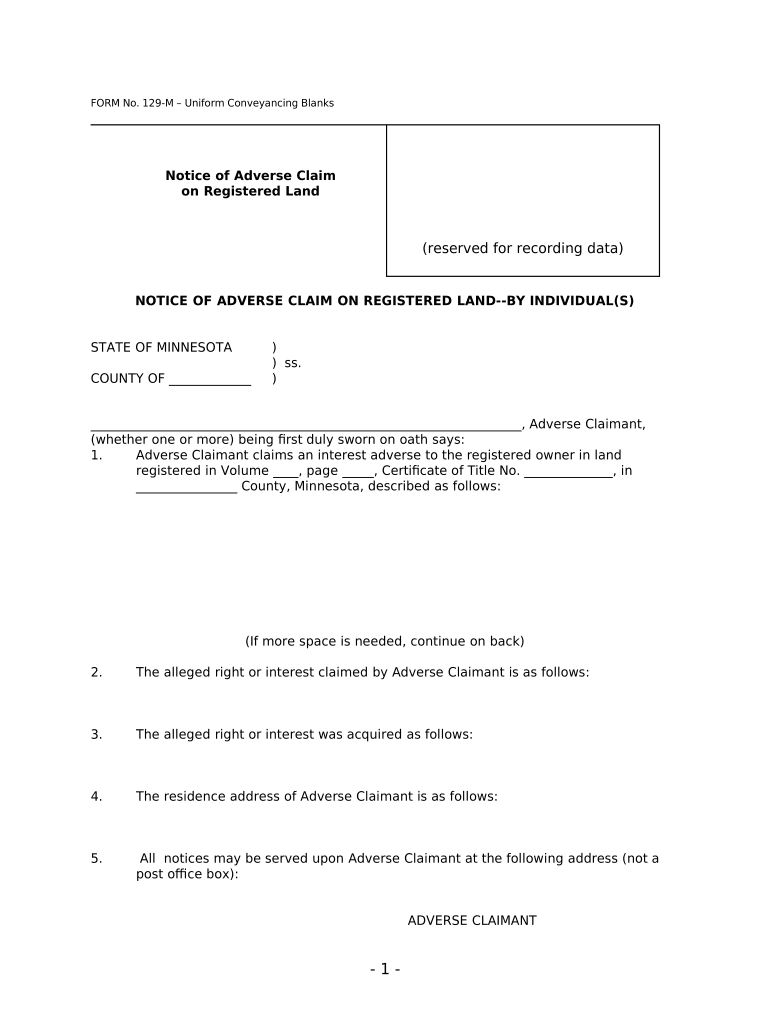
Filing a Notice of Adverse Claim publicly records your interest and warns potential purchasers, lienholders, and title insurers, helping preserve priority and enabling faster resolution of competing claims.

In practice, preparation is often handled by counsel or a title professional because precise legal descriptions and supporting documentation are required for effective recording and enforcement.
The person or entity asserting the adverse claim signs to attest to the facts alleged. Their signature should match the name used in supporting evidence and any government ID to avoid challenges to attribution.
A licensed title agent or attorney may sign when filing on behalf of a client; include their role and contact details to facilitate follow-up and service of process if the notice triggers litigation.
Full legal name and contact details of the claimant or filing agent, including mailing address and email for service and follow-up by title examiners or opposing parties.
Exact registered title information: certificate number, legal description, parcel identifier, or registration book/page references used in the state registry.
Concise description of the adverse interest asserted (e.g., adverse possession, recorded lien, fraud in conveyance), including dates and relevant transaction references.
State the remedy or relief sought (e.g., enter appearance, preserve priority, request quiet title) so third parties understand the potential effect on marketability.
List and attach key documents (deeds, recorded instruments, contracts, court pleadings) that the claimant relies on to substantiate the assertion.
Signed and dated signature block with notarization or verification as required by state registered-land rules to authenticate the filing.
| Field | Configuration |
|---|---|
| Document Template | Create a reusable template with fixed title references and fillable claim fields. |
| Signer Roles | Assign claimant and agent roles; require required-party signature fields. |
| Authentication | Enable strong signer authentication (email + SMS or KBA) when available. |
| Retention | Enable automatic archiving and exportable audit trail PDF after signing. |
Preserve original signed documents and export a signed PDF and certificate of completion; when using third-party eSign platforms, ensure compliance with ESIGN (15 U.S.C. ch. 96) and UETA where applicable.
File as soon as an adverse interest is discovered to preserve priority.
Registrar review and indexing can take days to weeks depending on workload.
If quiet title or litigation is needed, statutory limitation periods apply per state law.
If using RON, follow state ID-proofing and recording retention rules before notarization.
Keep originals until dispute fully resolved and final title cleared.
Complete drafting, attach exhibits, and obtain notarization or verification as required.
File the notice with the registered land office or county recorder and pay applicable fees.
Office indexes the notice; third parties searching title will see the recorded claim.
Parties negotiate, pursue quiet title actions, or otherwise resolve the competing interests.
| signNow | DocuSign | Adobe Sign | PandaDoc | HelloSign | |
|---|---|---|---|---|---|
| Starting Price | $8/user/mo | $15/user/mo | $14/user/mo | $19/user/mo | $15/user/mo |
| Free Trial | 7-day free trial | Varies by vendor | Varies by vendor | Varies by vendor | Varies by vendor |
| Bulk Send | Yes | Yes | Yes | Yes | No |
| Audit Trail | Yes | Yes | Yes | Yes | Yes |
| HIPAA Compliant | Yes | Yes | Yes | No | No |
A buyer discovered a prior unrecorded lien during closing
A lender claimed an overlooked assignment affected collateral priority