Establishing secure connection…Loading editor…Preparing document…

Affidavit in Support of Adverse Possessor

This template is fully customizable. Edit the text, fill out the fields, and send it for signature. Give it a try!
Affidavit in Support of Adverse Possessor

What an Affidavit in Support of Adverse Possessor Is

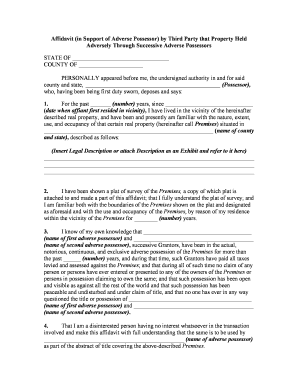
An Affidavit in Support of Adverse Possessor is a sworn written statement used to document facts that support a claim of adverse possession to establish title or quiet title to real property. The affidavit summarizes the claimant's continuous, open, notorious, exclusive, and hostile possession for the statutory period, describes the parcel and boundaries, and lists dates, witnesses, and supporting exhibits such as deeds, tax receipts, utility bills, or payment records. It is typically notarized and may be recorded with the county recorder to provide public notice of the claim.

Why the Affidavit Matters for Property Claims

The affidavit converts factual possession into a concise, sworn record that courts, title companies, and county recorders can review. It organizes proof of possession, helps establish constructive notice, and supports court petitions or title insurance exceptions when pursuing an adverse possession claim.

Why the Affidavit Matters for Property Claims

Who Typically Prepares or Signs This Affidavit

The affidavit is prepared by the adverse possessor or their attorney and may be signed by witnesses or supporting parties before a notary public.

  • Claimant / Adverse Possessor: Individual or entity claiming possession and completing sworn statements of use and occupancy.
  • Attorney or Title Professional: Prepares legal descriptions, integrates evidentiary exhibits, and advises on statutes and recording.
  • Witnesses / Neighbors: Provide corroborating statements about visible possession, improvements, or maintenance activities.

Parties involved should confirm state-specific filing, notarization, and witness requirements and retain originals for litigation or title review.

Step-by-Step: Completing the Affidavit

Follow these sequential steps to prepare, notarize, and record an affidavit that supports an adverse possession claim.

  • 01
    Gather Evidence: Collect deeds, receipts, photos, tax payments, and witness statements.
  • 02
    Draft Affidavit: Describe possession facts, attach exhibits, and include legal property description.
  • 03
    Sign and Notarize: Execute before a notary or via authorized RON where permitted.
  • 04
    Record or File: Submit to county recorder or file in court as needed.

Core Elements to Include in a Professional Affidavit

A complete affidavit addresses facts, legal description, evidence attachments, and authentication to withstand title review or court scrutiny.

Affirmation

A clear sworn statement by the claimant asserting continuous, exclusive, open, and hostile possession for the statutory period, written in first person and dated.
Legal Description

Precise parcel language or assessor parcel number copied from the recorded deed to ensure accurate identification for title searches and recorder indexing.

Timeline of Possession

Chronological account of acts and dates showing uninterrupted possession, including improvements, tax payments, or repairs.

Witness Statements

Signed declarations from neighbors or others corroborating visible possession, often noting when they first observed claimant's control of the property.

Exhibit List

Indexed attachments such as photos, utility bills, tax receipts, and maintenance records referenced in the affidavit to substantiate assertions.

Notary Acknowledgement

Notary block with seal and signature or a permitted RON record to authenticate the claimant's sworn statement for recording.

Key Data Elements and Required Verifications

Claimant Identity: Confirm with government ID
Property ID: Use deed description or parcel ID
Possession Dates: Provide exact MM/DD/YYYY
Witness Names: Include contact details
Attached Exhibits: Label and date each item
Notary Details: Include seal, jurisdiction, and date

Common Risks and Legal Consequences

Perjury Risk: Criminal penalties if false
Recording Refusal: County may reject defective filings
Title Challenges: Litigation if ownership disputed
Statute Deadline: Missed statutory period invalidates claim
Tax Liability: Back taxes may be assessed
Notary Defect: Improper notarization can void affidavit

Frequent Preparation Pitfalls to Avoid

  • Incomplete legal descriptions or use of informal addresses lead to recorder indexing errors and may hinder title searches.
  • Vague timelines without corroborating exhibits weaken claims; include dated receipts, photos with timestamps, and tax payment records where possible.
  • Relying only on oral witness statements without signed declarations reduces evidentiary weight in court or with title companies.
  • Using inconsistent names or failing to notarize properly risks rejection by county recorders or successful challenge by prior owners.

How the Affidavit Moves Through the Process

This sequence shows common routing from preparation to public notice or court filing.

  • Preparation: Draft affidavit and compile exhibits.
  • Authentication: Notarize in-person or via permitted RON.
  • Recording: File with county recorder for public notice.
  • Title Review: Title companies or courts evaluate evidentiary sufficiency.

Configuring an Online Workflow for the Affidavit

Design an electronic workflow that captures signatures, attachments, and notarization evidence while preserving an audit trail.

Field Configuration
Document Upload Accept PDF/DOCX and preserve metadata
Signer Authentication Email link plus SMS code or KBA
Notary Integration Enable RON or in-person notarization steps
Audit Trail Capture IP, timestamps, and version history

Technical and Integration Requirements

Choose a platform that supports document formats, audit trails, and the notarization method required by your state.

  • File Formats: PDF, DOCX supported
  • Integrations: CRM and cloud storage
  • Authentication: Email, SMS, or KBA options

Timing Considerations Relevant to Adverse Possession

Deadlines and statutory periods vary by state; understanding timing is essential to know when a claim matures or when corrective steps are required.

Statutory Periods:

Commonly range from 5 to 20 years depending on state

Tax Records:

Retain receipts showing tax payments during possession period

Recording Window:

Record affidavit to provide constructive notice when ready

Challenge Deadlines:

Adverse owners should note state limitations for quiet title actions

Notary Retention:

RON audio/video retention requirements vary by jurisdiction

eSignature Vendor Pricing and Feature Snapshot

Compare core pricing and feature availability for common eSignature vendors used to sign and route affidavits; signNow appears first per platform comparison conventions.

signNow DocuSign Adobe Sign PandaDoc HelloSign
Starting Price $8/user/mo $15/user/mo $14/user/mo $19/user/mo $15/user/mo
Free Trial 7-day trial (no card) Varies by plan Varies by plan Varies by plan Varies by plan
Bulk Send Yes Yes Yes Yes Yes
Audit Trail Yes Yes Yes Yes Yes
HIPAA Compliant Yes Yes Yes No No
Envelope Cap No cap 100 envelopes/user/year Varies by plan Varies by plan Varies by plan

Frequently Asked Questions and Practical Answers

Common questions address e-signature acceptability, notarization, supporting evidence, and risks. Answers reference federal e-signature principles and typical recording practice.


Need help? Contact support

be ready to get more
Join over 28 million airSlate SignNow users