Establishing secure connection…Loading editor…Preparing document…

Adverse Possession Form

This template is fully customizable. Edit the text, fill out the fields, and send it for signature. Give it a try!
Adverse Possession Form

What the Adverse Possession Form Is and When it Applies

The Adverse Possession Form documents a claimant’s factual basis for asserting ownership of land based on continuous, open, and notorious possession under state law. It typically collects the claimant’s identity, a precise property description, the asserted period of possession, supporting evidence such as witness statements or tax payments, and any maps or exhibits. The completed form is used to support a quiet title action or a recording notice in the county where the property is located; outcome depends on meeting statutory elements and the applicable state statute of limitations.

Why a Clear, Complete Form Matters

A well-prepared Adverse Possession Form centralizes the factual record required to prove possession, reduces disputes about dates and boundaries, and supports court filings or title actions. Accurate forms improve the odds of a successful quiet title claim and minimize later litigation over chain of title.

Why a Clear, Complete Form Matters

Who Typically Prepares or Receives This Form

The form is used by claimants asserting ownership, attorneys preparing quiet title actions, and county recording officers who accept supporting exhibits.

  • Claimants and property owners asserting continuous possession and control of land
  • Real estate attorneys preparing pleadings, quiet title petitions, or chain-of-title documentation
  • County recorders, title examiners, and surveyors reviewing evidence for recording or title insurance

Essential Sections of a Professional Adverse Possession Form

A complete form groups information so a reviewer can confirm identity, property, timeline, and supporting proof quickly.

Claimant ID

Full legal name and contact details for the person asserting adverse possession, plus any business or trust entity information.
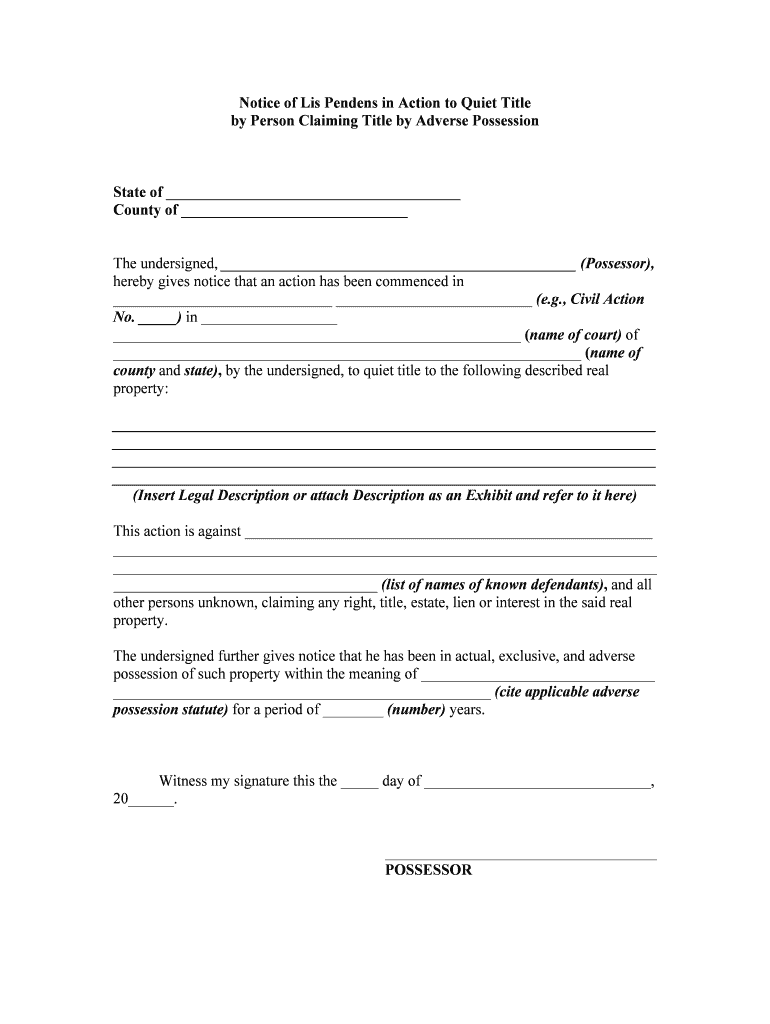
Property Description

Precise legal description or parcel number, street address, and county; include recorded instrument references where known.

Possession Timeline

Start and end dates (if applicable) and total uninterrupted period claimed, noting any statutory tolling events.

Acts of Possession

Concise statements of open, notorious, exclusive, hostile, and continuous acts—examples include fencing, cultivation, and tax payment.

Supporting Evidence

List of exhibits such as affidavits, photographs, utility bills, tax receipts, and survey plats attached to the claim.

Notary and Signature

Signed acknowledgement by claimant with date, notarization if required by state, and witness blocks where applicable.

Required Data Elements at a Glance

Claimant Name: Full legal name
Property ID: Parcel number or legal description
Possession Dates: MM/DD/YYYY range
Acts of Possession: Brief factual list
Exhibit List: Attached documents
Signatures: Signed and dated

Step-by-Step: Completing the Adverse Possession Form

Follow these sequential steps to prepare a complete, court-ready claim or recording package.

  • 01
    Gather records: Collect deeds, tax receipts, photos, and survey documents.
  • 02
    Describe possession: Summarize acts of control and dates clearly.
  • 03
    Assemble exhibits: Label and attach supporting affidavits and maps.
  • 04
    Sign and notarize: Execute with required notarization and witness statements.

Configuring an Online Completion Workflow

When preparing the form online, set authentication, required fields, and storage to meet legal and evidentiary needs.

Field Configuration
Authentication Email + SMS code or stronger KBA
Required Fields Make claimant name, property ID, dates required
Conditional Logic Show witness blocks when notarization is required
Storage Save PDF/A with audit trail and attachments

Where to File or Send the Completed Form

Routes depend on intended purpose: record with county, include in court filing, or provide to title companies and adjacent owners.

  • County Recorder: Record the form or notice with the county recorder where the land is located.
  • Court Filing: Attach the form to a quiet title petition at the appropriate county court.
  • Title Company: Provide the form and exhibits for insurance underwriting review.
  • Service to Owners: Serve adjoining owners and interested parties per local rules.

Digital Signing and Platform Considerations

Choose a platform that supports secure authentication, tamper-evident PDFs, and audit trails to preserve evidentiary value.

  • Authentication: Email, SMS, or KBA options
  • File Formats: PDF, PDF/A, DOCX supported
  • Integrations: Salesforce, NetSuite, Google Workspace

Timing Considerations and Statute of Limitations

Adverse possession depends on uninterrupted possession for the statutory period; deadlines and tolling rules differ substantially by state.

Typical Statutory Periods:

Range from 5 to 20 years depending on state law

Tolling Events:

Disability or minority of record owner may pause the clock in some states

Tax Payment Evidence:

Payment of property taxes during the period strengthens claims in many jurisdictions

Recording Notices:

Recording a notice does not always change the statutory period — check state statute

Confirm Local Deadline:

Always verify the controlling statute in the county or state where the land sits

Common Mistakes to Avoid When Preparing a Claim

  • Vague possession descriptions that fail to document continuous, hostile, and exclusive acts with dates and locations
  • Failing to attach or properly label supporting exhibits such as affidavits, tax receipts, or survey plats
  • Using inconsistent names or entity designations between deeds, tax records, and the claimant’s ID
  • Skipping required notarization or witness signatures based on local recording rules

Consequences of an Incorrect or Incomplete Form

Claim Rejection: Filing denied
Title Defect: Continued cloud on title
Trespass Liability: Civil damages possible
Tax Exposure: Back taxes or penalties
Loss of Priority: Recorded instruments may prevail
Fraud Allegations: Potential criminal exposure

Practical Tips for Accurate and Efficient Completion

Adopt a consistent, evidence-first approach to minimize defects and support later court review.

Verify Chain of Title
Confirm current recorded owners and recent conveyances before asserting adverse possession; discrepancies can defeat a claim and create liability.
Document Continuity
Collect dated photographs, receipts, tax records, and witness affidavits showing uninterrupted possession; contemporaneous evidence is far more persuasive.
Use Clear Maps
Attach a labeled plat or survey that shows contested boundaries and physical improvements to reduce ambiguity in court.
Consult Counsel Early
Have an attorney review statutory requirements, potential defenses, and appropriate recording or pleading strategies before filing.

eSignature Vendor Comparison for Completing and Signing the Form

Comparing basic commercial eSignature plans can help you select a provider that meets authentication, audit trail, and HIPAA needs when collecting signatures for evidence.

signNow DocuSign Adobe Sign PandaDoc HelloSign
Starting Price $8/user/mo $15/user/mo $14/user/mo $19/user/mo $15/user/mo
Free Trial Yes, 7-day free trial Varies by plan Varies by plan Varies by plan Varies by plan
Bulk Send Yes Yes Yes Yes No
Audit Trail Yes Yes Yes Yes Yes
Envelope Cap No cap 100 envelopes/user/year Varies Varies Varies

Frequently Asked Questions About the Adverse Possession Form

Answers to common procedural and legal questions to help you avoid common pitfalls and understand next steps.


Need help? Contact support

be ready to get more
Join over 28 million airSlate SignNow users