Case Caption
District and party names, case number, and court name placed exactly as on the complaint to ensure correct docketing and linkage to the existing file.
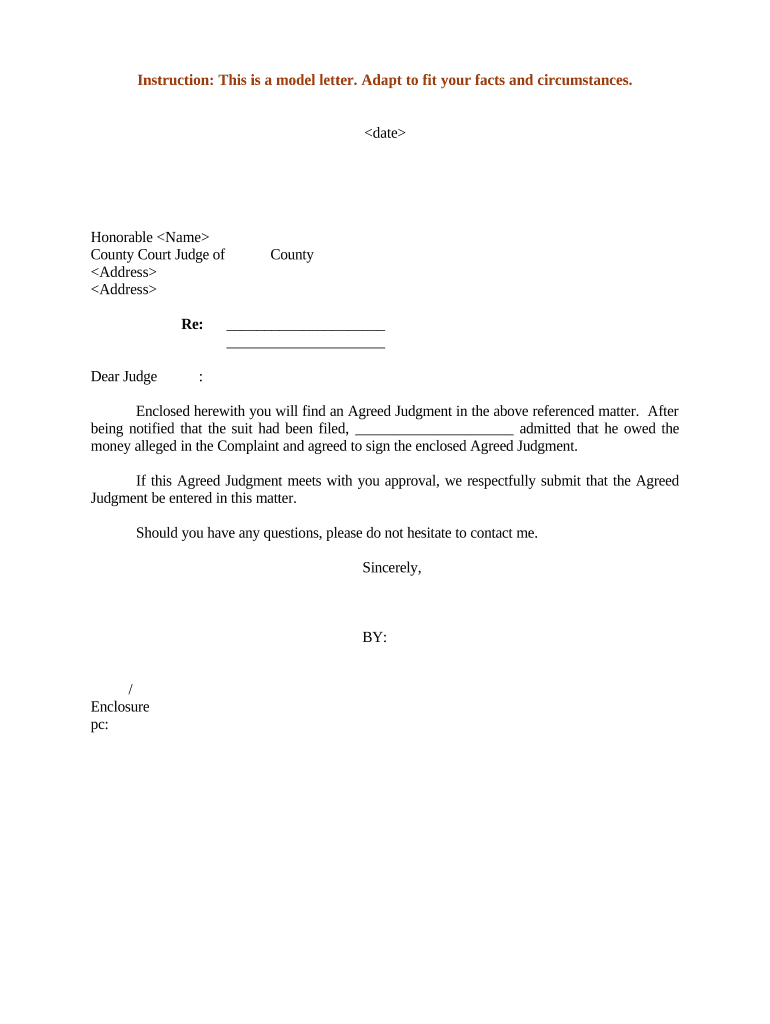
An Agreed Judgment clarifies enforcement rights and timelines, avoids protracted litigation over relief, and creates a court-backed remedy that can be enforced like any other judgment.

Roles vary by case and jurisdiction; always confirm who must sign and how the court requires submission before finalizing the document.
An authorized individual such as a corporate officer or an authorized agent may sign for an entity; include evidence of authority (board resolution or power of attorney) when required by the court.
A judge or clerk must enter and endorse the Agreed Judgment for it to become a court judgment; the court’s signature or docket entry typically creates the enforceable record.
District and party names, case number, and court name placed exactly as on the complaint to ensure correct docketing and linkage to the existing file.
Short background statements identifying the settlement agreement, the parties’ intent to be bound, and any prior orders or stipulations that affect the judgment.
Precise obligations: payment amounts, schedule, performance milestones, release language, and default consequences stated in specific, enforceable terms.
Specify remedies for breach (e.g., contempt, execution, garnishment) and whether post-judgment interest or attorney fees apply under statute or contract.
Designated lines for signatures, printed names, titles, dates, and, if required, notary acknowledgment or verification of authority for corporate signers.
A line for the judge or clerk to sign/enter the order and space for the clerk’s filing stamp or docket notation confirming entry on the public record.
| Field | Configuration |
|---|---|
| Case Number | Locked text field to prevent edits after signing |
| Party Signatures | Require full-name signature + date for each party |
| Authority Upload | File upload field for resolutions or POAs |
| Court Entry Block | Leave blank or mark 'For Court Use' (not to be signed by parties) |
Match platform features to court rules (eFiling requirements, notarization options) and preserve an exportable, tamper-evident copy for the court record.
Date you submit the proposed judgment to the clerk; court sets entry date upon acceptance.
Effective obligations begin on the date listed in the judgment (use MM/DD/YYYY).
Set clear due dates and late-payment consequences in the judgment.
Appeal deadlines are court-specific; many civil rules use 30 days from entry.
Post-entry enforcement procedures commence after the court’s entry and docketing of judgment.
| signNow | DocuSign | Adobe Sign | PandaDoc | HelloSign | |
|---|---|---|---|---|---|
| Starting Price | $8/user/mo | $15/user/mo | $14/user/mo | $19/user/mo | $15/user/mo |
| Free Trial | 7-day free trial | Varies by vendor | Varies by vendor | Varies by vendor | Varies by vendor |
| Bulk Send | Yes (Business Premium) | Yes (enterprise tiers) | Yes (enterprise tiers) | Yes (enterprise tiers) | Varies by plan |
| Audit Trail | Yes | Yes | Yes | Yes | Yes |
| HIPAA Compliant | Yes (BAA available) | Yes | Yes | No | No |
| Envelope Cap | No cap | 100 envelopes/user/year | Varies by plan | Varies by plan | Varies by plan |
Two commercial parties reach a settlement over contract claims and agree on payment terms and release language.
A consumer dispute resolves with a structured payment plan and confidentiality terms attached to the settlement.