Case Caption
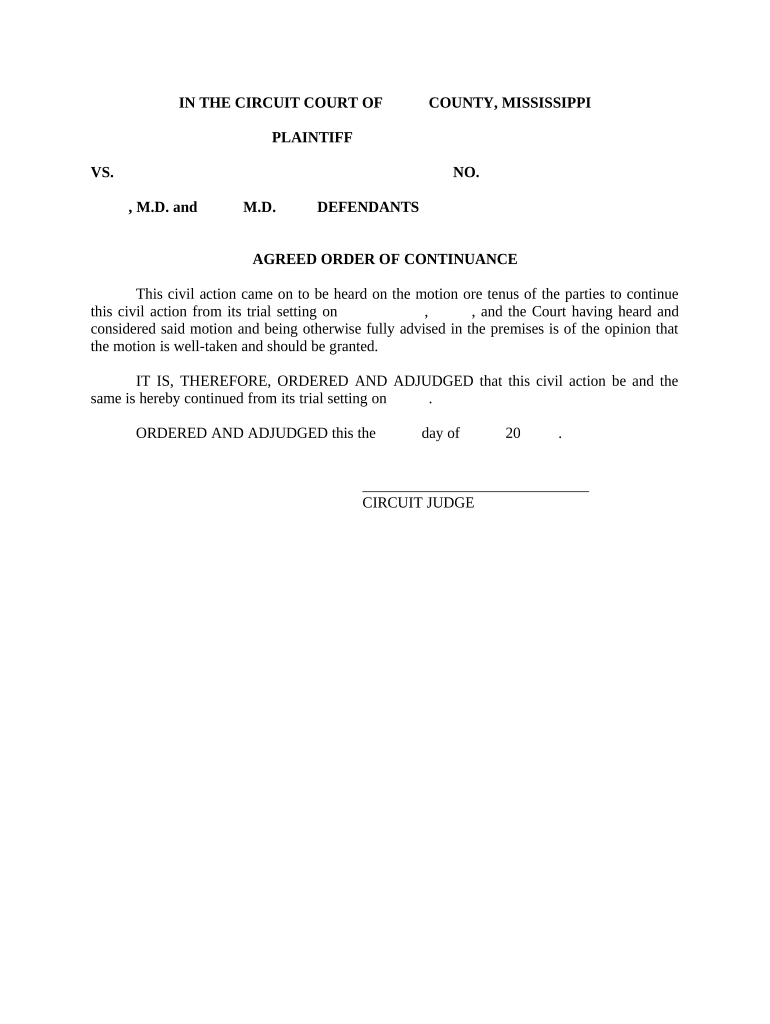
Full party names and court identifier matching prior pleadings to ensure the order is docketed correctly and associated with the right case file.
Several roles participate in preparing and signing an Agreed Order of Continuance; coordination avoids delays.
Confirm responsibilities early: counsel should agree on dates, notify the court per local rules, and preserve proof of service to avoid scheduling disputes.
An Agreed Order documents a mutual change to court scheduling, prevents surprise continuances, preserves the parties’ agreed timeline, and provides an official record for the clerk and the judge. It reduces the need for additional hearings, helps manage witness and counsel availability, and protects parties from default or sanction risk that can arise from unilateral no-shows or missed deadlines.

Full party names and court identifier matching prior pleadings to ensure the order is docketed correctly and associated with the right case file.
Brief statement of the parties’ agreement and reason for the continuance, written neutrally to inform the judge and clerk of the factual basis.
Precise language describing the continuance length, new hearing date/time, or scheduling window to avoid ambiguity at docketing.
Any related deadlines (discovery cutoffs, filing of motions) should be adjusted and listed to keep the case timeline consistent.
Signature blocks for counsel and parties with printed names, bar numbers for attorneys, and signature dates to demonstrate mutual consent.
A statement confirming how and when opposing counsel and parties were served, including method and date, to satisfy court rules.
| Field | Configuration |
|---|---|
| Document Format | Use PDF/A; include searchable text |
| Signature Type | Collect signature, printed name, and date |
| Service Evidence | Attach certificate of service PDF |
| Notifications | Enable email confirmations for signers |
| Criteria | Agreed Order | Motion to Continue |
|---|---|---|
| Required Signatures | all parties | moving party only |
| Court Filing | proposed and signed | motion and supporting brief |
| Typical Timing | faster entry | can require hearing |
| Contested? | yes possible |
Match your eSignature platform capabilities to the court’s e-filing and signature requirements to avoid rejections.
Tim Martin, Founder at Martin Properties, used online signing to process court-related and transactional documents efficiently.
Brian Fitzgibbons, COO at Optica Ventures LLC, highlighted ease of use for clients and internal teams during document exchanges.