Establishing secure connection…Loading editor…Preparing document…

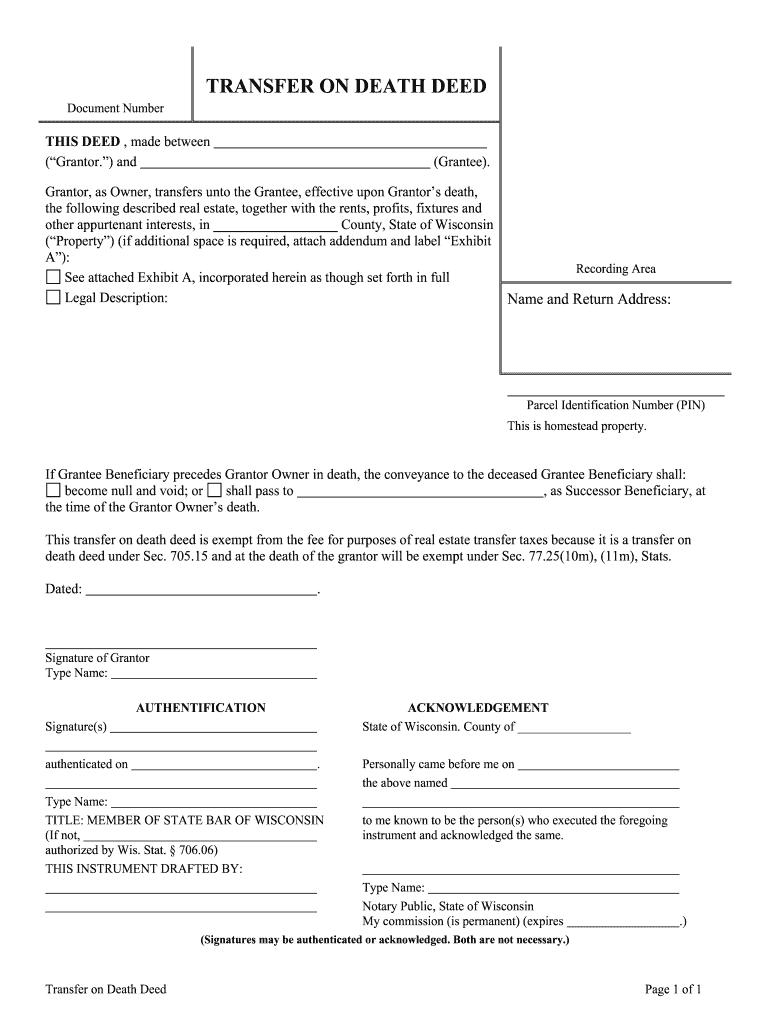
Transfer on Death Deed

This template is fully customizable. Edit the text, fill out the fields, and send it for signature. Give it a try!
Transfer on Death Deed

What a Transfer on Death Deed Does

A Transfer on Death Deed (sometimes called a beneficiary deed) is a recorded instrument that names one or more beneficiaries to receive real property automatically upon the owner’s death. The deed typically does not transfer present ownership; instead it preserves the owner’s control during life while creating a direct transfer at death that can often avoid probate. State law governs validity, recording requirements, and whether the deed is revocable. Use of a TOD deed can simplify property transfer but must use precise legal descriptions and follow local recording rules.

Why people use a Transfer on Death Deed

A Transfer on Death Deed can achieve a direct, post-mortem transfer of title that often avoids probate, preserves owner control while alive, and clarifies beneficiary designation without altering present ownership.

Why people use a Transfer on Death Deed

Typical users and signers

Attorneys, title companies, and county recorders are commonly involved to verify legal descriptions, notarization, and recording to ensure validity.

  • Homeowners with a single property seeking to avoid probate
  • Property owners who want to keep full control during life
  • Estate planners with modest estates who prefer a simple transfer

Core elements of a valid Transfer on Death Deed

A professionally prepared TOD deed contains defined parties, precise legal description, beneficiary identification, revocability language, notarization, and recording instructions to satisfy state requirements.

Grantor

Name the property owner exactly as on title or government ID; mismatched names can complicate recording or title transfer.
Beneficiary

Identify one or more beneficiaries by full legal name, relationship, and contact information to reduce ambiguity at transfer.

Legal description

Use the full recorded legal description or parcel number from the county recorder; street addresses alone are insufficient for deeds.

Effective condition

State that the transfer takes effect upon the grantor’s death, and include any survivorship or contingency rules for beneficiaries.

Revocation clause

Specify whether the deed is revocable and how revocation occurs (usually by recorded instrument or a later deed).

Notary and recording

Include a notary acknowledgement and instructions to record at the county recorder where the property is located; many jurisdictions require notarization.

Step-by-step: completing and recording a TOD deed

Follow these sequential steps to prepare, execute, and record a Transfer on Death Deed correctly.

  • 01
    Gather title info: Locate current deed and legal description
  • 02
    Draft deed: Prepare deed using statutory language where available
  • 03
    Sign before notary: Execute in presence of notary and any required witnesses
  • 04
    Record deed: File with county recorder where property is located

How the transfer takes effect

The practical workflow: ownership remains with grantor during life and title passes to beneficiary automatically at death when statutory conditions are met.

  • During life: Grantor retains full ownership and control
  • At grantor’s death: Beneficiary entitled to property by operation of law
  • Recording role: Recorded deed provides public notice and aids title transfer
  • Post-death steps: Beneficiary records death certificate and prepares new deed

Recommended online workflow components

When using a digital platform, configure fields and authentication to match legal and recording needs while preserving an audit trail.

Field Configuration
Grantor signature Require signature field plus date
Notary block Reserve space; attach notary acknowledgement PDF
Beneficiary details Use separate fields for name, DOB, contact
Attachment Upload existing deed or title report

Security and compliance considerations

Encryption: TLS 1.2/1.3 in transit; AES-256 at rest
Certifications: ISO 27001 and SOC 2 Type II
HIPAA: HIPAA-compliant workflows; BAA required
ESIGN / UETA: Meets ESIGN and UETA legal standards
21 CFR Part 11: Supports FDA-regulated electronic records
Accessibility: WCAG 2.0 Level AA accessibility support

Primary risks and legal consequences

Unrecorded deed: Clouds title; may fail to transfer
Incorrect description: Recording rejection or ambiguous title
Beneficiary issues: Predeceasing beneficiaries can trigger intestacy
Conflicting instruments: Deed may conflict with mortgage or lien
Tax consequences: Possible estate or transfer tax considerations
Improper execution: Missing notarization or witnesses voiding effect

Common preparation mistakes to avoid

  • Using a street address instead of the recorded legal description leads to recording rejection or title ambiguity.
  • Failing to notarize or secure required witness signatures can invalidate the deed under state law.
  • Naming an unclear beneficiary (nickname or partial name) increases the risk of disputes and delays in transfer.
  • Not checking mortgage or lien terms; some lenders require notice or payoff before property fully transfers to beneficiaries.

Best practices for reliable TOD deed execution

Adopt consistent habits to reduce risk and ensure smooth post-death transfer.

Confirm recorded legal description
Retrieve the current deed from the county recorder and copy the exact legal description and parcel ID into the TOD deed to avoid recording errors or ambiguities that can delay title transfer.
Execute with proper acknowledgements
Sign the deed only in the presence of the notary and any state-required witnesses, and verify the notary block matches county requirements so the instrument is accepted for recording.
Record promptly
Record the TOD deed in the county where the property is located prior to the grantor’s death to provide public notice and strengthen the deed’s intended effect at the time of death.
Consider title insurance review
Ask a title company to review the deed and run a title search to confirm encumbrances, mortgages, or lien issues that might affect beneficiary transfer.

Real-world scenarios where a TOD deed fits

Two concise examples illustrate how a Transfer on Death Deed is used in practice and what follow-up steps beneficiaries typically take.

Single-Property Owner

A homeowner with one rental property uses a TOD deed to name her adult child as beneficiary, simplifying post-death transfer

  • The deed is recorded during life to provide clear public notice
  • After death the beneficiary presents the recorded TOD deed and death certificate to update title and avoid a full probate administration.

Couple with Survivorship Plan

A married couple records TOD deeds naming each other and a contingent beneficiary, so the survivor retains ownership during life

  • The deeds are revocable and recorded locally
  • When the second spouse dies, the contingent beneficiary records the death certificate and acquires title without prolonged probate steps.

Timing considerations and recording expectations

While there is no universal statutory deadline, timely recording before death and correct execution are essential to the deed’s effectiveness and to avoid disputes.

Record before death:

Record the deed while the grantor is alive to provide public notice and protect against competing claims

No probate filing deadline:

A TOD deed typically avoids probate; probate timelines depend on local court schedules

Notary timing:

Sign and notarize in the same session to satisfy acknowledgement requirements

Update after life changes:

Revise beneficiary designations promptly after divorce, remarriage, or major estate changes

Title company timing:

Coordinate with a title company for post-death transfer and reissue of title documents

How eSignature options compare for executing a deed

Platforms differ by price model, bulk capabilities, HIPAA support, and envelope or session limits; signNow appears first for neutral comparison.

signNow DocuSign Adobe Sign PandaDoc HelloSign
Starting Price $8/user/mo $15/user/mo $14/user/mo $19/user/mo $15/user/mo
Free Trial 7-day free trial Varies by plan Varies by plan Varies by plan Varies by plan
Bulk Send Yes Yes Yes Yes No
Audit Trail Yes Yes Yes Yes Yes
HIPAA Compliant Yes Yes Yes No No

FAQs about Transfer on Death Deeds

Answers to common questions cover revocation, probate avoidance, e-signing, beneficiary contingencies, and recording practicalities.


Need help? Contact support

be ready to get more
Join over 28 million airSlate SignNow users