Establishing secure connection…Loading editor…Preparing document…

Asset Agreement

This template is fully customizable. Edit the text, fill out the fields, and send it for signature. Give it a try!
Asset Agreement

What an Asset Agreement Is and when it’s used

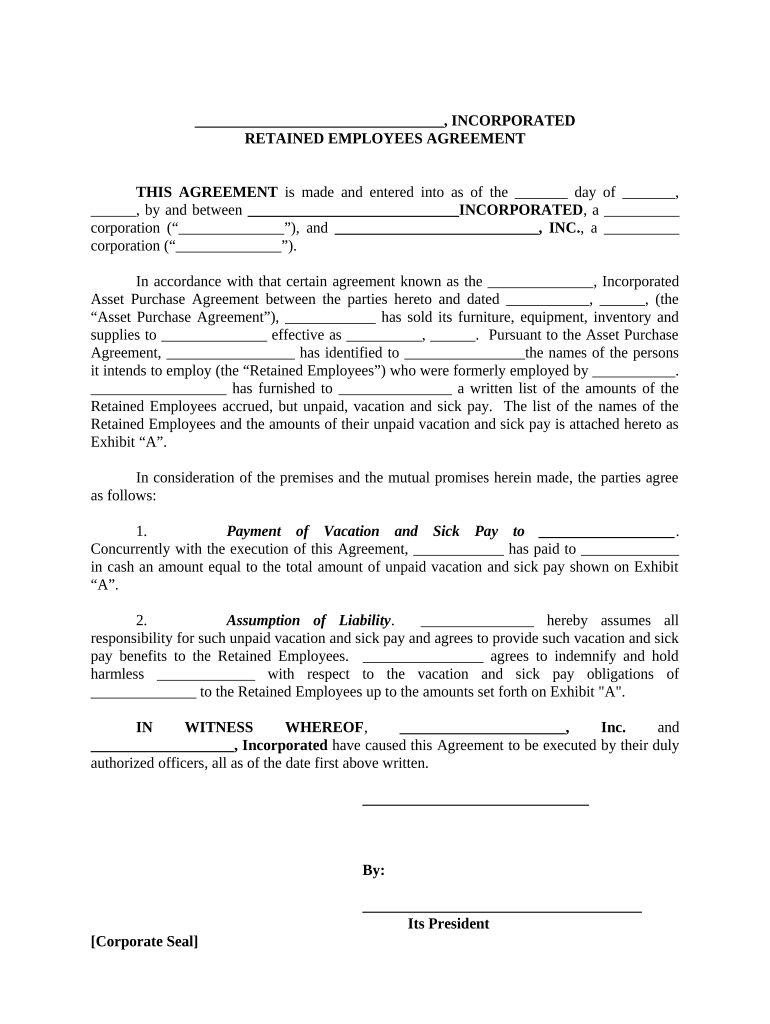
An Asset Agreement is a legal contract that documents the transfer, lease, pledge, or other disposition of property or intangible assets between parties. It defines the asset description, consideration, effective date, representations, warranties, and post-closing obligations. Asset Agreements cover many transaction types — equipment sales, intellectual property assignments, security interests, and inventory transfers — and are tailored by industry and jurisdiction. Properly completed, the agreement creates enforceable rights and duties and supports recordkeeping for tax, regulatory, and audit purposes, including signatures and any required notarization or witness attestations.

Why a clear Asset Agreement matters

A well-drafted Asset Agreement reduces ambiguity about ownership, payment, and liability, helps avoid disputes, and documents compliance steps such as tax reporting and any necessary notarization. It also defines remedies, risk allocation, and the timeline for performance.

Why a clear Asset Agreement matters

Who typically completes an Asset Agreement

Multiple parties and roles may prepare or sign an Asset Agreement depending on the transaction size and type.

  • Buyers and sellers of equipment, inventory, or business assets — often procurement, operations, or finance teams responsible for due diligence and payment terms.
  • Lenders and secured parties when the agreement creates or references a security interest; legal or credit departments review terms and collateral descriptions.
  • Legal counsel and contract administrators who add representations, warranties, indemnities, and closing conditions to protect parties and ensure enforceability.

Parties should confirm signatory authority and any notarization or witness rules before signing to avoid post-closing challenges.

Typical signers and reviewers

Company Executive

Chief executive, CFO, or authorized officer who has corporate authority to transfer assets; their signature binds the company and often requires a counterparty representative and a dated signature block with title.

Legal or Title Officer

In-house counsel or title officer who verifies descriptions, liens, representations, and ensures any required notarization or recording steps are included prior to execution.

Core elements to include in a professional Asset Agreement

Include consistent, specific language for the asset, parties, consideration, timeline, and post-closing obligations to create a clear and enforceable contract.

Asset Description

Precise identification including serial numbers, schedules, intellectual property registration numbers, or detailed exhibits so the subject matter cannot be reasonably disputed.
Consideration

State the exact cash amount, payment schedule, assumed liabilities, or other exchange terms and how payments will be delivered and applied.

Representations

Seller representations about title, condition, authority to sell, and absence of liens; buyer representations about authority and funding.

Closing Mechanics

Specify closing date, deliverables at closing, required certificates, proof of payment, and procedures if conditions are unmet.

Indemnities & Warranties

Define survival period for warranties, scope of indemnities, caps, and procedures for notice and defense of claims.

Governing Law & Dispute Resolution

Designate the governing state law, venue, and whether arbitration or court litigation will resolve disputes.

Step-by-step: completing and executing an Asset Agreement

Follow these sequential steps to prepare, review, and finalize the agreement with minimal rework and compliance risk.

  • 01
    Prepare Draft: Describe assets, payment, and conditions clearly; attach exhibits and title evidence.
  • 02
    Internal Review: Legal and finance confirm authority, tax treatment, and lien status prior to sending.
  • 03
    Execute: Parties sign, date, and provide notarization or witness attestations if required.
  • 04
    Post-Closing Tasks: Record filings, remit payments, and retain executed originals and audit trail.

Typical routing workflow for digital execution

Digital workflows reduce manual handoffs; map required approvals and authentication steps before sending.

  • Upload Document: Sender uploads the final agreement and any exhibits in PDF or DOCX format.
  • Place Fields: Add signature, initials, dates, and conditional fields for optional clauses.
  • Set Signer Order: Define sequential or parallel signing and add authentication requirements.
  • Send & Audit: Platform delivers signing links, captures timestamps, and stores the audit trail.

Recommended digital workflow settings for Asset Agreement

Configure authentication, field behavior, and notifications to balance security and signer convenience.

Field Configuration
Signature Type Typed, drawn, or uploaded image allowed; require signer identity verification.
Authentication Email plus SMS code or knowledge-based verification for higher-value transfers.
Conditional Clauses Use conditional fields for optional indemnities or escrow release triggers.
Notifications Enable reminders and completion receipts for all signers and the contract owner.

Digital signing and technical considerations

Choose a platform that supports secure uploads, audit trails, and the file formats you use.

  • File Formats: PDF and DOCX are standard; ensure the platform preserves page layout and embedded exhibits.
  • Integrations: Look for connectors with CRM, cloud storage, and document management for automated filing.
  • Security: Platform should offer TLS and AES-256 encryption and maintain detailed audit logs.

Confirm the platform supports notarization workflows or RON where required and retains a tamper-evident final document copy.

Key security and compliance data points to verify

Encryption: TLS 1.2/1.3 in transit
At-Rest Encryption: AES-256
Audit Trail: IP and timestamp logging
HIPAA: BAA available
21 CFR Part 11: Compliance options
Certifications: SOC 2 Type II / ISO 27001

Common legal and financial risks if the agreement is incorrect

Tax Penalties: Reporting errors can trigger IRC §6721 penalties
Invalid Transfer: Incomplete conveyance language may fail to transfer title
Lien Exposure: Undisclosed liens can result in indemnity claims
Contract Voidance: Missing signature authority can void obligations
I-9 Noncompliance: Employment-related asset transfers risk DHS violations
Notary Errors: Improper notarization can delay recording

Frequent mistakes when preparing Asset Agreements

  • Vague asset descriptions that require later clarification and produce disputes over what was transferred.
  • Omitting lien searches or title evidence before closing, exposing the buyer to undisclosed encumbrances.
  • Using inconsistent party names or abbreviated entity names that prevent proper filing or bank acceptance.
  • Failing to specify governing law or dispute resolution, which increases litigation complexity and cost.

Real-world examples of Asset Agreement use

These short case summaries show how agreements vary by purpose and industry.

Equipment Sale — Optica Ventures

Optica Ventures sold specialized lab equipment using an asset schedule to list serial numbers

  • Sale price paid via escrow to protect both parties
  • The schedule and escrow instructions eliminated ambiguity and sped payment release after delivery and inspection.

IP Assignment — Technology Firm

A software startup assigned copyrights to an acquirer with a detailed exhibit describing codebases

  • Consideration included earnouts tied to performance milestones
  • Clear assignment clauses and defined deliverables prevented post-close IP disputes and streamlined integration.

Practical tips for accurate, efficient completion

Apply consistent checks and controls before sending the document for signature to minimize rework.

Use attached exhibits
Attach itemized asset lists, title reports, and lien searches as exhibits so the core agreement references fixed, auditable records.
Verify signer authority
Obtain corporate resolutions or power-of-attorney evidence when entities sign to avoid later challenges to authority.
Standardize dates and formats
Use MM/DD/YYYY and consistent currency designations to prevent accounting or tax interpretation issues.
Keep an audit trail
Store signed copies with metadata, signer authentication details, and any notarization recordings for audit and enforcement purposes.

Key deadlines and timing expectations

Track dates that affect performance, tax reporting, and statutory filing requirements to avoid penalties or missed obligations.

Effective Date:

Use the agreed MM/DD/YYYY; it triggers obligations and retention periods.

Closing Date:

Date when payment and asset transfer occur; tie delivery and documentation to this date.

Tax Reporting:

Provide relevant tax forms or information to counterparties in time to meet IRS deadlines.

Recordation:

Record deeds or UCC financing statements promptly to perfect security interests.

Retention Start:

Retention windows typically begin at execution or closing; confirm the applicable trigger.

Milestone timeline from draft to recorded instrument

Map these numbered stages to reduce missed steps between negotiation and final recording.

01

Draft & Review

Prepare the initial agreement and circulate for internal review and due diligence.

02

Negotiation

Exchange redlines, resolve open items, and finalize exhibits.

03

Execution

All parties sign, apply notarization/witnessing if required, and exchange executed copies.

04

Recordation & Closeout

File deeds, UCC-1s, and complete payment; retain evidence and close transaction files.

eSignature providers and pricing considerations for Asset Agreements

Compare common pricing and capability lines when selecting a platform for signing, notarization, and document retention. Pricing and feature availability vary by plan and vendor.

signNow DocuSign Adobe Sign PandaDoc HelloSign
Starting Price $8/user/mo $15/user/mo $14/user/mo $19/user/mo $15/user/mo
Free Trial 7-day free trial Varies Varies Varies Varies
Bulk Send Yes Varies Varies Varies Varies
Audit Trail Yes Yes Yes Yes Yes
Envelope Cap No cap 100 envelopes/user/year limit Varies Varies Varies

FAQs and troubleshooting for Asset Agreement completion

Answers to common questions about execution, enforceability, notarization, and electronic signing to help resolve typical issues.


Need help? Contact support

be ready to get more
Join over 28 million airSlate SignNow users