Parties
Full legal names and capacities of the subordinating creditor, senior creditor (if applicable), borrower, and any other affected parties; include corporate designations and contact information.
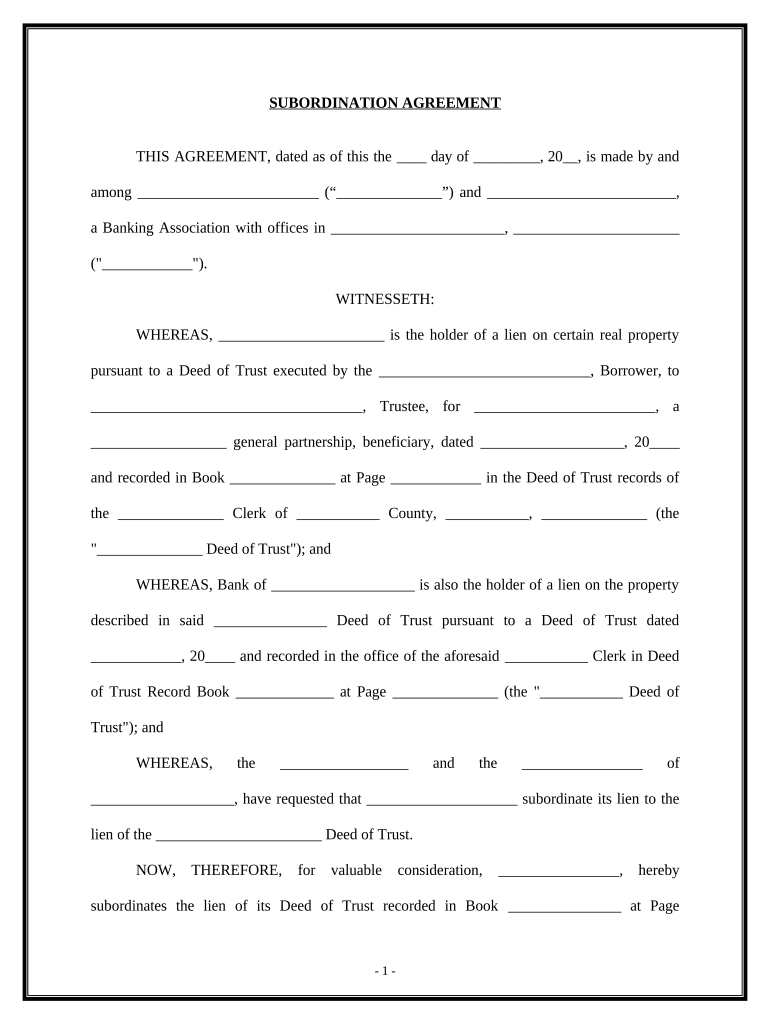
Subordination clarifies repayment order and enables additional financing, such as a new mortgage or construction loan, while protecting the rights and expectations of involved lenders. It reduces ambiguity about priority and facilitates closings where multiple liens exist.

Each party relies on the agreement to document consent to priority changes and to enable recording or lien indexing where required.
A lender signatory is typically the current lienholder agreeing to subordinate its lien. The lender’s authorized officer should sign and, if required, provide corporate resolution or power of attorney documentation to show signing authority.
The borrower or property owner countersigns when required and provides accurate property and loan identifiers. Borrower signatures often accompany notarization and must match title records to avoid recording rejection.
Full legal names and capacities of the subordinating creditor, senior creditor (if applicable), borrower, and any other affected parties; include corporate designations and contact information.
Background statements identifying the original loan documents, dates, recording references, and the reason for subordination to provide context for the new priority arrangement.
Clear clause stating which instrument is subordinated and to which existing or future lien it is subordinated, including any limitations or conditions on the subordination.
Legal description of the real property or collateral (not just a street address) sufficient for county recorder indexing and title search purposes.
Signature lines, printed names, titles, corporate acknowledgements, dates, and notarization sections formatted to meet local recording requirements.
Direction on where to record, return-to contact, and any required recording fees or attachments so the recorder can accept and index the agreement.
| Field | Configuration |
|---|---|
| Authentication | Email link or SMS code; use KBA where lender requires identity proofing |
| Signature type | Standard electronic signature; select PKI certificate if non-repudiation required |
| Notarization | Enable RON session or prepare for in-person notarization per jurisdiction |
| Return routing | Auto-send executed PDF to lender, title company, and county recorder contact |
Ensure the provider offers audit trails, optional advanced signer authentication, and a BAA if dealing with protected health information.
| signNow | DocuSign | Adobe Sign | PandaDoc | HelloSign | |
|---|---|---|---|---|---|
| Starting Price | $8/user/mo | $15/user/mo | $14/user/mo | $19/user/mo | $15/user/mo |
| Free Trial | 7-day free trial | Varies | Varies | Varies | Varies |
| Bulk Send | Yes | Yes | Yes | Yes | No |
| Audit Trail | Yes | Yes | Yes | Yes | Yes |
| Envelope Cap | No cap | 100 envelopes/user/year | Varies | Varies | Varies |
1–10 business days depending on underwriting and document complexity
Same day to several days; RON can shorten scheduling delays
County recorder processing can range from same-day to multiple weeks
Title companies typically require a recorded copy before clearing exceptions
Provide recorded copies to all parties within 1–5 business days of recording
Prepare the agreement with accurate loan and property references before circulation.
Collect lender approvals and any required title company endorsements.
Have authorized signers complete signatures in presence of a notary or via RON methods.
Submit to the county recorder and confirm indexing; distribute recorded copies to stakeholders.
A local developer needed a construction loan while an existing mortgage remained in place.
Corporate real estate team standardized subordinate forms integrated with their ERP.
| Criteria | Subordination Agreement | Intercreditor Agreement |
|---|---|---|
| Purpose | change lien priority | allocate rights between lenders |
| Parties involved | lender and borrower | multiple lenders |
| Typical use | refinancing/second loans | complex syndicated loans |
| Recording | often recorded | usually private agreement |