Establishing secure connection…Loading editor…Preparing document…

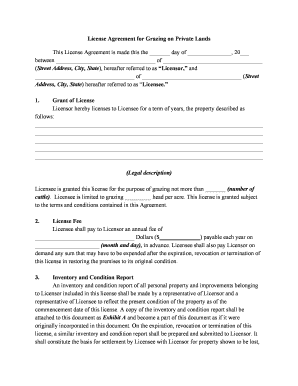
License Agreement for Grazing on Private Lands

This template is fully customizable. Edit the text, fill out the fields, and send it for signature. Give it a try!
License Agreement for Grazing on Private Lands

What this License Agreement is and when it applies

A License Agreement for Grazing on Private Lands is a legally binding contract that permits a livestock owner or operator to pasture animals on privately owned acreage under defined terms. The agreement typically allocates grazing rights, establishes the license period, sets payment or consideration, assigns responsibilities for fencing and water access, and defines liability, insurance, and indemnity. It is used where ownership remains with the landowner while grazing privileges are granted to another party for a fixed term or season, and may require notarization or recording depending on state law.

Why use a formal grazing license instead of informal arrangements

A written License Agreement clarifies expectations, reduces dispute risk, and documents financial and operational terms between landowner and grazer.

Why use a formal grazing license instead of informal arrangements

Who typically prepares and signs this grazing license

Identification of the signing parties and their roles in the document reduces ambiguity and supports enforcement if disputes arise.

  • Private landowners seeking controlled livestock access under defined terms and limited liability.
  • Ranchers or grazers needing temporary pasture rights without purchasing land.
  • Agricultural managers or lessees coordinating multi-party grazing on contiguous parcels.

Typical signers and authorized representatives

Landowner

The individual or entity that owns the parcel and grants grazing rights; may need to provide proof of ownership and sign as owner or corporate officer, with full authority to bind the property.

Operator

The livestock owner or manager who accepts grazing rights and obligations; responsible for animal welfare, payment, and compliance with agreed biosecurity, fencing, and liability terms.

Core clauses to include in a professional grazing license

A comprehensive agreement balances rights and duties: define scope, access, duration, compensation, liability, and dispute resolution to limit ambiguity.

Parties

Identify landowner and licensee with legal names, contact information, and representative authority to sign on behalf of entities.
Land Description

Describe property boundaries, pasture areas, and excluded zones using parcel ID, map references, and GPS coordinates where practical.

Grazing Rights

Specify permitted livestock types, stocking rates, seasonal windows, rotation plans, and any restrictions on supplemental feed or treatments.

Compensation

Set per-head, per-acre, or lump-sum payments, invoicing schedule, acceptable payment forms, and consequences for late or missed payments.

Maintenance & Utilities

Allocate responsibility for fencing, gates, water access, wells, and shared infrastructure; identify who pays repair or installation costs.

Liability & Insurance

Require proof of insurance, indemnity language, and procedures for incident reporting, animal loss, or environmental damage remediation.

How to set up a digital workflow for this agreement

Configure a straightforward online flow that captures signatures, supporting documents, and an audit trail for compliance and recordkeeping.

Document Upload PDF or DOCX with clear signature blocks
Signer Order Set signing sequence: owner then operator
Authentication Email or SMS code for signer verification
Supporting Files Attach proof of ownership and insurance certificates
Retention Enable audit trail and secure storage

Typical execution process for electronic completion

Follow a clear step sequence to collect signatures, supporting documents, and to retain an evidentiary audit trail that meets ESIGN/UETA tests.

  • Upload Document: Prepare final contract and upload to the eSign platform
  • Place Fields: Add signature, date, and initial fields where required
  • Invite Signers: Send secure signing links or email invitations
  • Complete and Archive: Collect signatures and store signed copy with audit record

Technical considerations for digital signing and storage

Confirm the provider supports industry integrations and compliance controls relevant to your jurisdiction and record retention needs.

  • File formats: PDF and DOCX supported
  • Integrations: CRM and cloud storage connectivity
  • Security: TLS and AES encryption

Key dates and notice periods to include and monitor

Set explicit dates and notice windows in the agreement to prevent disputes and ensure timely renewals or terminations.

Effective Date:

Date when the license begins and obligations commence

Term End Date:

Final day of permitted grazing or season end

Renewal Notice:

Specify required notice period (commonly 30–90 days)

Payment Due Date:

When fees must be paid after invoice

Insurance Proof Deadline:

Date by which current insurance certificates must be provided

Milestones from draft to renewals

Track each milestone from drafting through recording and scheduled reviews to keep the agreement active and enforceable.

01

Drafting Completed

Agreement language finalized and reviewed by counsel

02

Execution

All parties sign and date the final document

03

Notarization/Recording

Notarize if required; record if local laws demand

04

Annual Review

Review terms annually before renewal notice window

Common preparation mistakes to avoid

  • Failing to identify the precise parcel or pasture boundaries leads to grazing disputes and liability uncertainty.
  • Using vague payment terms or 'reasonable' rates causes enforcement problems and differing expectations between parties.
  • Omitting insurance and indemnity requirements risks exposing the landowner to livestock claims and environmental remediation costs.
  • Not specifying stocking rates or permitted livestock types can result in overgrazing, property damage, and contract breaches.

Security and compliance elements to include in the workflow

Encryption: TLS 1.2/1.3 in transit
At-rest protection: AES-256 encryption
Audit Trail: Timestamped signature events
Access Controls: Role-based permissions
HIPAA Options: BAA available where needed
Certifications: SOC 2 Type II and ISO 27001

Consequences and legal risks of an incomplete or incorrect agreement

Breach Damages: Monetary liability for contract violations
Trespass Liability: Claims if livestock stray or damage neighbors
Unpaid Fees: Collection costs and interest
Insurance Lapse: Loss of coverage and indemnity gaps
Environmental Fines: Penalties for pollution or harm
Invalid Execution: Voidable agreement due to missing signatures

Recording or filing the agreement after execution

Decide whether the license should be recorded or simply retained; recording may affect third-party notice and property title searches.

  • Record with County: Record if statute or parties want public notice
  • Retain Executed Copy: Store signed originals and digital copies securely
  • Notify Neighbors: Provide notice to adjoining owners if required
  • Update Insurance: Send insurer a copy to verify coverage

Practical tips to ensure a smooth grazing license

Follow consistent document standards and operational checklists to reduce disputes and administrative friction.

Use precise property descriptions
Attach a map or exhibit showing fenced areas and GPS coordinates to avoid ambiguity about permitted grazing locations.
Specify stocking rates
Define maximum animal units and rotation plans to protect pasture health and reduce environmental and neighbor complaints.
Require insurance proof
Ask for a certificate of insurance naming the landowner as additional insured and verify coverage limits before livestock arrival.
Document communications
Keep written records of notices, adjustments, and incident reports to support enforcement or insurance claims if necessary.

Practical examples of how grazing licenses are used

Two short scenarios show common structures: seasonal pasture rights and long-term licensed grazing with maintenance obligations.

Seasonal Pasture License

A landowner grants grazing from May 1 to Sept 30 for a fixed per-head fee

  • Stocking rate limited to preserve forage
  • The license required annual proof of liability insurance and a 30-day renewal notice to continue.

Multi-Year Managed Grazing

A ranch operator secures a three-year license with rotational plans and fence responsibilities

  • Operator handles fence upkeep
  • The agreement ties payments to pasture condition inspections and includes termination for environmental noncompliance.

Common eSignature vendor pricing and capabilities for executing licenses

Compare starting prices and core capabilities; signNow appears first as a competitively priced option with enterprise features and compliance support.

signNow DocuSign Adobe Sign PandaDoc HelloSign
Starting Price $8/user/mo $15/user/mo $14/user/mo $19/user/mo $15/user/mo
Free Trial 7-day free trial No No Yes, limited Yes, limited
Bulk Send Yes Yes Yes Yes No
Audit Trail Yes Yes Yes Yes Yes
HIPAA Compliant Yes Yes Yes No No
Envelope Cap No cap 100 envelopes/user/year Varies Varies Varies

Frequently asked questions about executing and enforcing the grazing license

Answers to common legal and process questions when preparing, signing, or recording a License Agreement for Grazing on Private Lands.


Need help? Contact support

be ready to get more
Join over 28 million airSlate SignNow users