Header Information
Company name, meeting type (annual), meeting date, time, and physical or virtual location clearly identified at the top of the document.
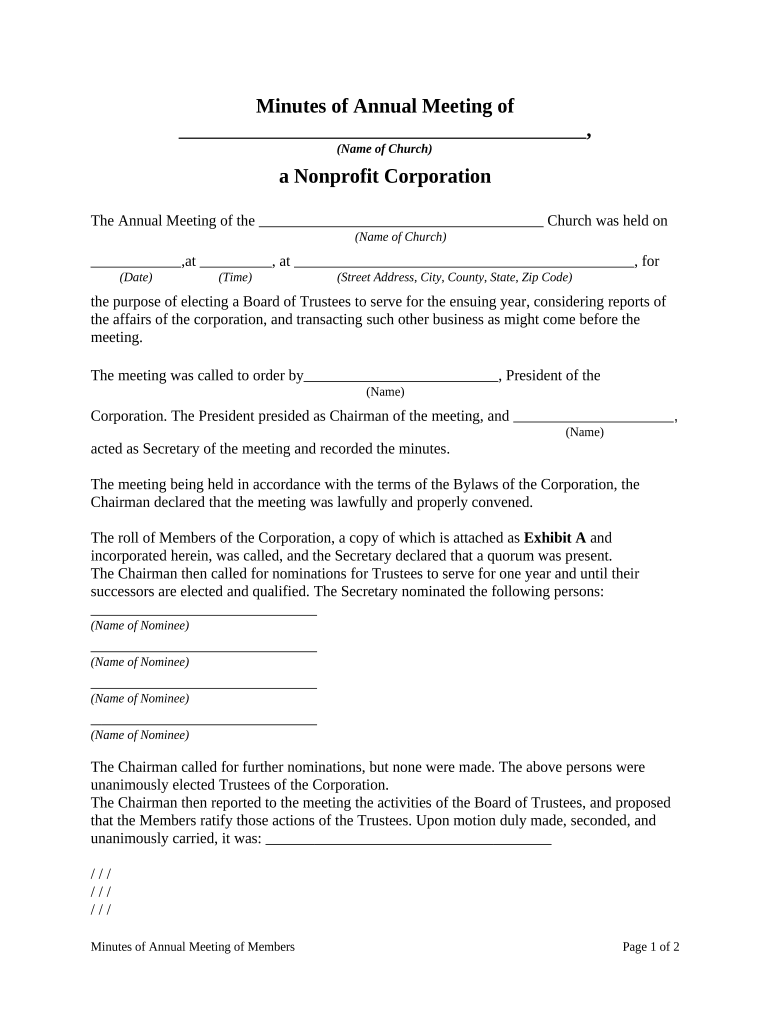
Minutes create a legal and historical record of corporate decisions, reduce disputes about authority or intent, and demonstrate compliance with bylaws and fiduciary duties; they also support financial audits, regulatory reviews, and third-party reliance when needed.

The primary users include corporate secretaries, board chairs, corporate counsel, and officers who record and approve minutes.
The Corporate Secretary prepares or supervises drafting of the minutes, ensures they follow bylaws, and stores certified copies in the official records. The secretary often circulates drafts for review before final approval.
The Board Chair recaps meeting decisions and typically certifies or signs the approved minutes to confirm accuracy and the meeting's legitimacy under the bylaws.
Company name, meeting type (annual), meeting date, time, and physical or virtual location clearly identified at the top of the document.
Full list of directors, officers, invited guests, and proxies; note quorum status and any absences to support action validity.
Concise itemization of each agenda item and the substance of discussion, focusing on decisions and actions rather than verbatim dialogue.
Exact resolution language, who moved/seconded, and outcome of votes, including counts for, against, and abstentions when applicable.
Record whether votes were by voice, show of hands, roll call, or written ballot and note any recusals or conflicts of interest.
Signature block for the officer or secretary certifying the minutes as true and accurate, with the signature date and title.
| Field | Configuration |
|---|---|
| Document Type | PDF/A final format |
| Signature Method | Electronic signature with audit trail |
| Authentication | Email link or optional SMS code |
| Storage Policy | Encrypted cloud; retained per retention schedule |
Choose a platform that supports common formats, secure signatures, and integrations your organization uses.
Store final signed minutes as tamper-evident PDFs and ensure your provider meets required compliance frameworks for your industry.
Prepare minutes promptly after the meeting, commonly within 7–14 days.
Minutes are usually approved at the next regular or special board meeting.
Circulate draft minutes to board members for review within a reasonable corporate timeframe.
File only corporate actions that require state filings; minutes themselves usually remain internal records.
Retention periods are counted from the meeting date or approval date, per policy.
Establish agenda and distribute notice as required by bylaws.
Hold the annual meeting and record attendance and actions.
Prepare a factual draft promptly after adjournment.
Obtain approval, sign the minutes, and archive under retention policy.
Their team adopted standardized minutes templates to improve consistency and auditability.
A small real estate company moved to electronic minutes and remote signatures to avoid delays.
| signNow | DocuSign | Adobe Sign | PandaDoc | HelloSign | |
|---|---|---|---|---|---|
| Starting Price | $8/user/mo | $15/user/mo | $14/user/mo | $19/user/mo | $15/user/mo |
| Free Trial | 7-day free trial | Varies by plan | Varies by plan | Varies by plan | Varies by plan |
| Bulk Send | Yes | Yes | Yes | Yes | Varies |
| Audit Trail | Yes | Yes | Yes | Yes | Yes |
| HIPAA Compliant | Yes | Yes | Yes | No | No |
| Envelope Cap | No cap | 100 envelopes/user/year | Varies | Varies | Varies |