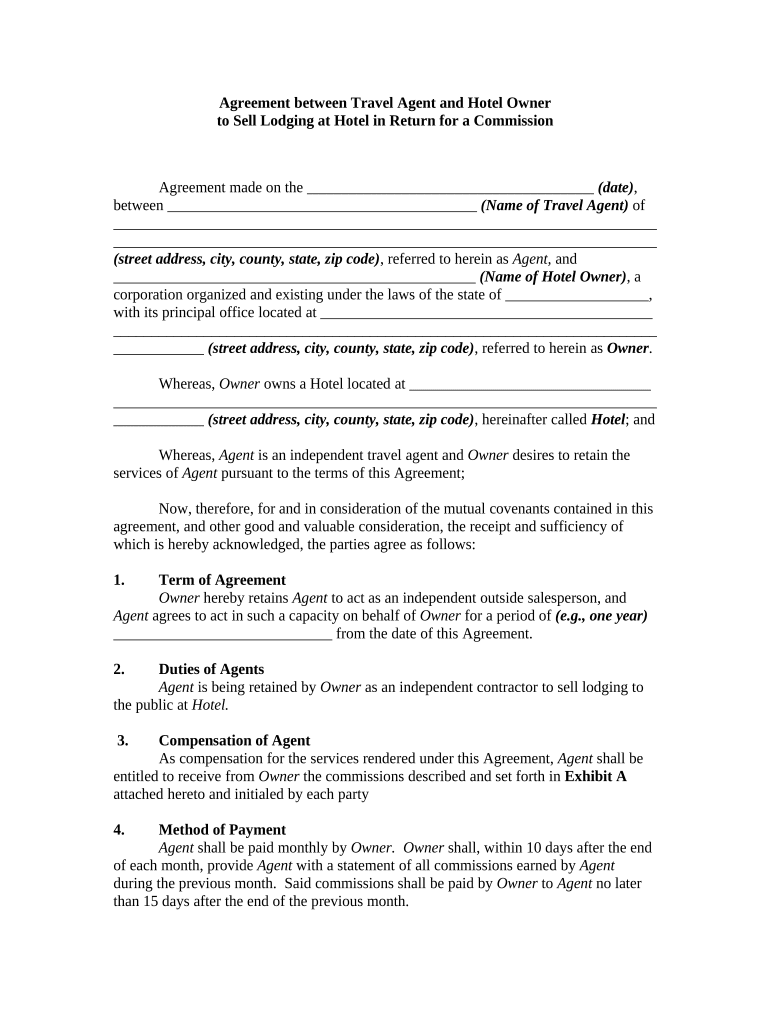
Travel Agreement
What a Travel Agreement Is and when it’s used
Why a clear Travel Agreement matters
A clear Travel Agreement reduces misunderstandings by documenting obligations, timelines, and financial terms in writing. It protects travelers and providers by allocating risk, describing cancellation and refund rules, and specifying documentation requirements such as passports or medical waivers.
Who typically prepares and signs a Travel Agreement
Travel Agreements are used by organizations and individuals arranging travel, and by legal or administrative staff who approve bookings.
- Travel managers and agencies handling bookings and supplier terms.
- Parents or legal guardians consenting to minor travel arrangements.
- Employers or HR teams arranging business travel and expense rules.
Signers should be the authorized party (traveler, guardian, employer designee) and must provide accurate identification and payment authorization to avoid processing delays.
Primary signers and approvers
Traveler
The individual taking the trip. Must provide full legal name, government ID information when asked, and sign to acknowledge terms, health requirements, and payment authorization. For minor travelers, the guardian signs and may need to produce supporting documents.
Organizer
The agency, employer representative, or sponsor who books travel, confirms payments, and accepts responsibility for applicable supplier terms. The organizer signs to confirm services to be provided and any limitations of liability.
Common risks and legal consequences
Frequent preparation mistakes to avoid
- Using informal language that leaves cancellation and refund obligations unclear, creating later disputes over fees and credits.
- Failing to list exact trip dates and times, which can void coverage or cause supplier rebooking issues.
- Omitting passport or visa requirements for international travel, leaving travelers unsupported when denied boarding.
- Not verifying signatory authority for corporate bookings, leading to later rejection of reimbursement or contract enforcement.
Step-by-step: completing a Travel Agreement
-
01Gather IDs: Collect full legal names and government ID numbers.
-
02Enter trip details: Add departure, return dates, and destinations.
-
03Specify payments: Set fees, deposit, and refund rules clearly.
-
04Sign and store: Sign all parties and retain the final executed copy.
Typical routing and approval flow
-
Drafting: Organizer prepares agreement with trip and payment details.
-
Internal approval: If employer-sponsored, HR or finance reviews terms.
-
Signatures: Traveler and organizer sign; guardian signs for minors.
-
Distribution: Executed copies sent to all parties and stored securely.
How to set up an online signing workflow
| Field | Configuration |
|---|---|
| Authentication method | Email link, SMS code, or KBA depending on risk |
| Signature order | Choose sequential or parallel signing based on role |
| Conditional fields | Show fields only when specific options are selected |
| Notifications | Set reminders and completion alerts for signers |
Compatible platforms and file formats
Travel Agreements should be prepared in standard formats to ensure compatibility with eSigning and recordkeeping systems.
- Integrations: Salesforce, NetSuite, Microsoft 365
- File formats: PDF, DOCX, HTML
- Storage options: Box, Google Drive, Egnyte
Choose a platform that supports industry integrations and produces tamper-evident signed PDFs with detailed audit trails to preserve enforceability and simplify record retrieval.
Key deadlines and timing to include
Booking cut-off date:
State the last date to confirm reservations and avoid late fees.
Cancellation notice period:
Specify number of days required for full or partial refunds.
Payment due date:
List deposit and final payment due dates (MM/DD/YYYY).
Document delivery:
Indicate how and when itineraries, tickets, or visas will be provided.
Claims window:
Specify deadline for submitting travel claims or refund requests.
Comparison: eSignature pricing and key features
| signNow | DocuSign | Adobe Sign | PandaDoc | HelloSign | |
|---|---|---|---|---|---|
| Starting Price | $8/user/mo | $15/user/mo | $14/user/mo | $19/user/mo | $15/user/mo |
| Free Trial | 7-day free trial | Varies by vendor | Varies by vendor | Varies by vendor | Varies by vendor |
| Bulk Send | Yes (plan-dependent) | Yes (plan-dependent) | Yes | Yes | Varies |
| Audit Trail | Yes | Yes | Yes | Yes | Yes |
| HIPAA Compliant | Yes (BAA) | Varies by plan | Varies by plan | Varies by plan | Varies by plan |
Practical tips for accurate, efficient completion
Real-world examples of Travel Agreement use
Martin Properties
Martin Properties needed repeatable remote approvals for employee relocations and group travel.
- They standardized one Travel Agreement for all moves.
- The team reported consistent execution across mobile and desktop, reduced turnaround time, and clearer reimbursement processing for employees and finance teams.
Fertility Centers of Illinois
A healthcare provider needed secure consent and travel arrangements for patient transfers.
- They required HIPAA controls and audit trails.
- By adopting an eSigning workflow with integrated privacy controls, they retained compliant records and simplified coordination between clinics and transport vendors.
Frequently asked questions about Travel Agreements and eSigning
-
Are electronic signatures legally valid?
Yes. Electronic signatures are legally enforceable under the federal ESIGN Act (15 U.S.C. ch. 96) and state UETA laws where adopted, provided intent, consent, attribution, and retention are present.
-
When is notarization required?
Most Travel Agreements do not require notarization. Notarization is required only when a specific legal form needs it (for example, parental consent in some jurisdictions or powers of attorney). Check state notary rules.
-
Can minors travel on a signed agreement?
Minor travel typically requires guardian consent and sometimes notarization; airline and border rules vary. Include guardian details and consider notarization if requested by carriers or authorities.
-
How do I revoke or amend a signed agreement?
Amendments should be executed in writing and signed by all parties. To revoke, follow termination clauses in the agreement; a unilateral change without consent usually is ineffective.
-
Is remote notarization acceptable?
Many states permit Remote Online Notarization (RON) with identity proofing and recorded audio-video; state rules differ, so verify the applicable state's notary law before relying on RON.
-
How should executed agreements be stored?
Store tamper-evident signed PDFs with audit trails in a secure repository and retain them per retention policy and any applicable statutes, such as IRS or HIPAA rules.