Establishing secure connection…Loading editor…Preparing document…

Alabama Conservatorship

This template is fully customizable. Edit the text, fill out the fields, and send it for signature. Give it a try!
Alabama Conservatorship

What an Alabama Conservatorship Is and When It's Used

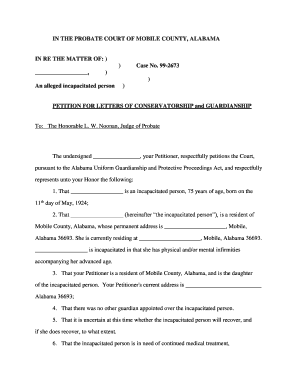
An Alabama Conservatorship is a court-supervised legal arrangement in which a judge appoints a conservator to manage the personal care, financial affairs, or both, of an adult who cannot manage those matters independently due to incapacity. The process begins with a petition to the probate court and typically requires evidence of incapacity, notice to interested parties, and a court hearing. Conservatorship scope can be limited or plenary, covering specific assets or decisions. This guide explains the document components, filing pathway, e-signature options, and practical steps for completing a conservatorship petition in Alabama.

Why a Formal Conservatorship Matters

Establishing an Alabama Conservatorship provides court-authorized decision-making for individuals lacking capacity, protects assets, and clarifies responsibilities for care providers and family. It creates enforceable duties for the conservator and judicial oversight to reduce financial abuse and ensure lawful administration of the protected person's affairs.

Why a Formal Conservatorship Matters

Who Typically Prepares or Signs Conservatorship Papers

Typical users include family members, attorneys, and healthcare or financial professionals seeking to formalize decision authority for an incapacitated adult.

  • Family members pursuing legal authority to manage care and finances.
  • Private attorneys preparing the probate petition and supporting legal documentation.
  • Healthcare providers or financial advisors supplying medical affidavits or asset inventories.

Step-by-Step: Preparing and Filing an Alabama Conservatorship

Follow these steps to complete and file an Alabama Conservatorship petition, from document preparation to final court appointment and post-appointment reporting obligations.

  • 01
    Prepare Petition: Draft petition with all required facts and attached medical evidence.
  • 02
    Serve Notice: Provide notice to the protected person and interested parties per local rules.
  • 03
    Court Hearing: Attend hearing; present evidence and witness testimony as ordered.
  • 04
    Post-Appointment: File inventories and periodic reports as required by the court.

How Electronic Workflows Can Support Petition Assembly

Electronic submission and eSignature integration can streamline petition assembly, notarization, and document service where permitted by state law and local court rules.

  • Upload Documents: Scan petitions, medical affidavits, and financial exhibits.
  • Place Fields: Add signature, date, and initial fields for required signers.
  • Authenticate Signers: Use ID verification, email, or court-prescribed methods.
  • Export PDF: Generate signed PDF with audit trail for filing.

Setting Up an eSignature Workflow for Court-Ready Filings

Configure an electronic workflow to collect signatures, attach exhibits, authenticate signers, and produce a court-ready PDF with audit metadata.

Field Configuration
Document Upload Document Upload | PDF with numbered exhibits
Signature Fields Signature Fields | Signature, date, initials, witness
Authentication Authentication | Email plus ID verification option
File Export File Export | Signed PDF with embedded audit trail
Notifications Notifications | Email copies to petitioner and counsel

Technical Requirements for eSigning and eFiling

E-signature platforms must support notarization, signer authentication, and export of court-ready PDFs to align with probate procedures.

  • Formats: PDF/A and Word DOCX supported.
  • Integrations: Works with case management and cloud storage.
  • Notarization: Remote notarization where permitted.

Core Components Every Conservatorship Petition Should Include

A professional Alabama Conservatorship petition includes verified petitioner details, a medical capacity record, asset inventory, proposed powers, notice evidence, and clear signature and verification sections for the court.

Petition Details

State the petitioner’s relationship, contact details, legal capacity to petition, and the specific orders requested. Include the statutory basis for venue and any jurisdictional facts to support probate court jurisdiction.
Medical Evidence

Attach physician affidavits, capacity evaluations, or hospital records that describe diagnosis, prognosis, and functional limitations. Timely, contemporaneous medical documentation strengthens the petition and assists the court’s decision.

Asset Inventory

Provide a detailed list of the protected party’s assets and liabilities with approximate values, account numbers, and supporting statements. The court uses this to set bond and oversight requirements.

Proposed Powers

Specify whether the conservator will have authority over finances, healthcare decisions, or limited powers. Clear delineation prevents later disputes and guides the conservator’s fiduciary duties and reporting obligations.

Notice & Service

Document proof of service to the protected person, next of kin, and interested parties. Use certified mail, personal delivery, or court-approved methods and attach return receipts or affidavits of service.

Signatures & Notary

Include signature blocks for petitioner, proposed conservator, medical report affidavits, and any required witnesses. Notarization or in-court affirmation may be required by the local probate rules.

Security and Compliance Considerations for Conservatorship Documents

Encryption: TLS 1.2/1.3 in transit; AES-256 at rest.
HIPAA: HIPAA-compliant workflows; BAA required.
Audit Trail: Timestamped actions and IP logs.
Authentication: Multi-factor and ID verification options.
Access Controls: Role-based permissions and SSO support.
Compliance: ESIGN, UETA, and 21 CFR support.

Common Pitfalls to Avoid When Preparing Conservatorship Papers

  • Incomplete medical affidavits often lead to adjournments; secure contemporaneous evaluations and clearly state functional limitations to avoid repeated requests from the court.
  • Incorrect party names, mismatched identifiers, or missing account numbers delay asset inventories and can trigger additional subpoenas or bond increases during administration.
  • Failure to properly serve notice to all interested parties can invalidate proceedings; follow local rules for personal service, certified mail, or publication as directed.
  • Using an unsigned or improperly notarized medical affidavit risks rejection; verify notary, signature dates, and that physicians sign in the presence of required witnesses.

Consequences of Inaccurate or Incomplete Conservatorship Filings

Delay Risks: Court continuances and added costs.
Wrong Party: Invalid service; voided orders.
Insufficient Evidence: Petition denial risk.
Financial Abuse: Improper asset management exposure.
Noncompliance: Fines or removal of conservator.
Signature Issues: Unaccepted e-signatures may be rejected.

Typical Deadlines and Court-Required Timelines

Key timelines vary by county; common deadlines include initial petition service, medical affidavits, inventories, bond posting, and periodic reporting schedules set by the probate court.

Petition Service:

Serve within local rule timeframes; commonly weeks before hearing.

Medical Evidence:

Obtain and file timely medical affidavits before hearing.

Inventory Filing:

File asset inventory within court-ordered timeframe.

Bond Posting:

Post bond if required prior to authority exercise.

Periodic Reports:

Submit accountings and status reports per court schedule.

Key Processing Milestones from Petition to Appointment

Milestone timeline from petition to appointment outlines docketing, service, hearing, and initial conservator duties after court order.

01

File Petition

Submit petition and exhibits with the probate clerk.

02

Serve Parties

Provide notice to the protected person and interested parties.

03

Attend Hearing

Present evidence; court decides on appointment.

04

Begin Duties

Conservator inventories assets and follows reporting obligations.

Representative Scenarios Illustrating Common Outcomes

Real-world examples illustrate common conservatorship scenarios, showing petition preparation, evidence gathering, and court outcomes tied to procedural completeness.

Family Petition

A daughter petitioned for conservatorship after her father’s stroke, collecting medical reports and bank statements to support urgency and asset protection.

  • Court appointed conservator with limited financial powers.
  • Timely service and detailed inventories reduced the need for bond increases and allowed the conservator to stabilize accounts, pay urgent bills, and coordinate healthcare decisions while reporting regularly to the probate court.

Attorney-led Petition

An attorney filed a conservatorship for an incapacitated client, assembling forensic accounting and physician affidavits to address contested notices from siblings.

  • Court required limited bond and monitoring.
  • Clear documentation, counsel-led service, and court-ready exhibits resolved disputes efficiently; the conservator provided annual accountings and followed court instructions, avoiding removal or sanctions during ongoing oversight.

eSignature Pricing and Capability Snapshot for Conservatorship Workflows

Comparative pricing and capabilities for eSignature vendors relevant to filing and executing an Alabama Conservatorship petition, with signNow listed first per platform features.

signNow DocuSign Adobe Sign PandaDoc HelloSign
Starting Price $8/user/mo $15/user/mo $14/user/mo $19/user/mo $15/user/mo
Free Trial 7-day free trial Varies Varies Varies Varies
Bulk Send Yes Yes Yes Yes No
Audit Trail Yes Yes Yes Yes Yes
HIPAA Compliant Yes Yes Yes No No

Frequently Asked Questions and Troubleshooting

Answers to common questions about completing, e-signing, notarizing, and filing an Alabama Conservatorship petition, plus troubleshooting for common document errors.


Need help? Contact support

be ready to get more
Join over 28 million airSlate SignNow users