Inf or m ation on Wri t P roc eedi ngs in M isde m eanor ,
In fra ction, a nd Li m ited C ivil Ca ses
___ ___ __ ___ __ ___ __ __ ___ __ ___ __ ___ __ __ ___ __ ___ __ ___ __ __ ___ __ ___ __ ___ __ __ ___ __
Inf or m ation on W rit Proceed ings i n APP-150-INFO, Page 1 of 12
Misde m eanor , Inf raction, and Lim ited Civil Cases
AP P -150 -INF O
Rev. July 1, 201 0, Optional Form California Rules of Court, rules 8.930–8.936
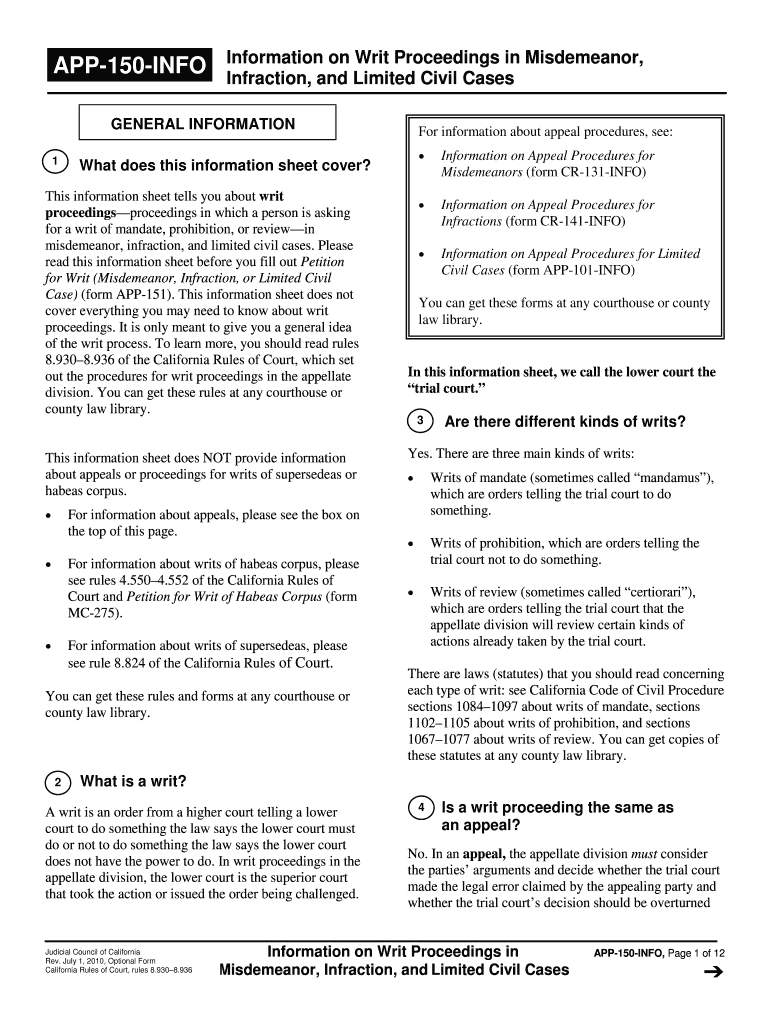
This information s he et tells you about writ
proc eed ings— proc eeding s in w hich a person is asking
for a w rit of m anda te, proh ibition, o r review— in
misde meanor , infraction, a nd l imited c ivil cases. P lease
read this information she et be fore you fill o ut Petition
for W rit (Misdem eano r, In frac tion, or Limited C ivil
Case) (fo rm A PP-151) . T his informatio n s he et doe s no t
cov er everything you m ay ne ed to k now abou t w rit
proc eeding s. It is onl y m eant to give you a g ene ral ide a
of the writ proc ess. To l ear n m ore, y ou s houl d read rules
8.930 –8.93 6 of the C alifornia R ules of C ou rt, w hich set
out the proc edur es for w rit proc eeding s in t he appe llate
division. You c an g et the se rules at any cou rtho use or
This inf ormation she et do es N OT pr ov ide information
about appe als or p roc eed ings f or w rits of supe rsed eas or
ha be as corpus .
• For information a bout appe als, pl ease see the box on
the top o f this pa ge.
• For information a bout w rits of ha beas corpus , p lease
see rules 4.55 0–4.55 2 of the C alifornia R ules of
Cour t and Petition f or W rit of H abe as C orpu s (for m
MC -275) .
• For information a bout w rits of sup ersede as, p lease
see rule 8.824 of the C alifornia R ules of C our t.
You c an g et the se r ules and form s at any cour thous e or
A writ is an or de r from a hi ghe r cour t telling a low er
cour t to do s om ething the law says the low er cou rt m ust
do or no t to do som ething the law says the low er court
doe s no t ha ve the pow er to do. I n w rit pr oceeding s in the
appe llate di vision, t he low er cou rt is the supe rior court
tha t took the action o r issue d t he orde r be ing cha lleng ed.
In th is infor ma tion sh eet, we cal l the lower cou rt the
“trial cou rt.”
Yes. The re a re three m ain k inds of w rits:
• Wr its of m anda te ( som etimes ca lled “ manda mus”),
which a re orde rs telling the trial cou rt to do
som ething .
• W rits of proh ibition, w hich are orde rs telling the
trial cou rt not to do som ething .
• Wr its of r ev iew (som etimes c alled “ce rtiorari”),
which a re orde rs telling the trial cou rt tha t the
appe llate d ivision w ill rev iew cer tain k inds of
act ions already tak en by the trial cou rt.
The re are l aws ( statutes) that you s hou ld r ead conc erning
each type of w rit: see C aliforni a C ode of C ivil Proced ure
sect ion s 1084 –1097 a bou t writs of m anda te, section s
1102 –1105 abou t w rits of prohi bition, and sections
1067 –1077 abou t w rits of review. Y ou c an g et cop ies of
No. In a n ap pe al, the app ellate di vision must cons ide r
the parties’ argum ent s and de cide w he the r the t rial cou rt
made the leg al er ror cl aimed by the app ealing pa rty an d
whe the r the trial cour t’s de cision s houl d be ov erturne d
W ha t doe s thi s inf or m ation s he et cove r?
W hat is a writ?
Are t her e d iffer en t ki nds o f writs?
Is a writ p roce ed ing the sam e a s
an a ppe al?
1
2
3
4
For inform ation a bout appe al proc edur es, see:
• Information on A ppe al Procedur es for
Misde mean ors (fo rm C R-131 -INF O)
• Information on A ppe al Procedur es for
Infrac tion s (for m C R-141 -INF O)
• Information on A ppe al Procedur es for Lim ited
Ci vil Cas es (for m AP P-101-INF O)
You c an g et the se forms at any cour thous e or coun ty
GE NERAL IN FOR M ATION
count y law library.
count y law library.
the se s tatutes at any coun ty law library.
Judicial Council of California
law library.
Information on Writ Proceedings in Misdemeanor,
Infraction, and Limited Civil Cases
___________________________________________________________________________ _
Rev. July 1, 2010 Information on Writ Proceedings in APP-150- INFO, Page 2 of 12
Misdemeanor, Infraction, and
Limited Civil Cases
APP -150 -INFO
based on that error (this is called a “decision on the
merits”). In a writ proceeding , the appellate division is
not required to make a decision on the merits; even if the
trial court made a legal error, the appellate division can
decide not to consider that error now, but to wait and
consider the error as part of any appeal from the final
judgment. Most requests for writs are denied without a
decision on the merits (this is called a “summary
denial”). Becaus e of this, appeals are the ordinary way
that decisions made by a trial court are reviewed and
w rit proceedings are often called proceedings for
“extraordinary” relief.
Appeals and writ proceedings are also used to review
different kinds of decisions by the trial court. Appeals
can be used only to review a trial court’s final judgment
and a few kinds of orders. Most rulings made by a trial
court before it issues its final judgment cannot be
appealed right away; they can only be appealed after the
trial cour t case is over, as part of an appeal of the final
judgment. Unlike appeals, writ proceedings can be used
to ask for review of certain kinds of important rulings
made by a trial court before it issues its final judgment.
No. A writ proceeding is NOT a new trial . The
appellate division will not consider new evidence, such
as the testimony of new witnesses. Instead, if it does not
summarily deny the request for a writ, the appellate
division reviews a record of what happened in the trial
court and the tr ial court’s ruling to see if the trial court
made the legal error claimed by the person asking for the
writ. When it conducts its review, the appellate division
presumes that the trial court’s ruling is correct; the
person who requests the writ must show t he appellate
division that the trial court made the legal error the
person is claiming.
No.
Writs can only address certain legal errors: Writs can
only address the following types of legal errors made by
a trial court:
• The trial court has a legal du ty to act but:
o Refuses to act
o Has not done what the law says it must do
o Has acted in a way the law says it does not have
the power to act
• The trial court has performed or says it is going to
perform a judicial function (like deciding a person’s
rights und er law in a particular case) in a way that
the court does not have the legal power to do.
There must be no other adequate remedy: The trial
court’s error must also be something that can be fixed
only with a writ. The person asking for the writ must
show t he appellate division that there is no adequate way
to address the trial court’s error other than with the writ
(this is called having “no adequate remedy at law”). As
mentioned above, appeals are the ordinary way that trial
court decisions are reviewed. I f the trial court’s ruling
can be appealed, the appellate division will generally
consider an appeal to be good enough (an “adequate
remedy”) unless the person asking for the writ can show
the appellate division that he or she will be harmed in a
way that cannot be fixed by the appeal if the appellate
division does not issue the writ (this is called
“irreparable” injury or harm).
Statutory writs : There are laws (statutes) that provide
that certain kinds of rulings can or must be challenged
using a writ pro ceeding. These are called “statutory
writs.” Here is a list of some of the most common
rulings that a statute says can or must be challenged
using a writ:
• A ruling on a motion to disqualify a judge (see
California Code of Civil Procedure section 170.3(d))
• Denial of a motion for summary judgment (see
California Code of Civil Procedure section
437c(m)(l))
• A ruling on a motion for summary adjudication of
issues (see California Code of Civi l Procedure
section 437c(m)(l))
• Denial of a stay in an unlawful deta iner matter (see
California Code o f Civil Procedure section 1176)
• An order disqualifying the prosecuting attorne y (see
California Penal Code section 1424)
Is a writ proceeding a new trial ?
Can a writ be used to address any
errors made by a trial cou rt?
5
6
Information on Writ Proceedings in Misdemeanor,
Infraction, and Limited Civil Cases
___________________________________________________________________________ _
Rev. July 1, 2010 Information on Writ Proceedings in APP-150- INFO, Page 3 of 12
Misdemeanor, Infraction, and
Limited Civil Cases
APP -150 -INFO
You can get copies of these statutes at any county law
library or online at www.leginfo.ca.gov/calaw.html. You
will need to check whether there is a statute providing
that the specific ruling you want to challenge can or
must be reviewed using a writ proceeding. (Note that
just because there is a statute requiring or allowing you
to ask for a writ to ch allenge a ruling does not mean that
the court must grant your request; the appellate division
can still deny a request for a statutory writ.)
Common law w rits: Even if there is not a statute
specifically providing for a writ proceeding to challenge
a part icular ruling, most trial court rulings other than the
final judgment can potentially be challenged using a writ
proceeding if the trial court made the type of legal error
described above and the petitioner has no other adequate
remedy at law. These writs are called “common law”
writs.
No. Different courts have the power (called
“jurisdiction”) to consider requests for writs in different
types of cases. The appellate division can only consider
requests for writs in limited civil, misdemeanor, and
infr action cases. A limited civil case is a civil case in
which the amount claimed is $25,000 or less (see
California Code of Civil Procedure sections 85 and 88).
Misdemeanor cases are cases in which a person has been
charged with or convicted of a crime for which the
punishment can include jail time of up to one year but
not time in state prison (see California Penal Code
sections 17 and 19.2 ). (If the person was also charged
with or convicted of a felony in the same case, it is
considered a felony case, not a misdemeanor case.)
Infraction cases are cases in which a person has been
charged with or convicted of a crime for which the
punishment can be a fine, traffic school, or some form of
community service but cannot include any time in jail or
prison (see Cal ifornia Penal Code sections 17 and 19.8).
Examples of infractions include traffic tickets or
citations for violations of some city or county
ordinances. (If a person was also charged with or
convicted of a misdemeanor in the same case, it is
considered a m isdemeanor case, not an infraction case.)
You can get copies of these statutes at any county law
library or online at www.leginfo.ca.gov/calaw.html.
The appellate division does NOT have jurisdiction to
consider requests for writs in either unlimited civil
cases
(civil cases in which the amount claimed is more than
$25,000) or felony cases (cases in which a person has
been charged with or convicted of a crime for which the
punishment can include time in state prison). R equests
for writs in these cases can b e made in the Court of
Appeal. The appellate division also does NOT have the
jurisdiction to consider requests for writs of habeas
corpus; requests for these writs can be made in the
superior court.
If you are asking for the writ, you are called the
PETITIONER. You should read “Information for the
Petition er,” beginning on page 4 .
T he court the petitioner is asking to be ordered to do or
not to do something is called the RESPONDENT. In
appellate division writ proceedings, the trial court is the
respo ndent.
Any other party in the trial court case who would be
affected by a ruling regarding the request for a writ is a
REAL PARTY IN INTEREST. If you are a real party in
interest, you should read “Information for a Real Party in
Interest,” begin ning on page 9.
You do not have to have a lawyer; you are allowed to
represent yourself in a writ proceeding in the appellate
division. But writ proceedings can be very complicated
and you will have to follow the same rules that lawyers
have to follow . If you have any questions about the writ
procedures, you should talk to a lawyer. In limited civil
cases and infraction cases, you must hire a lawyer at
your own expense if you want one (the court cannot
provide one). You can get information about finding a
lawy er on the California Courts Online Self -Help Center
at www.courtinfo.ca.gov/selfhelp/lowcost.
Can the appellate division consider a
request for a writ in any case?
Who are the parties in a writ proceeding?
Do I need a lawyer to represent me in
a writ proceeding?
7
8
9
Inf or m ation on Wri t P roc eedi ngs in M isde m eanor ,
Inf raction, a nd Li m ited C ivil Ca ses
___ ___ __ ___ __ ___ __ __ ___ __ ___ __ ___ __ __ ___ __ ___ __ ___ __ __ ___ __ ___ __ ___ __ __ ___ __
Rev. July 1, 201 0 Inf or m ation on W rit P roceedi ng s in APP-150-INFO, Page 4 of 12
Misd em ean or, Inf raction, and Lim ited Civil Cases
AP P -150 -INF O
This part of the informatio n she et is w ritten f or the
pe titione r— the pa rty asking for the w rit. It expl ains
som e of the rules and p roc edur es relating to ask ing for a
writ. The information m ay also be he lpful to a real party
in i nterest. There is m ore in formation for a real pa rty in
interest starting on pa ge 9 of this information s he et.
Only a pa rty in t he trial c ou rt p roc eeding — the plaint iff
or de fend ant in a ci vil ca se or the de fend ant or
prosecuting agenc y in a m isde meanor or infraction
case — can ask for a w rit ch alleng ing a r uling on a
motion t o d isqu alify a judg e (see C alifornia C od e of
Civil Procedu re section 170 .3( d)). P arties are a lso
usua lly the onl y one s tha t ask for w rits cha lleng ing ot her
kinds of trial cou rt ruling s. How ever, in m ost cases, a
pe rson w ho w as not a pa rty doe s h av e t he leg al right to
ask for a w rit if tha t pe rson ha s a “be neficial interest ” i n
the trial cou rt’s ruling . A “b en eficial interest” m eans that
the person ha s a s pe cific right or interest affected by the
ruling tha t goe s be yond t he gene ral rights or interest s t he
publ ic m ay ha ve in t he ruling .
To ask for a w rit you m ust ser ve and file a pe tition fo r a
writ (see be low for an e xp lana tion o f how to “ serve and
file” a pe tition). A petition is a f ormal req ue st tha t the
appe llate d ivision i ssu e a w rit. A pe tition for a w rit
expl ains to the appe llate di vision w ha t ha ppe ne d i n the
trial cou rt, w hat legal e rror you ( the petitione r) be lieve
the trial cou rt m ade , w hy you ha ve no o the r ade qua te
remedy at law, a nd w ha t or de r you a re reque sting the
appe llate d ivision t o m ak e.
If you a re r epre sen ted by a l aw yer, y our law yer w ill
prepa re your petition for a writ. If you a re not
represented by a lawyer, y ou m ust us e Petition f or W rit
(Misde meanor , Infrac tion, or Limited C ivil C ase) (form
AP P-151) to p repare your petition. Y ou c an g et form
you t o f ill in the informatio n t ha t ne eds to be in a w rit
pe tition.
a. Descr ipt ion of your int er est in t he t rial
cour t’s ruling
Your pe tition ne eds to t ell the app ellate di vision w hy
you ha ve a r ight to a sk for a w rit in the ca se. A s
discu ssed a bov e, usua lly on ly a pe rson w ho w as a pa rty
in t he t rial cour t case — the pl aint iff or de fenda nt in a
civil case or the de fenda nt or prosecuting agenc y in a
misde meanor or i nfraction case — ask s f or a w rit
cha lleng ing a r uling in t hat case. I f you w ere a pa rty in
the trial cou rt case, say that in y our pe tition. I f you w ere
not a party, y ou w ill need to de scribe w ha t “bene ficial
interest” you ha ve in t he trial court’s ruling . A
“be ne ficial interest” m eans tha t you ha ve a spe cific r ight
or i nterest affect ed by the ruling that goe s beyond t he
gene ral rights or interest s t he publ ic m ay ha ve i n t he
ruling . T o show the appe llate division that you ha ve a
be ne ficial interest in t he ruling you w ant to c ha lleng e,
you must de scribe how the ruling w ill affect you i n a
direct and n eg ative w ay .
b. Descr ipt ion o f the legal er ror you bel iev e t he
trial cou rt m ade
Your pe titio n w ill n eed to t ell the appe llate di vision w ha t
leg al error you be liev e t he trial co urt m ade . N ot ev ery
mistak e a t rial cou rt m ight m ake can be ad dre sse d by a
writ. Y ou m ust show tha t the trial court m ade one of the
follow ing type s of legal errors:
• The trial c ourt ha s a legal d uty to a ct bu t:
o Refuses t o a ct
o Has not do ne w hat the law say s i t m ust do
o Has ac ted in a w ay the l aw say s i t doe s not ha ve
the pow er to a ct
• The trial court ha s pe rformed or says it is going to
pe rform a jud icial func tion (like de ciding a pe rson ’s
rights unde r law in a pa rticular case) in a w ay tha t
the cour t doe s no t ha ve the legal pow er to do.
To show the app ellate division t ha t the trial c our t m ade
one of the se legal errors, y ou w ill ne ed t o:
• Show tha t the trial cour t has the legal dut y or the
pow er to a ct or no t act in a pa rticular w ay. Y ou w ill
ne ed to t ell the ap pe llate d ivision w ha t leg al
W ho can as k f or a writ?
How do I a sk for a writ?
How do I pr epa re a writ p etition?
10
11
12
IN FOR M ATION F OR T HE P ETIT ION ER
This form ask s
AP P-151 a t any cou rtho use or cou nty law library.
Information on Writ Proceedings in Misdemeanor,
Infraction, and Limited Civil Cases
___________________________________________________________________________ _
Rev. July 1, 2010 Information on Writ Proceedings in APP-150- INFO, Page 5 of 12
Misdemeanor, Infraction, and
Limited Civil Cases
APP -150 -INFO
authority —what constitutional provi sion, statute,
rule, or published court decision—establishes the
trial court’s legal duty or power to act or not act in
that way.
• Show the appellate division that the trial court has
not acted in the way that this legal authority says the
court is require d to act. You will need to tell the
appellate division exactly where in the record of
what happened in the trial court it shows that the
trial court did not act in the way it was required to.
c . Description of why you need the writ
One of the most import ant parts of your petition is
explaining to the appellate division why you need the
writ you have requested. Remember, the appellate
division does not have to grant your petition just because
the trial court made an error. You must convince the
appellate d ivision that it is important for it to issue the
writ.
Your petition needs to show that a writ is the only way
to fix the trial court’s error . To convince the court you
need the writ , you will need to show the appellate
division that you have no way to fi x the trial court’s
error other than through a writ (this is called having “no
adequate remedy at law”).
This will be hard if the tria l court’s ruling can be
appealed. If the ruling you are challenging can be
appealed, either immediately or as part of an appeal of
the final judgment in your case, the appellate division
will generally consider this appeal to be a good enough
way to fix the trial court’s ruling (an “adequate
remedy”). To be able to explain to the appellate division
why you do not have an ade quate remedy at law, you
will need to find out if the ruling you want to challenge
can be appealed, either immediately or as part of an
appeal of the final judgment .
Here are some trial court rulings that can be appealed.
There are laws (statutes) that sa y that certain kinds of
trial court rulings (“orders”) can be appealed
immediately. In limited civil cases, California Code of
Civil Procedure section 904.2 lists orders that can be
appealed immediately, including orders:
• Changing or refusing to ch ange the place of trial
(venue)
• Granting a motion to quash ser vice of summons
• Granting a motion to stay or dismiss the act ion on
t he ground of inconvenient forum
• Granting a new trial
• Denying a motion for judgm ent notwithstanding the
verdict
• Granting or dissol ving an injunction or refusing to
grant or dissolve an injunction
• Appointing a receiver
• Made after final judgment in the case
In misdemeanor and infraction cases, orders made after
the final judgment that affect the substantial rights of the
defendant can be appealed immedia tely (California
Penal Code section 1466) .
In misdemeanor cases, o rders granting or denying a
motion to suppress evidence c an also be appealed
immediately (California Penal Code section 1538.5(j)) .
You can get copies of these statut es at any county law
library or online at www.leginfo.ca.gov/calaw.html. You
should also check to see if there are published court
decisions that indicate whether you can or must use an
appeal or a writ petition to challenge the type of ruling
you want to challenge in your case.
If the ruling can be appealed, you will need to show
that an appeal will not fix the trial court’s error . If the
trial court ruling you want to challenge can be appealed,
you will need to show the appellate division why that
appeal is not good enough to fix the trial court’s error.
To do that, you will need to show the appellate division
how you will be harmed by the trial court’s error in a
way that cannot be fixed by the appeal if the appellate
division does not issue the writ (this is called
“irreparable” injury or harm ). For example, because of
the time it takes for an appeal, the harm you want to
prevent may happen before an appeal can be finished.
Information on Writ Proceedings in Misdemeanor,
Infraction, and Limited Civil Cases
___________________________________________________________________________ _
Rev. July 1, 2010 Information on Writ Proceedings in APP-150- INFO, Page 6 of 12
Misdemeanor, Infraction, and
Limited Civil Cases
APP -150 -INFO
d . Description of the order you want the
appellate division to make
Your petit ion needs to describe what you are asking the
appellate division to order the trial court to do or not do.
Writ petitions usually ask that the trial court be ordered
to cancel ( “vacate” ) its ruling, issue a new ruling, or not
take any steps to enforce its ruling.
If you want the appellate division to order the trial court
not to do anything more until the appellate division
decides whether to grant the writ you are requesting, you
must ask for a “stay.” If you want a stay, you should first
ask the trial court for a stay. You should tell the
appellate division whether you asked the trial court for a
stay. If you did not ask the trial court for a stay, you
should tell the appellate division why you did not do
this.
If you ask the appellate division for a st ay, make sure
you also fill out the “Stay r equested” box on the first
page of the Petition for Writ (Misdemeanor, Infraction,
or Limited Civil Case) (form APP-151).
e . Verifying the petition
Petitions for writs must be “verified.” This means that
either the petition er or the petitioner’s attorney must
declare under penalty of perjury that the facts stated in
the petition are true and correct , must sign the petition,
and must indicate the date that the petition was signed.
On the last page of the Petition for Writ (Misdemeanor,
Infraction, or Limited Civil Case) (form APP-151), there
is a place for you to verify your petition.
Y es. Along with the petition, you must serve and file a
record of what happened in the trial court (see below for
an explanati on of how to serve and file the petition).
Since the appellate division judges were not there in the
trial court, a record of what happened must be sent to the
appellate division for its review. The materials that make
up this record are called “supporting documents.”
What needs to be in the supporting documents: The
supporting documents must include:
• A record of what was said in the trial court about the
ruling that you are challenging (this is called the
“oral proceedings”) and
• Copies of certain importa nt documents from the trial
court.
Read below for more information about the se two parts
of the supporting documents.
Record of the oral proceeding s: There are several ways
a record of what was said in the trial court may be
provided to the appellate div ision:
• A transcript —A transcript is a written record (often
called the “verbatim” record) of the oral proceedings
in the trial court. If a court reporter was in the trial
court and made a record of the oral proceedings, you
can have the court reporter prepare a transcript of
those oral proceedings, called a “reporter’s
transcript,” for the appellate division. If a reporter
was not there , but the oral proceedings were
officially recorded on approved electronic recording
equipment, you can have a transcript p repared for
the appellate division from the official electronic
recording of these proceedings. You (the petitioner)
must pay for preparing a transcript, unless the court
orders otherwise.
• A copy of an electronic recording —If the oral
proceedings were off icially recorded on approved
electronic recording equipment, the court has a local
rule for the appellate division permitting this
recording to be used as the record of the oral
proceedings, and all the parties agree ( “stipulate ”), a
copy of the official e lectronic recording itself can be
used as the record of the oral proceedings instead of
a transcript . You (the petitioner) must pay for
preparing a copy of the official electronic recording,
unless the court orders otherwise.
• A summary —If a transcript or official electronic
recording of what was said in the trial court is not
available, your petition must include a declaration (a
statement signed by the petitioner under penalty of
perjury) either:
o Explaining why the transcript or official
electronic recor ding is not available and
providing a fair summary of the proceedings,
Is there anything else that I need to
serve and file with my petition ?
13
Information on Writ Proceedings in Misdemeanor,
Infraction, and Limited Civil Cases
___________________________________________________________________________ _
Rev. July 1, 2010 Information on Writ Proceedings in APP-150- INFO, Page 7 of 12
Misdemeanor, Infraction, and
Limited Civil Cases
APP -150 -INFO
including the petitioner’s arguments and any
statement by the court supporting its ruling or
o Stating that the transcript or electronic recording
has been ordered, the date it was ordered, and
the date it is expected to be filed.
Copies of documents from the trial court : Copies of the
following documents from the trial court must also be
included in the supporting documents:
• The trial court ruling b eing challenged in the petition
• All do cuments and exhibits submitted to the trial
court supporting and opposing the petitioner’s
position
• Any other documents or portions of documents
submitted to the trial court that are necessary for a
complete understanding of the case and of the ruling
bei ng challenged
What if I cannot get copies of the documents from the
trial court because of an emergency? Rule 8.931 of the
California Rules of Court provides that in extraordinary
circumstances the petition may be filed without copies of
the documents from the trial court . If the petition is filed
without these documents, you must explain in your
petition the urgency and the circumstances making the
documents available.
Format of the supporting documents : Supporting
documents must be put in the format required by rule
8.931 of the California Rules of Court . Among other
things, there must be a tab for each document and an
index listing the documents that are included. You
should carefully read rule 8.931. You can get a copy of
rule 8.931 at any courthouse or county law library or
online at www. courtinfo.ca.gov/rules.
Yes. For statutory writs, the statute usually sets the
deadline for serving and filing the petition. Here is a list
of the deadlines for filing petitions for some of the most
common statutory writs (you can get copies of these
statutes at any county law library or online at
www.leginfo.ca.gov/calaw.html ).
Statutory Writ Filing Deadline
Writ challenging a ruling on a
motion to disqualify a judge
(see California Code of Civil
Procedure section 170.3(d)) 10 days after notice
to the parties of the
decision
Writ challenging the denial of
a motion for summary
judgment (see California Code
of Civil Procedure section
437c(m)(l)) 20 days after service
of written notice of
entry of the order
Writ challenging a ruling on a
motion for summary
adjudication of issues (see
California Code of Civil
Procedure section 437c(m)(l)) 20 days after service
of written notice of
entry of the order
For common law writs or statutory writs where the
statute does not set a deadline, you should file the
petition as soon as possible and not later than 30 days
after the court makes the ruling that you are challenging
in the petition. While there is no absolute deadline for
filing these petitions, writ petitions are us ually used
when it is urgent that the trial court’s error be fixed.
Remember, the court is not required to grant your
petition even if the trial court made a n error . If you delay
in filing your petition, it may make the appellate division
think that it is not really urgent that the trial court’s error
be fixed and the appellate division may deny your
petition. If there are extraordinary circumstances that
delayed the filing of your petition, you should explain
these circumstances to the appellate division i n your
petition.
Rule 8.931(d) requires that the petition and one set of
supporting documents be served on any named real party
in interest and that just the petition be served on the
respondent trial court. “Serving” a petition on a party
means tha t you must:
• Have somebody over 18 years old who is not a party
to the case— so not you—mail or deliver (“serve”)
the petition to the real party in interest and the
respondent court in the way required by law .
Is there a deadline to ask for a writ ?
How do I “serve” my petition ?
14
15
Inf or m ation on Wri t P roc eedi ngs in M isde m eanor ,
Inf raction, a nd Li m ited C ivil Ca ses
___ ___ __ ___ __ ___ __ __ ___ __ ___ __ ___ __ __ ___ __ ___ __ ___ __ __ ___ __ ___ __ ___ __ __ ___ __
Rev. July 1, 201 0 Inf or m ation on W rit P roceedi ng s in APP-150-INFO, Page 8 of 12
Misd em ean or, Inf raction, and Lim ited Civil Cases
AP P -150 -INF O
• Mak e a r ecor d t hat the pe tition ha s be en s erved . T his
reco rd is cal led a “proof of ser vice.” Proof of Se rvice
(Appe lla te D ivision) (fo rm A PP-109) can b e us ed t o
make t his r eco rd. The pr oof of service m ust show
who s erved the petition, w ho w as served w ith t he
pe tition, how the pe tition w as served ( by m ail or in
pe rson), and t he date the pe tition w as served.
You c an g et m ore information a bou t how to s erve cou rt
doc um ents and pr oof of service from What Is Proo f of
Se rvice? (form A PP-109 -INF O) and on t he California
Cour ts Online Self-Help C enter at www.c ou rtinfo.c a.go v
/selfhelp/low cos t/getread y.htm#servi ng.
To file a pe tition for a w rit in t he app ellate division, y ou
must br ing or m ail the origina l petition, inc lud ing the
suppor ting doc um ents, a nd the proo f of service to t he
clerk for the appe llate di vision o f th e sup erior cou rt tha t
made the ruling you a re cha lleng ing . If the sup erior cou rt
ha s m ore than one cou rthou se location, you s houl d c all
the clerk at the courthous e whe re the ruling you a re
cha lleng ing w as m ade to ask w he re t o file y our petition.
You s hou ld m ake a copy of all the doc um ents you a re
plann ing to file for your ow n r ecords be fore you f ile
the m w ith t he court. It is a good i de a to b ring or m ail an
extra copy of the pe tition to the clerk w he n y ou f ile your
origina l and a sk t he clerk t o stamp t his copy to show that
the origina l has be en filed.
The re is no f ee to f ile a pe tition for a w rit in a
misde meanor or infraction case, but the re is a fee to file
a pe tition for a w rit in a lim ite d civil case. Y ou shou ld
ask the clerk for the app ellate d ivision w he re y ou a re
filing the pe tition w ha t this fee is. If you c annot afford to
pa y this filing fee, y ou c an ask the co urt to w aive t his
fee. To do t his, y ou m ust fill out an App lication f or
Waiver of C ou rt Fees a nd Costs (fo rm FW -001) . Y ou
can get form F W -001 a t any cour thou se or cou nty law
W ithin 10 da ys after you s erve and f ile your pe tition, t he
respo nde nt or any real pa rty in i nterest can s erve and file
prelimina ry oppos ition to the pe tition . W ithin 10 da ys
after an oppo sition i s filed, you may serve and f ile a
reply to tha t op pos ition.
The app ellate di vision doe s not ha ve to w ait for an
oppos ition o r reply be fore it can act on a pe tition for a
writ, how ever. W ithou t w aiting , the app ellate division
can:
a. Issue a st ay
b. Sum marily de ny the pe titio n
c. Issue an a lterna tive w rit or orde r to show cause
d. Notify th e pa rties th at it is cons idering is suing a
preem ptor y w rit in t he first ins tanc e
Read be low for m ore information a bou t the se opt ion s.
a. Stay of trial cou rt pr oc eedi ngs
A st ay is an or de r from the appe llate division t elling th e
trial cou rt not to do any thing more unt il the appe llate
division de cide s w he the r to grant your pe tition. A stay
put s the trial cou rt pr oceeding s on t empor ary hol d.
b. Sum mar y deni al
A “sum mary de nial” m eans tha t the app ellate d ivision
de nies the pe tition w ithou t de ciding w he ther the trial
cour t m ade the leg al error claimed by the petitione r or
whe the r the w rit requ ested by the pe tition er shou ld be
issu ed ba sed o n t hat error. Rem embe r, e ven i f the trial
cour t m ade a l eg al er ror, the appe llate di vision can
de cide no t to con sider tha t error now but to wait and
cons ide r the er ror as p art of any appe al from the fina l
judg ment. N o r easons need to be given f or a sum mary
de nial. Most pe titions for w rits are denied i n t his w ay.
c. Alter na tive writ or or de r to sho w cause
An “ alterna tiv e w rit” is an orde r telling th e trial c our t
eithe r to do w ha t the pe titio ner has r eque sted i n the
pe tition ( or som e modi fied form of w ha t the pe tition er
How do I file m y pe tition ?
Do I ha ve to pa y to f ile a pe tition ?
W hat hap pen s af ter I file m y petition?
16
17
18
library. You can file this application either before you
file your petition or with your petition. The court will
review this application and decide whether to waive
the filing fee.
Information on Writ Proceedings in Misdemeanor,
Infraction, and Limited Civil Cases
___________________________________________________________________________ _
Rev. July 1, 2010 Information on Writ Proceedings in APP-150- INFO, Page 9 of 12
Misdemeanor, Infraction, and
Limited Civil Cases
APP -150 -INFO
requested) or to show the appellate division why the t rial
court should not be ordered to do what the petitioner
requested. An “order to show cause” is similar; it is an
order telling the trial court to show the appellate division
why the trial court should not be ordered to do what the
petitioner requested i n the petition (or some modified
form of what the petitioner requested). The appellate
division will issue an alternative writ or an order to show
cause only if the petitioner has shown that he or she has
no adequate remedy at law and the appellate divisio n has
decided that the petitioner may have shown that the trial
court made a legal error that needs to be fixed.
If the appellate division issues an alternative writ and the
trial court does what the petitioner requested (or a
modified form o f what the petitioner requested as
ordered by the appellate division), then no further action
by the appellate division is needed and the appellate
division may dismiss the petition.
If the trial court does not comply with an alternative
writ , however, or if the appellate division issues an order
to show cause, then the respondent court or a real party
in interest can file a response to the appellate division’s
order (called a “return”) that explains why the trial court
should not be ordered to do what the petitioner
r equested. The return must be served and filed within the
time specified by the appellate division or, if no time is
specified, within 30 days from the date the alternative
writ or order to show cause was issued. The petitioner
will then have an opportunity to serve and file a reply
within 15 days after the return is filed. The appellate
division may set the matter for oral argument. When all
the papers have been served and filed (or the time to
serve and file them has passed) and oral argument is
completed, the appellate division will decide the case.
d. Peremptory writ in the first instance
A “peremptory writ in the first instance” is an order
telling the trial court to do what the petitioner has
requested (or some modified form of what the petitioner
req uested) that is issued without the appellate division
first issuing an alternative writ or order to show cause. It
is very rare for the appellate division to issue a
peremptory writ in the first instance, and it will not do so
without first notifying the p arties and giving the
respondent court and any real party in interest a chance
to file an opposition. The respondent court or a
real party in interest can file a
response to the appellate division’s notice (called an
“opposition”) that explains why the tri al court should not
be ordered to do what the petitioner has requested. The
opposition must be served and filed within the time
specified by the appellate division or, if no time is
specified, within 30 days from the date the notice was
issued. The petitioner will then have a chance to serve
and file a reply within 15 days after the opposition is
filed. The appellate division may then set the matter for
oral argument. When all the papers have been served and
filed (or the time to serve and file them has passed) and
oral argument is completed, the appellate division will
decide the case.
If the court denies your petition, it may be helpful to talk
to a lawyer. In a limited civil or infraction case, you
must hire a lawyer at your own expense if you want one
(the court cannot provide one). You can get information
about finding an attorney on the California Courts
Online Self -Help Center at www.courtinfo.ca.gov
/selfhelp/lowcost.
This part of the information sheet is written for a real
party in inter est—a party from the trial court case other
than the petitioner who will be affected by a ruling on a
petition for a writ . It explains some of the rules and
procedures relating to responding to a petition for a writ.
The information may also be helpful to the petitioner.
You do not have to do anything. The California Rules of
Court give you the right to file a preliminary opposition
to a petition for a writ within 10 days after the petition is
served and filed, but you are not required to do this. The
appellate division can take certain actions without
waiting for any opposition, including:
What should I do if the court denies
my petition?
I have received a copy of a petition for
a writ in a case in which I am a party.
Do I need to do anything?
19
2 0
INFORMATION FOR A REAL PARTY
IN INTEREST
Information on Writ Proceedings in Misdemeanor,
Infraction, and Limited Civil Cases
___________________________________________________________________________ _
Rev. July 1, 2010 Information on Writ Proceedings in APP-150- INFO, Page 10 of 12
Misdemeanor, Infraction, and
Limited Civil Cases
APP -150 -INFO
• Summarily denying the petition
• Issuing an alternat ive writ or order to show cause
• Notifying the parties that it is considering issuing a
peremp tory writ in the first instance
Read the response to question for more information
about these options.
Most petitions for writs are summarily denied, often
within a few days after they are filed. If you have not
already received something from the appellate div ision
saying what action it is taking on the petition, it is a
good idea to call the appellate division to see if the
petition has been denied before you decide whether and
how to respond.
This would also be a good time to talk to a lawyer. You
do not have to have a lawyer; you are allowed to
represent yourself in a writ proceeding in the appellate
division. But writ proceedings can be very complicated
and you will have to follow the same rules that lawyers
have to follow . If you have any questions about w rit
proceedings or about whether and how you should
respond to a writ petition, you should talk to a lawyer. In
a limited civil case or infraction case, you must hire a
lawyer at your own expense if you want one (the court
cannot provide one). You can get information about
finding an attorney on the California Courts Online Self -
Help Center at www.courtinfo.ca.gov/selfhelp/lowcost.
If the petition has not already been summarily denied,
you may, but are not required to, serve and file a
preliminary oppositi on to the petition within 10 days
after the petition was served and filed. In general, it is a
good idea to consider filing a preliminary opposition if
the petition misstates the facts or if you think the petition
shows that the trial court made a legal error that may
need to be fixed. However, the appellate division will
not grant a writ without first issuing an alternative writ,
an order to show cause, or a notice that it is considering
issuing a peremptory writ. In all these circumstances,
you will get n otice from the court and have a chance to
file a response. A preliminary opposition is therefore
typically used to explain to the appellate division why
you believe it should not grant an alternative writ or
order to show cause.
If you decide to file a pr
eliminary opposition, you must
serve that preliminary opposition on all the other parties
to the writ proceeding. “Serving and filing” an
opposition means that you must: • Have somebody over 18 years old who is not a party
to the case— so not you—mail or deliver (“serve”)
the preliminary opposition to the other parties in the
way required by law .
• Make a record that the preliminary opposition has
been served. This record is called a “proof of
service.” Proof of Service (Appellate Division) (form
APP -109) can b e used to make this record. The
proof of service must show who served the
preliminary opposition, who was served with the
preliminary opposition, how the preliminary
opposition was served (by mail or in person), and
the date the pr eliminary opposition was served.
• File the original preliminary opposition and the
proof of service with the appellate division . You
should make a copy of the preliminary opposition
you are planning to file for your own records before
you file it with the court. It is a good idea to bring or
mail an extra copy of the preliminary opposition to
the clerk when you file your original and ask the
clerk to stamp this copy to show that the original has
been filed.
You can get more information about how to serve court
documents and proof of service from What Is Proof of
Service? (form APP -109 -INFO) and on the California
Courts Online Self -Help Center at www.courtinfo.ca.gov
/selfhelp/lowcost/getready.htm#serving.
Yes. Unless the trial court has already done what the
alternative writ told it to do, you should serve and file a
response called a “return.”
As explained above, the appellate division will issue an
alternative writ or an order to show cause only if the
appellate division has decided that the petition er may
have shown tha t the trial court made a legal error that
21 I have received a copy of an alternative
writ or an order to show cause issued
by the appellate division. Do I need to
do anything?
18
Information on Writ Proceedings in Misdemeanor,
Infraction, and Limited Civil Cases
___________________________________________________________________________ _
Rev. July 1, 2010 Information on Writ Proceedings in APP-150- INFO, Page 11 of 12
Misdemeanor, Infraction, and
Limited Civil Cases
APP -150 -INFO
needs to be fixed. An “alternative writ” is an order
telling the trial court either to do what the petitioner has
requested in the petition (or some modified form of what
the petitioner requested) or to show the appellate
division why the trial court should not be ordered to do
what the petitioner requested. An “order to show cause”
is similar; it is an order telling the trial court to show the
appellate division why the trial court should not be
ordered to do what the petitioner requested in the
petition (or some modified form of what the petitioner
requested ).
If the appellate division issues an alternative writ and the
trial court does what the petitioner requested (or a
modified form of what the petitioner reque sted as
ordered by the appellate division), then no further action
by the appellate division is needed and the appellate
division may dismiss the petition. If the trial court does
not comply with an alternative writ, however, or if the
appellate division i ssues an order to show cause, then the
respondent court or the real party in interest may serve
and file a response to the appellate division’s order,
called a “return.”
A return is your argument to the appellate division about
why the trial court should not be ordered to do what the
petitioner has requested. If you are represented by a
lawyer in the writ proceeding, your lawyer will prepare
your return. If you are not represented by a lawyer, you
will need to prepare your own return. A return is usually
a legal response called an “answer.” An answer is used
to admit or deny the facts alleged in the petition, to add
to or correct the facts , and to explain any legal defenses
to the legal arguments made by the petitioner. You
should read California Code of C ivil Procedure sections
430.10–430.80 for more information about answers. You
can get copies of these statutes at any county law library
or online at www.leginfo.ca.gov/calaw.html . A return
can also include additional supporting documents not
already filed by the petitioner.
If you do not file a return when the appellate division
issues an alternative writ or order to show cause, it does
not mean that the appellate division is required to issue
the writ requested by the petitioner. However, the
appellate di vision will treat the facts stated by the
petitioner in the petition as true, which makes it more
likely the appellate division will issue the requested writ. Unless the appellate division sets a different filing
deadline in its alternative writ or order to show cause,
you must serve and file your return within 30 days after
the appellate division issues the alternative writ or order
to show cause. The return must be served on all the other
parties to the writ proceeding. “Serving and filing” the
return means that you must:
• Have somebody over 18 years old who is not a party
to the case— so not you—mail or deliver (“serve”)
the return to the other parties in the way required by
law .
• Make a record that the return has been served. This
record is called a “proof of service.” Proof of Service
(Appellate Division) (form APP -109) can be used to
make this record. The proof of service must show
who served the return, who was served with the
return, how the return was served (by mail or in
person), and the date the ret urn was served.
• File the original return and the proof of service with
the appellate division . You should make a copy of
the return you are planning to file for your own
records before you file it with the court. It is a good
idea to bring or mail an extr a copy of the return to
the clerk when you file your original and ask the
clerk to stamp this copy to show that the original has
been filed.
You can get more information about how to serve court
documents and proof of service from What Is Proof of
Service? (form APP -109 -INFO) and on the California
Courts Online Self -Help Center at www.courtinfo.ca.gov
/selfh elp/lowcost/getready.htm#serving.
Yes. You should serve and file a response called an
“opposition.”
As explained in the answer to question , a
“peremptory writ in the first instance” is an order telling
the trial court to do what the petitioner has requested (or
22 I have received a copy of a notice from
the appellate division indicating it is
considering issuing a peremptory writ
in the first instance. Do I need to do
anything?
18
Information on Writ Proceedings in Misdemeanor,
Infraction, and Limited Civil Cases
___________________________________________________________________________ _
Rev. July 1, 2010 Information on Writ Proceedings in APP-150- INFO, Page 12 of 12
Misdemeanor, Infraction, and
Limited Civil Cases
APP -150 -INFO
some modified form of what the petitioner requested as
ordered by the appellate division) that is issued without
the appella te division first issuing an alternative writ or
order to show cause. The appellate division will not
issue a peremptory writ in the first instance without first
giving the parties notice and a chance to file an
opposition. However, when the appellate divi sion issues
such a notice, it means that the appellate division is
strongly considering granting the writ requested by the
petition er.
An opposition is your argument to the appellate division
about why the trial court should not be ordered to do
what the petition er has requested. If you are represented
by a lawyer in the writ proceeding, your lawyer will
prepare your opposition. If you are not represented by a
lawyer, you will need to prepare your own opposition.
Like a return discussed above, an opposition is usually a
legal response called an “answer.” An answer is used to
admit or deny the facts alleged in the petition, to add to
or correct the facts, and to explain any legal defenses to
the legal arguments made by the petitioner. You should
read Califor nia Code of Civil Procedure sections
430.10–430.80 for more information about answers. You
can get copies of these statutes at any county law library
or online at www.leginfo.ca.gov/calaw.html.
Unless the appellate division sets a different deadline in
its notice that it is considering issuing a peremptory writ,
you must serve and file your opposition within 30 days
after the appellate division issues the notice. The
opposition must be served on all the other parties to the
writ proceeding. “Serving and fi ling” the opposition
means that you must:
• Have somebody over 18 years old who is not a party
to the case— so not you—mail or deliver (“serve”)
the opposition to the other parties in the way
required by law .
• Make a record that the opposition has been served .
This record is called a “proof of service.” Proof of
Service (Appellate Division) (form APP -109) can be
used to make this record. The proof of service must
show who served the opposition, who was served
with the opposition, how the opposition was served
(by mail or in person), and the date the opposition
was served.
• File the original opposition and the proof of service
with the appellate division . You should make a copy
of the opposition you are planning to file for your
own records before you file it wi th the court. It is a
good idea to bring or mail an extra copy of the
opposition to the clerk when you file your original ,
and ask the clerk to stamp this copy to show that the
original has been filed.
You can get more information about how to serve court
documents and proof of service from What Is Proof of
Service? (form APP -109 -INFO) and on the California
Courts Online Self -Help Center at w ww.courtinfo.ca.gov
/selfhelp /lowcost/getready.htm#serving.
After you file a return or opposition, the petitioner has
15 days to serve and file a reply. The appellate division
may also set the matter for oral argument. When all the
papers have been filed (or the time to file them has
passed) and oral argument is completed, the appellate
division will decide the ca se.
23 What happens after I serve and file my
return or opposition?