Establishing secure connection…Loading editor…Preparing document…

Application for Part A Hospital Insurance

This template is fully customizable. Edit the text, fill out the fields, and send it for signature. Give it a try!
Application for Part A Hospital Insurance

What the Application for Part A Hospital Insurance Is

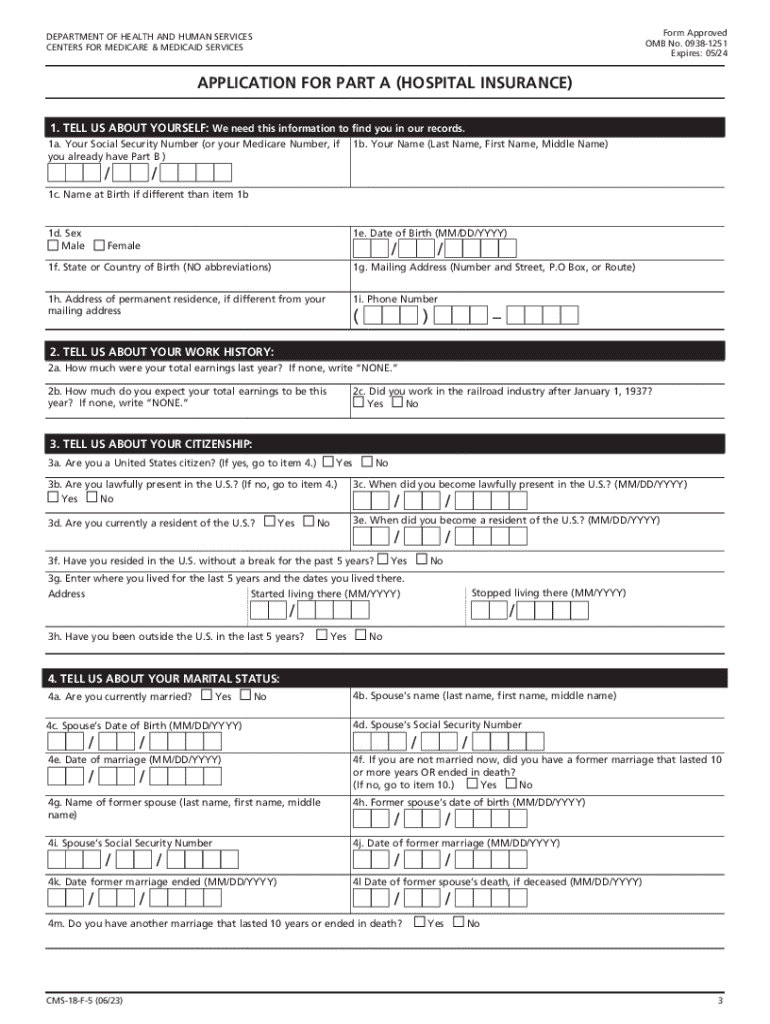
The Application for Part A Hospital Insurance is the official enrollment form individuals use to request Medicare Part A (hospital insurance) coverage. It collects the applicant's identity, eligibility details, work history or premium status, and declarations needed to establish entitlement. Federal agencies use the information to determine effective dates, premium liability and coordination with other benefit programs. Although the form is a federal enrollment instrument, supporting documents such as proof of age or citizenship are commonly required when the application is submitted online, by mail, or through an authorized representative.

Why this Application Matters for Hospital Coverage

Completing the Application for Part A Hospital Insurance correctly starts or updates Medicare hospital coverage, determines premium responsibility, and sets the benefits effective date. Accurate completion avoids enrollment delays and potential gaps in coverage during hospital stays or post-discharge care.

Why this Application Matters for Hospital Coverage

Who Typically Completes the Application

The form is completed by applicants approaching eligibility, people claiming benefits based on work history, and authorized representatives acting for beneficiaries.

  • Beneficiaries — Individuals turning 65 or qualifying earlier through disability who need hospital insurance enrollment or status confirmation.
  • Authorized Representatives — Legal agents, attorneys-in-fact, or family members completing the application on behalf of an incapacitated beneficiary.
  • Employers / HR Staff — Occasionally assist employees who need documentation of work history or employer coverage for enrollment verification.

Use the appropriate signer type and include any documentation that demonstrates the signer's authority when an agent or representative files on behalf of the applicant.

Core Sections Found on a Professional Application for Part A

A complete application groups identity verification, eligibility facts, and attestations into clear sections so agencies can make timely determinations. Expect fields that document work credits, premium status, and supporting documentation.

Applicant Details

Full legal name, preferred name, Social Security number, and current mailing address required to identify and match records.
Eligibility History

Employment history, quarters of coverage, and prior entitlement questions used to calculate premium-free entitlement or premium liability.

Premium Status

Questions about Medicare Part A premiums, whether entitlement is premium-free, and any employer-based coverage affecting enrollment.

Proof Documents

Placeholders for attachments such as birth certificate, citizenship or lawful presence evidence, and prior Medicare documentation.

Representative Info

If someone files on the applicant's behalf, the representative's name, relationship, and authority documentation are recorded.

Signature and Attestation

Applicant or authorized signer must attest to the truthfulness of the statements and sign and date the application.

Step-by-Step: Completing the Application

Follow these sequential actions to assemble and submit a correct application.

  • 01
    Gather documents: Collect ID, SSN proof, and eligibility evidence.
  • 02
    Complete form: Enter details clearly and check for accuracy.
  • 03
    Attach proofs: Scan and attach legible supporting documents.
  • 04
    Submit: Send via the chosen channel and retain a copy.

Where and How the Application Is Submitted

Federal enrollment forms may be filed through multiple channels; choose the one that matches your situation and documentation readiness.

  • Online Submission: Use the agency's secure portal or authorized e-services when available.
  • Mail: Send the completed form and copies of supporting documents to the agency address on the form.
  • In Person: Visit a local field office for assistance and identity verification.
  • Authorized Representative: An agent may submit paperwork with proof of authority attached.

Configuring an Online Completion Workflow

When completing applications electronically, set up a document workflow that enforces required fields and collects attachments consistently.

Field Configuration
Required Fields Make SSN, DOB, and signature mandatory.
Attachment Types Accept PDF or high-resolution JPG for proofs.
Signer Authentication Use email plus SMS code for signer attribution.
Audit Trail Enable IP, timestamp, and action logs for each signer.

Digital Signing and eSubmission Requirements

Use a secure eSignature platform that supports required file formats, strong authentication, and audit trails when submitting electronically.

  • File Formats: PDF, DOCX accepted for forms and attachments.
  • Integrations: Connect with cloud storage like Google Workspace or Box for attachments.
  • Authentication: Email plus SMS or knowledge-based verification enhances signer attribution.

Ensure the chosen platform retains a verifiable audit trail and offers HIPAA or BAA-level protections when health data is involved.

Required Information and Sensitive Data Elements

Social Security Number: Primary identifier; protect with encryption.
Date of Birth: Used for eligibility verification.
Proof of Citizenship: Passport, naturalization papers, or similar.
Work History: Employer names and dates for credits.
Signatures: Applicant or authorized representative signature.
Contact Information: Mailing address, phone number, and email.

Common Errors to Avoid

  • Entering an incorrect or mistyped Social Security number commonly causes processing delays and identity verification failures.
  • Submitting unreadable or cropped scans of birth certificates or passports often triggers requests for replacement documents and slows enrollment.
  • Omitting representative authority or failing to attach power of attorney when someone else signs will result in rejection or follow-up.
  • Using inconsistent names (maiden vs. married) without supporting documentation leads to record-matching problems and extra verification steps.

Consequences of an Incorrect or Incomplete Application

Processing Delays: Submission errors extend review timelines.
Coverage Gap: Delayed acceptance can create temporary lack of hospital coverage.
Denial: Missing eligibility evidence may lead to denial.
Overpayment Risk: Incorrect premium status can trigger repayment requests.
Identity Hold: Mismatch in identity information can require in-person verification.
Administrative Follow-Up: Agencies may request additional documentation or affidavits.

Timing: Enrollment Periods and Processing Expectations

Enrollment windows and processing expectations determine when coverage begins and how quickly decisions are made; prepare documentation before your eligibility period.

Initial Enrollment Period:

A seven-month window around turning 65 commonly triggers initial entitlement rules.

Special Enrollment Periods:

Life events such as employment changes may create limited windows to enroll without penalty.

General Enrollment:

Individuals who miss initial periods typically use a general enrollment period to request coverage.

Processing Time:

Expect several weeks for verification; complex cases require more time.

Effective Date:

Coverage start depends on enrollment timing and agency rules.

eSignature Vendor Pricing and Compliance Snapshot

Compare common eSignature providers on starting price, trial availability, bulk-send capability, audit trails, and HIPAA compliance. signNow is listed first per comparison conventions.

signNow DocuSign Adobe Sign PandaDoc HelloSign
Starting Price $8/user/mo $15/user/mo $14/user/mo $19/user/mo $15/user/mo
Free Trial 7-day free trial Varies Varies Varies Varies
Bulk Send Yes Yes Yes Yes Yes
Audit Trail Yes Yes Yes Yes Yes
HIPAA Compliant Yes Yes Yes No No

Real-World Examples of Electronic Enrollment Workflows

Organizations use online forms and eSignatures to accelerate enrollment and maintain compliance while protecting applicant data.

Fertility Centers of Illinois

A healthcare provider digitized patient enrollment and consent forms to reduce paper handling.

  • They required HIPAA-compliant workflows and audit trails.
  • The digital process preserved security, provided verifiable signatures, and simplified record retention for audits and patient requests.

Optica Ventures LLC

A small administrator adopted e-sign forms to manage beneficiary enrollments remotely.

  • Bulk sending and templates reduced repetitive data entry.
  • Standardized digital workflows improved turnaround and reduced physical record storage overhead for administrative staff.

Who Can Sign the Application

Applicant — Beneficiary

The primary beneficiary must sign when able. The signature attests to the accuracy of statements and triggers validation against federal records.

Representative — POA

A person with a valid power of attorney may sign for the applicant; include the executed POA and any required proof of authority.

Frequently Asked Questions About the Application

Answers to common questions about completing, signing, and submitting the Application for Part A Hospital Insurance.


Need help? Contact support

be ready to get more
Join over 28 million airSlate SignNow users