Court Caption
Court name and docket information should match the accompanying complaint or appeal to avoid administrative rejection and to ensure the judge can identify the underlying matter quickly.
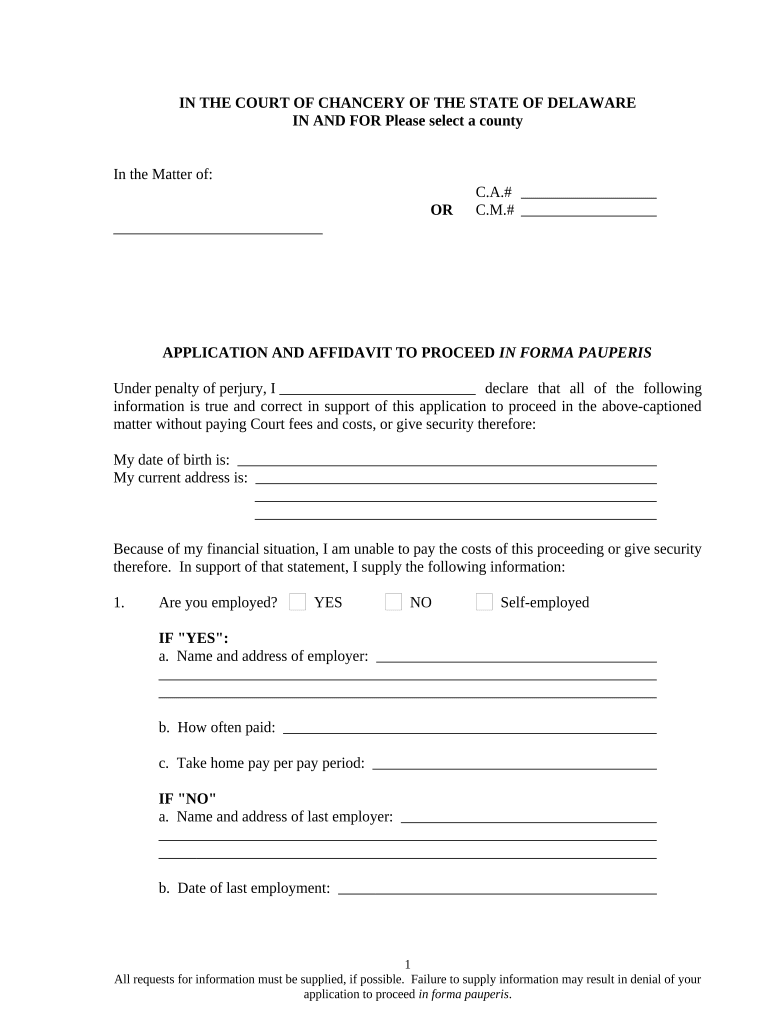
A properly prepared application allows a litigant to seek access to the court system without an upfront fee and reduces administrative delays. Courts grant waivers when the record shows genuine inability to pay; incomplete or inconsistent information can cause denial or require immediate cure. Electronic completion and a clear supporting packet improve review speed while preserving the applicant’s sworn attestation.

The form is most often completed by self-represented litigants, attorneys on behalf of low-income clients, and public interest organizations assisting eligible individuals.
An individual representing themselves who completes the financial disclosure, signs under penalty of perjury, and provides supporting proof when available. Accuracy is critical because false statements can lead to sanctions or criminal exposure.
Court staff accepts the application, checks for required fields and signatures, and forwards it to the judge or judicial officer for determination; clerks may request supplemental proof or return incomplete forms for correction.
Court name and docket information should match the accompanying complaint or appeal to avoid administrative rejection and to ensure the judge can identify the underlying matter quickly.
Full legal name, mailing address, birthdate, and contact phone or email as required by the local rule; use the name on government ID to prevent identity mismatches.
List gross and net income sources, pay frequency, and employer details. Include public benefits and irregular income like tips to provide a complete eligibility picture.
Itemize bank balances, vehicles, property, loans, and credit card balances. Small inaccuracies can slow review—round amounts but avoid omissions.
Detail housing, utilities, medical costs, transportation, and dependent support to demonstrate necessary living expenses that limit ability to pay court fees.
Applicant must sign and date under penalty of perjury. Include notary or witness attestation only if a jurisdiction’s local rule requires it.
| Field | Configuration |
|---|---|
| Document Upload | Require PDF/ DOCX with size limits |
| Authentication Method | Email link plus optional SMS code |
| Required Attachments | Configure mandatory file fields for proofs |
| Signature Type | Allow e-signature with audit trail |
Use a platform that supports PDF and DOCX uploads, audit trails, and secure signer authentication to meet court and regulatory expectations.
| signNow | DocuSign | Adobe Sign | PandaDoc | HelloSign | |
|---|---|---|---|---|---|
| Starting Price | $8/user/mo | $15/user/mo | $14/user/mo | $19/user/mo | $15/user/mo |
| Free Trial | 7-day free trial | Yes | Yes | Yes | Yes |
| Bulk Send | Yes | Yes | Yes | Yes | No |
| Audit Trail | Yes | Yes | Yes | Yes | Yes |
| HIPAA Compliant | Yes | Yes | Yes | No | No |
| Envelope Cap | No cap | 100 envelopes/user/year | Varies by plan | Varies by plan | Varies by plan |
A clinic assembles a client packet with pay stubs and benefit letters to support a waiver request
An individual completes the form, signs under penalty of perjury, and attaches bank statements
File the application with the complaint or petition
Respond promptly to clerks’ requests for additional documents
Some courts issue immediate administrative determinations
Judicial review may take several business days
Meet appellate filing deadlines even if waiver is pending