Establishing secure connection…Loading editor…Preparing document…

Arizona Beneficiary Deed

This template is fully customizable. Edit the text, fill out the fields, and send it for signature. Give it a try!
Arizona Beneficiary Deed

What an Arizona Beneficiary Deed Is and how it works

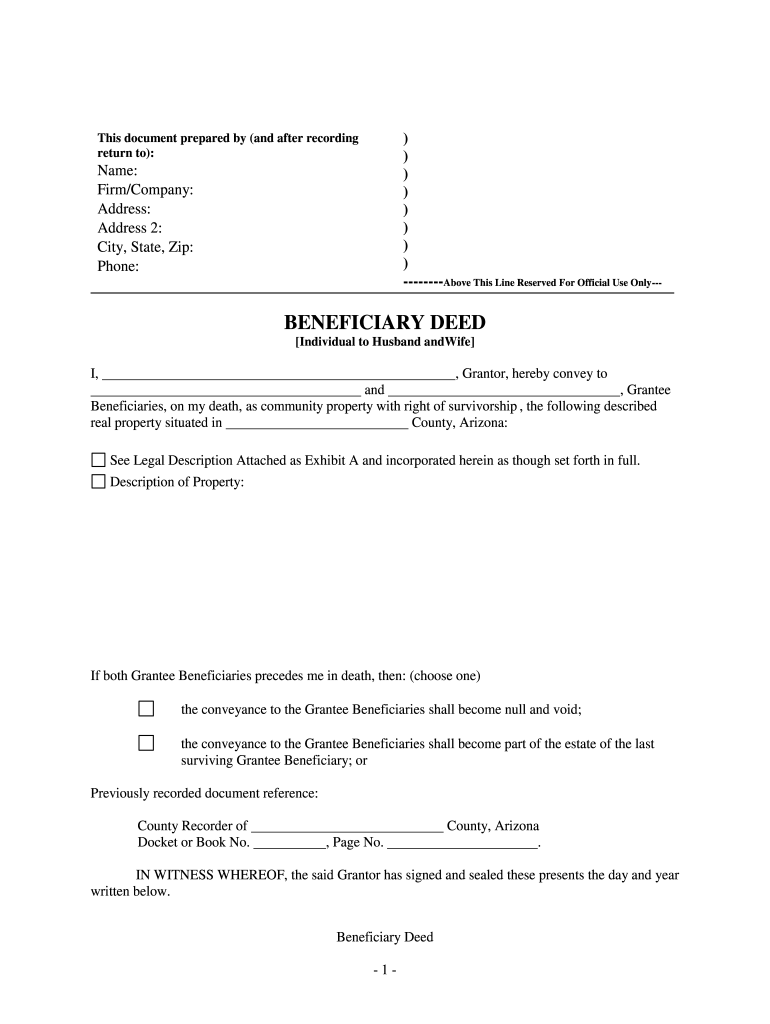
An Arizona Beneficiary Deed is a transfer-on-death instrument that lets a property owner (grantor) name one or more beneficiaries to receive real property when the grantor dies, without probate. It records a present conveyance that takes effect only upon the grantor’s death, preserving the grantor’s lifetime ownership and control. The deed must include a legal description of the property, the named beneficiary, and the grantor’s signature with a notary or remote online notarization when permitted; recording at the county recorder completes the transfer mechanism.

Why an Arizona Beneficiary Deed matters for estate planning

A beneficiary deed avoids probate for the specific parcel, allows you to retain full control while alive, and supports a faster transfer to heirs at death. It complements other estate documents and is recognized for conveyance purposes when properly executed and recorded under state recording rules.

Why an Arizona Beneficiary Deed matters for estate planning

Who typically prepares or signs an Arizona Beneficiary Deed

Use with broader estate plans (wills, trusts) to ensure beneficiary consistency and coordinate with professional advice when tax or creditor issues may arise.

  • Older homeowners who want to avoid probate and keep day-to-day control of the property.
  • People with second homes or rental property who wish to simplify transfer at death.
  • Estate planners and attorneys preparing targeted nonprobate conveyances for clients.

Step-by-step: completing an Arizona Beneficiary Deed

Follow these core steps in order to prepare, sign, and record the deed correctly.

  • 01
    Prepare Deed: Draft deed with grantor, beneficiary, and full legal description.
  • 02
    Confirm Beneficiary: Verify beneficiary identity and any contingent beneficiary details.
  • 03
    Notarize Signature: Sign before a notary or use approved RON procedures where permitted.
  • 04
    Record Deed: Submit to county recorder where the property is located for official indexing.

How to customize and complete the deed online

Configure a digital workflow to collect signatures, notarization, and recording-ready PDFs.

Field Configuration
Beneficiary Field Required text field with validation for full legal name
Legal Description Field Large text area to paste deed legal description
Notary Acknowledgement Checkbox + date field reserved for notary or RON stamp
Final PDF Export Flattened PDF/A export suitable for county recording

Where to file and what happens after recording

Recording the deed is the final step that publicly documents the beneficiary designation; it does not vest title until the grantor’s death.

  • County Recorder: Record in the county where the property is located; recorder indexes the instrument.
  • Recording Office Review: Recorder checks for proper acknowledgement and formatting before acceptance.
  • Recorded Copy Returned: You receive a recorded copy or recording stamp as proof of filing.
  • Effect at Death: Title passes to beneficiary at grantor’s death if instrument meets state requirements.

Digital signing and file-format requirements for online completion

Choose a solution that exports recording-ready, tamper-evident PDFs and supports required notarization or RON capture to meet county recorder standards.

  • File Types: PDF, DOCX supported
  • Authentication: Email + optional SMS or advanced auth
  • Integrations: Works with Google Workspace, Microsoft 365

Practical tips for accurate and efficient completion

Follow these practical steps to reduce recording delays and future disputes.

Use Exact Legal Description
Copy the legal description verbatim from the current recorded deed or title report to avoid recorder rejection and ensure precise conveyance.
Verify Beneficiary Identity
Confirm beneficiary full legal names, birthdates, and contact details to reduce ambiguity and facilitate post-death transfer.
Follow Notary or RON Rules
Ensure the notary wording matches county requirements and that any remote notarization meets state identity-proofing and audio-video retention standards.
Record a Clean Copy
Record a single clear original copy with required acknowledgements; keep certified recorded copies in a secure location and with your estate file.

Common mistakes to avoid when preparing the deed

  • Using a street address instead of the formal legal description causes recorder rejection and title ambiguity.
  • Failing to notarize or follow RON identity-proofing requirements delays or voids the recording.
  • Naming a beneficiary without a contingent beneficiary leaves no fallback if the beneficiary predeceases the grantor.
  • Mismatched names between deed and ID trigger additional proofing steps and possible re-filing.

Risks and consequences of incorrect beneficiary deeds

Recording Rejection: Delays title transfer
Unintended Transfer: Ambiguous language may grant unintended interests
Probate Exposure: Errors can force property into probate
Creditor Claims: Creditors may challenge post-death transfers
Tax Consequences: Incorrect filings can affect estate tax reporting
Legal Disputes: Conflicts among heirs may result

Essential elements to include in a professional Arizona Beneficiary Deed

A complete deed contains specific clauses and blocks that ensure the instrument is clear, enforceable, and recordable.

Grantor Identification

Full legal name and current mailing address of the property owner executing the deed; this ties the instrument to the correct titleholder.
Beneficiary Designation

Clear naming of primary and contingent beneficiaries with identifying details to avoid ambiguity at the time of transfer.

Legal Property Description

The precise deed description or parcel number as recorded in county records; essential for title clarity and recorder acceptance.

Statement of Transfer

Language stating the deed conveys property upon the grantor’s death and that the grantor retains rights during life.

Notary Acknowledgment

A notary block or RON acknowledgement that meets state requirements, including signature, seal, and notarization language.

Recording Block

A blank area reserved for county recorder stamps and recording information to be added at filing.

Real-world scenarios using beneficiary deeds

Examples illustrate how property owners and practitioners use beneficiary deeds to simplify transfers and avoid probate in practice.

Martin Properties — Small rental portfolio

A landlord adds a beneficiary deed for a single rental parcel to avoid probate at death

  • Simplified transfer to heir
  • The owner preserved rental income and management decisions while alive; recording the deed reduced post-death administrative cost for the family.

Optica Ventures — Investment property

An individual investor used a beneficiary deed to name a successor for a vacation home

  • Title avoids probate
  • The recorded deed allowed the investor to sell or refinance during life without beneficiary consent, while ensuring a nonprobate transfer at death.

E-signature vendor pricing comparison for executing and notarizing deeds

Compare common vendor starting prices and core capabilities relevant to signing, notarization support, and compliance for deed workflows.

signNow DocuSign Adobe Sign PandaDoc HelloSign
Starting Price $8/user/mo $15/user/mo $14/user/mo $19/user/mo $15/user/mo
Free Trial 7-day trial Available Available Available Available
Bulk Send Yes (premium plan) Yes Yes Yes No
Audit Trail Yes Yes Yes Yes Yes
HIPAA Compliant Yes Yes Yes No No

Frequently asked questions about the Arizona Beneficiary Deed

Answers to common questions about execution, recording, revocation, and e-signature validity.


Need help? Contact support

be ready to get more
Join over 28 million airSlate SignNow users