Establishing secure connection…Loading editor…Preparing document…

Artisan's Lien

This template is fully customizable. Edit the text, fill out the fields, and send it for signature. Give it a try!
Artisan's Lien

What an Artisan's Lien Is and when it applies

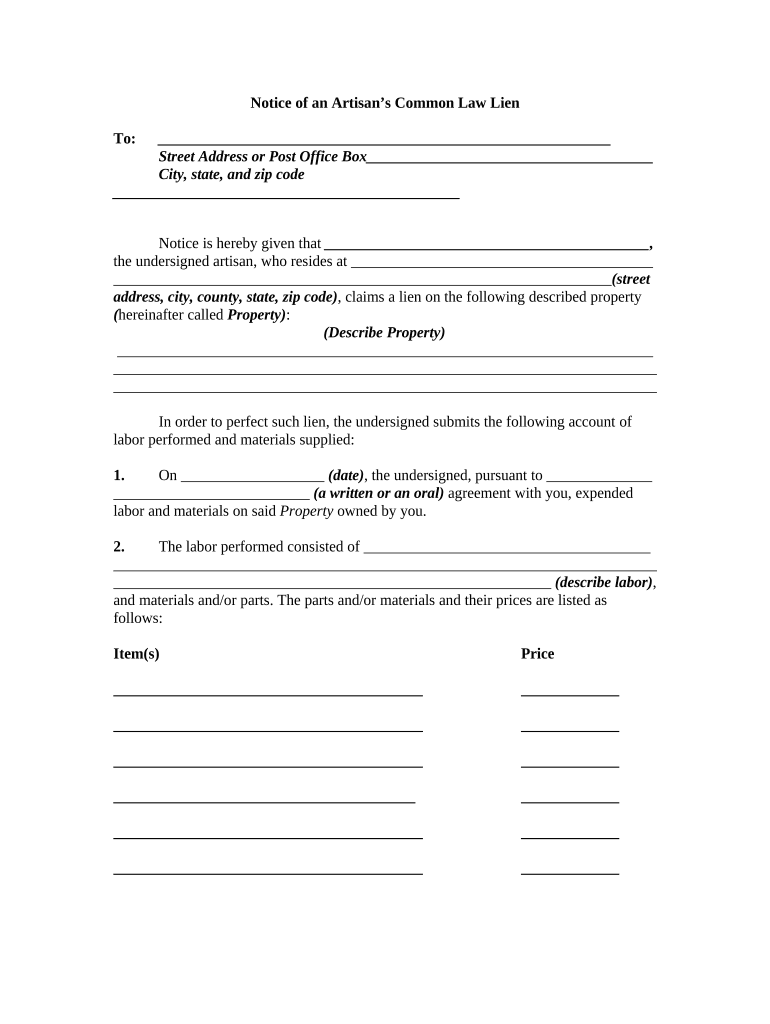
An Artisan's Lien is a statutory claim filed by a craftsman, contractor, or supplier to secure payment for labor or materials provided for improving real property. It creates a security interest against the particular property where work was performed, allowing the claimant to seek payment through lien enforcement or foreclosure if unpaid. Procedures, required contents, and filing deadlines vary by state law; compliance with local statutes is essential to preserve lien rights. This document guides completion, filing, and common legal considerations for U.S. practitioners.

Step-by-step: Preparing and filing an Artisan's Lien

Follow these steps to prepare, execute, and record an Artisan's Lien in compliance with typical U.S. state procedures.

  • 01
    Verify Entitlement: Confirm unpaid balance and contractual right to assert a lien.
  • 02
    Gather Documents: Collect contracts, invoices, delivery tickets, and lien waivers.
  • 03
    Complete Lien Form: Fill claimant details, property description, amount claimed, and dates.
  • 04
    File and Serve: Record with county recorder and serve required notices to owner.

Common users and stakeholders involved with Artisan's Liens

Typical claimants include contractors, subcontractors, suppliers, and specialized trades seeking secured payment for work performed.

  • General contractors — file liens for unpaid work on construction projects within contract terms.
  • Subcontractors and laborers — preserve rights when direct contract with owner is absent.
  • Material suppliers — claim for delivered materials used in property improvements.

Core elements every professional Artisan's Lien should include

A professional Artisan's Lien includes specific elements and attachments that ensure enforceability and facilitate recording across jurisdictions; include all required statutory components.

Claimant Information

Provide full legal name, business entity details, mailing and contact addresses, and taxpayer identification where required. Accurate claimant data aids enforcement, matching payments, and title searches after recording.
Property Description

Include the legal description or parcel number from county records, site address, and any lot or project identifiers. Precise property data prevents recording errors and ensures the lien attaches properly.

Statement of Work

Detail dates of performance, services provided, and materials supplied with itemized entries. Courts and recorders rely on clear descriptions to assess the lien's factual foundation.

Amount Claimed

State principal, interest (if allowed), and itemized charges; include numeric and written totals, supporting invoices, and calculation notes to reduce disputes and clarify priority calculations for enforcement.

Signature/Notary

Signatures must be dated and, if statute requires, acknowledged by a notary. Some recorders accept RON; verify accepted notarization methods with the recorder's office procedures.

Recording Instructions

Include recording county, required copies, fee payment method, and any cover sheet or index information. Follow county formatting and submission rules to avoid processing delays.

Security and compliance considerations for electronic submission

Encryption: TLS 1.2/1.3 in transit, AES-256 at rest
Certifications: SOC 2 Type II, ISO 27001, PCI DSS
HIPAA: BAA available; HIPAA-compliant workflows
21 CFR Part 11: Supports electronic records and signatures
Audit Trail: Detailed timestamps, IP, and activity logs
User Access: Role-based controls and SSO options

Key risks and penalties from incorrect filings

Late Filing: May forfeit lien rights
Incorrect Description: Recording rejection or invalid lien
Improper Service: Enforcement delayed or dismissed
Statute Violations: Civil penalties possible
Intentional Misstatement: Exposure to fraud claims
Costs and Fees: Attorney and filing expenses

Common preparation mistakes to avoid

  • Using an imprecise legal description or relying only on a street address can lead to recording rejection or failure to attach the lien to the correct parcel.
  • Failing to serve required notices promptly, or incorrectly addressing service, frequently results in unenforceable liens or costly litigation to correct procedural defects.
  • Listing the wrong claimant name, omitting tax identification information, or mismatching invoicing details can trigger payment disputes and administrative rejections.
  • Submitting unsigned forms, missing notarization where required, or relying on unsupported e-filing methods can delay recording and weaken lien priority.

Typical filing flow for an Artisan's Lien

A typical workflow: prepare the lien, obtain signatures and notarization as needed, file with the recorder, and serve copies to property stakeholders.

  • Prepare Document: Complete required fields and attach supporting invoices and contracts.
  • Obtain Signatures: Signatory executes and dates; notarize if jurisdiction requires.
  • Record Lien: Submit to county recorder and pay applicable recording fees.
  • Serve Notice: Deliver statutory notice to owner, general contractor, and lender when required.

Configuring an e-filing workflow for lien submission

Configure an e-filing workflow to match local requirements: authentication, conditional fields, notarization support, and automated delivery of recorded copies.

Workflow Configuration Field Name Label How the workflow behaves and required settings for e-filing.
Signer Authentication Method and Level Email link, SMS code, or KBA depending on state.
Conditional Fields and Calculations Enabled Show or hide lines based on claim type; auto-calc totals.
Notarization Support and Recording Options Attach notarization block, support RON session capture when allowed.
Automated Delivery and Secure Storage Send recorded documents to stakeholders and archive in secure repository.

Technical capabilities to look for when preparing e-submissions

Use platforms that support PDF, Word, secure storage, and native integrations to simplify e-filing and evidence capture.

  • Formats: PDF, DOCX, and HTML supported
  • Integrations: Salesforce, NetSuite, Microsoft 365, Procore
  • Authentication: Email, SMS, SSO, or advanced options

Pricing and core capabilities: signNow compared to alternatives

The table compares typical starting prices and feature availability for eSignature vendors commonly used when preparing and filing Artisan's Liens.

signNow DocuSign Adobe Sign PandaDoc HelloSign
Starting Price $8/user/mo $15/user/mo $14/user/mo $19/user/mo $15/user/mo
Free Trial 7-day free trial Varies by plan Varies by plan Varies by plan Varies by plan
Bulk Send Yes Yes Yes Yes No
Audit Trail Yes Yes Yes Yes Yes
HIPAA Compliant Yes Yes Yes No No

Key deadlines and time-sensitive actions to track

Key time-sensitive events for Artisan's Liens include initial notice, filing, service, enforcement, and release actions; timelines vary significantly by state statute.

Notice of Intent to Lien:

Serve notice when statutorily required before filing.

Filing Deadline:

Record lien within state-specific deadline after last work.

Service of Claim:

Deliver claim or notice to owner and construction parties.

Enforcement Window:

Begin foreclosure or litigation within statute of limitations.

Release or Satisfaction:

File recorded release promptly after payment to clear title.

Frequently asked questions about Artisan's Liens

Answers to frequent questions about filing, enforceability, and electronic submission of Artisan's Liens in the United States.


Need help? Contact support

be ready to get more
Join over 28 million airSlate SignNow users