Establishing secure connection…Loading editor…Preparing document…

Louisiana Attorney Disciplinary Action

This template is fully customizable. Edit the text, fill out the fields, and send it for signature. Give it a try!
Louisiana Attorney Disciplinary Action

What the Louisiana Attorney Disciplinary Action Is

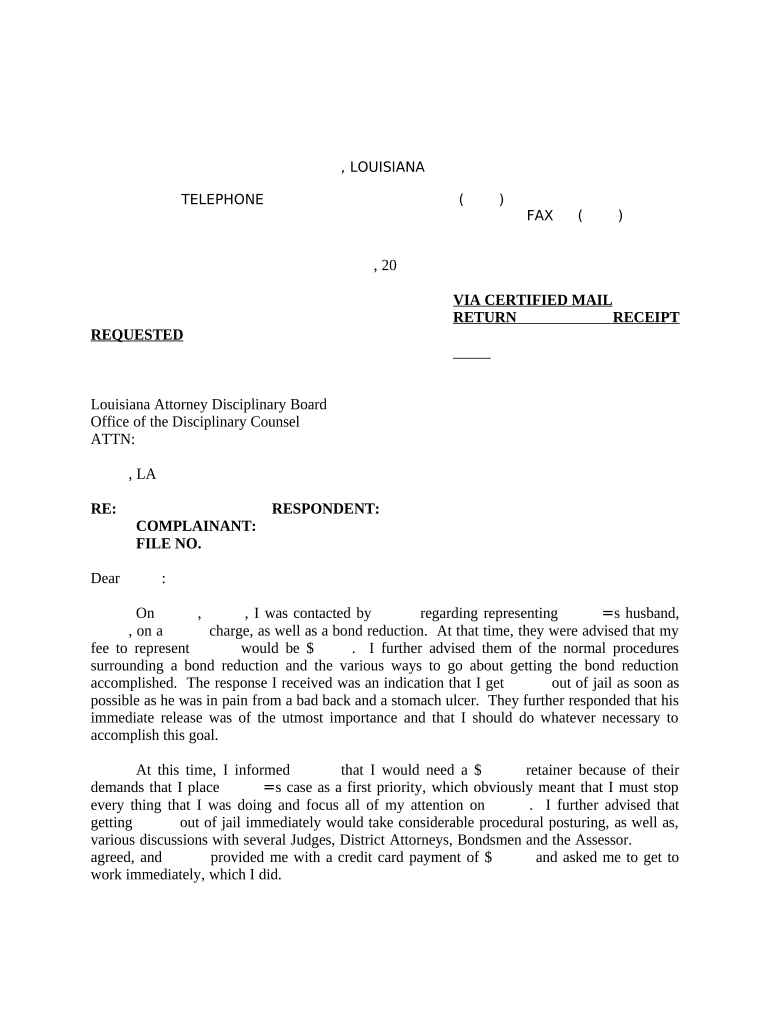
The Louisiana Attorney Disciplinary Action is the formal administrative process for reporting, investigating, and resolving allegations of professional misconduct by attorneys licensed in Louisiana. Complaints may allege ethics rule violations, misappropriation of client funds, neglect, incompetence, criminal conduct, or conflicts of interest. Matters are typically filed with the Office of Disciplinary Counsel or the Attorney Disciplinary Board and proceed through intake, investigation, and, when appropriate, formal hearing procedures. Possible outcomes include dismissal, admonition, probation, suspension, or disbarment; procedural rules govern filing, service, and evidentiary submissions.

Why this document matters for due process and accountability

Filing or responding to a disciplinary action sets the procedural record that controls an attorney’s license status and future practice privileges.

Why this document matters for due process and accountability

Who prepares or interacts with these disciplinary filings

Professionals and members of the public use this form to report alleged attorney misconduct or to respond to complaints.

  • Members of the public: individuals who file complaints about attorney conduct, malpractice, or ethical violations.
  • Respondent attorneys: lawyers named in complaints who must answer allegations and may submit evidence and mitigating materials.
  • Disciplinary counsel and investigators: review allegations, gather records, and recommend formal proceedings when warranted.

Who else needs to be involved

Accurate completion helps the disciplinary office process cases faster and reduces the chance of dismissal for procedural defects.

Representative users and their roles

Complainant

A private client or third party who experienced alleged harm. The complainant files factual statements, attaches supporting documents (correspondence, trust accounting, billing), and may provide contact information for follow-up by investigators. Clear, dated evidence increases investigative efficiency and credibility.

Respondent Attorney

The lawyer named in the complaint who must respond within any procedural deadline, disclose relevant records, and may retain counsel. Respondents should preserve client files, prepare factual rebuttals, and submit mitigation or corrective action to limit sanction risk.

Essential data protections and compliance points

Encryption: TLS 1.2/1.3 in transit; AES-256 at rest.
Audit Trail: Timestamped actions and signer attribution.
HIPAA Considerations: Redact PHI; BAA required for covered entities.
ESIGN / UETA: Electronic signatures enforceable under ESIGN/UETA.
Access Control: Role-based permissions and MFA recommended.
Record Integrity: Tamper-evident storage and version history.

Key legal risks and penalties to avoid

False Reporting: Potential sanctions or referral.
Late Response: Procedural default or adverse inference.
Failure to Preserve: Spoliation or evidentiary sanctions.
Privacy Breach: HIPAA / confidentiality violations.
Incomplete Filing: Dismissal for lack of information.
Unauthorized Disclosure: Ethics or malpractice exposure.

Common preparation pitfalls to watch for

  • Submitting unsigned or undated exhibits that cannot be authenticated, delaying investigation and possibly causing the submission to be returned.
  • Failing to include clear timelines and supporting documents such as billing records or trust account ledgers, which forces investigators to request follow-up and extends case resolution.
  • Using overly broad or conclusory language instead of factual narrative tied to dates, communications, and transactions, which reduces the complaint’s actionable clarity.
  • Neglecting to redact confidential medical or financial information where required, exposing the filer to privacy compliance issues and possible removal of the document.

Step-by-step: prepare and submit or respond

Use a consistent sequence: gather evidence, complete required fields, obtain signatures, then submit by the disciplinary office’s accepted method.

  • 01
    Gather: Collect documents, dates, and contact information.
  • 02
    Draft: Describe facts clearly and attach exhibits.
  • 03
    Authenticate: Sign, notarize if required, or apply eSignature.
  • 04
    Submit: Send to the disciplinary office via accepted channel.

Recommended online workflow settings for eSubmission

Configure a secure, auditable flow so each signer and reviewer is recorded with attribution and timestamps.

Field Configuration
Authentication Email plus SMS code or ID verification
Signature Type Electronic signature with audit trail
Document Format PDF/A for long-term preservation
Access Control Role-based viewer and editor rights

Technology considerations for electronic submission

Choose platforms that support secure upload, audit trails, accepted file formats, and adequate signer authentication for disciplinary filings.

  • File Formats: PDF, DOCX, or certified PDF/A
  • Integrations: Connectors for Google Workspace and Microsoft 365
  • Authentication: Email+SMS, KBA, or government ID checks

Practical platform selection notes

Ensure any vendor used produces a tamper-evident signed file and preserves a searchable audit trail; confirm vendor compliance for sensitive information handling.

How electronic filing and eSignature typically work

An electronic workflow reduces handling and captures a clear record: upload, assign fields, authenticate signers, then transmit to the disciplinary office.

  • Upload: Attach complaint and exhibits in accepted formats.
  • Assign: Place signature, date, and initials fields where needed.
  • Authenticate: Apply chosen signer authentication method.
  • Transmit: Send via secure portal or email per board rules.

Key milestones in the disciplinary process

Cases proceed through intake, investigation, resolution recommendation, and final disposition with procedural windows at each stage.

01

Intake

Initial screening to assess jurisdiction and sufficiency of facts.

02

Investigation

Fact-gathering, witness interviews, and record requests occur.

03

Hearing

Formal evidentiary hearing if probable cause exists.

04

Disposition

Board issues sanction, dismissal, or other corrective measures.

Timing expectations and processing notes

Specific deadlines vary by office; file promptly and follow any board instructions to avoid procedural consequences.

Initial Filing Deadline:

No universal statutory deadline; timely filing preserves evidence and witness access.

Response Period:

Respondents must follow board-specified deadlines for answers and document production.

Investigation Window:

Investigations may take weeks to months depending on complexity.

Hearing Scheduling:

Scheduling depends on board calendar and case posture.

Final Order:

Final disposition timing varies with appeals or review processes.

Core components of a professional disciplinary submission

A complete filing organizes the complaint, supporting evidence, authentication, service records, and contact details so the disciplinary office can proceed without clerical follow-up.

Complaint Narrative

Chronological, fact-based description of events including dates, locations, and actions alleged, avoiding legal conclusions unbacked by specific facts.
Exhibits

Attach emails, invoices, trust ledgers, contracts, and other documents; label exhibits and reference them clearly in the narrative.

Affidavits

Sworn witness statements or declarations that corroborate material facts and are signed under penalty of perjury when appropriate.

Service Records

Proof of service on the respondent and any cover letters or delivery receipts showing how the filing was transmitted.

Authentication

Signatures and notarizations where required, or electronic signature metadata showing signer identity, timestamp, and audit trail.

Contact Details

Current addresses, phone numbers, and email for complainant and respondent to facilitate investigator communications.

Practical tips for accurate, efficient filings

Adopt consistent documentation habits and use a checklist to reduce errors and speed case handling by the disciplinary office.

Use numbered exhibits
Number and reference exhibits inline with the narrative; provide a table of contents so investigators can quickly locate supporting evidence.
Preserve original files
Keep unaltered originals or certified copies for production; document chain of custody and avoid editing metadata that could raise authenticity questions.
Redact sensitive data
Redact personal health information and unrelated financial data when not essential to the allegation to comply with privacy rules.
Record communications
Log dates and summaries of relevant calls and meetings, and attach corroborating emails or text messages to the complaint.

Illustrative submission scenarios

Two practical examples show how a well-documented complaint and a timely response can affect case progression and outcomes.

Public Complaint Example

A client submitted invoices and trust account statements showing unexplained withdrawals

  • Investigator requested bank records and obtained corroboration
  • After timely follow-up and clear exhibits the matter advanced to probable cause review and yielded negotiated mitigation rather than immediate suspension.

Respondent Response Example

An attorney responded with dated engagement letters and emailed fee agreements to rebut overbilling allegations

  • The response included client consent forms and corrected billing entries
  • The documented rebuttal narrowed issues, shortened investigation time, and supported a lesser sanction recommendation.

Representative eSignature vendor pricing and feature comparison

Compare commonly used eSignature vendors for cost and basic feature availability when preparing or submitting disciplinary filings; signNow is listed first per vendor comparison standards.

signNow DocuSign Adobe Sign PandaDoc HelloSign
Starting Price $8/user/mo $15/user/mo $14/user/mo $19/user/mo $15/user/mo
Free Trial 7-day free trial Varies by vendor Varies by vendor Varies by vendor Varies by vendor
Bulk Send Yes (premium tiers) Yes Yes Yes No
Audit Trail Yes Yes Yes Yes Yes
HIPAA Compliant Yes Yes Yes No No
Envelope Cap No cap 100 envelopes/user/year limit Varies by plan Varies by plan Varies by plan

Frequently asked questions about filings and eSubmission

Answers to common questions about whether you can e-sign, how to authenticate signers, retention, and what to expect during investigation.


Need help? Contact support

be ready to get more
Join over 28 million airSlate SignNow users