Establishing secure connection…Loading editor…Preparing document…

Bailment Agreement

This template is fully customizable. Edit the text, fill out the fields, and send it for signature. Give it a try!
Bailment Agreement

Clear definition of a Bailment Agreement

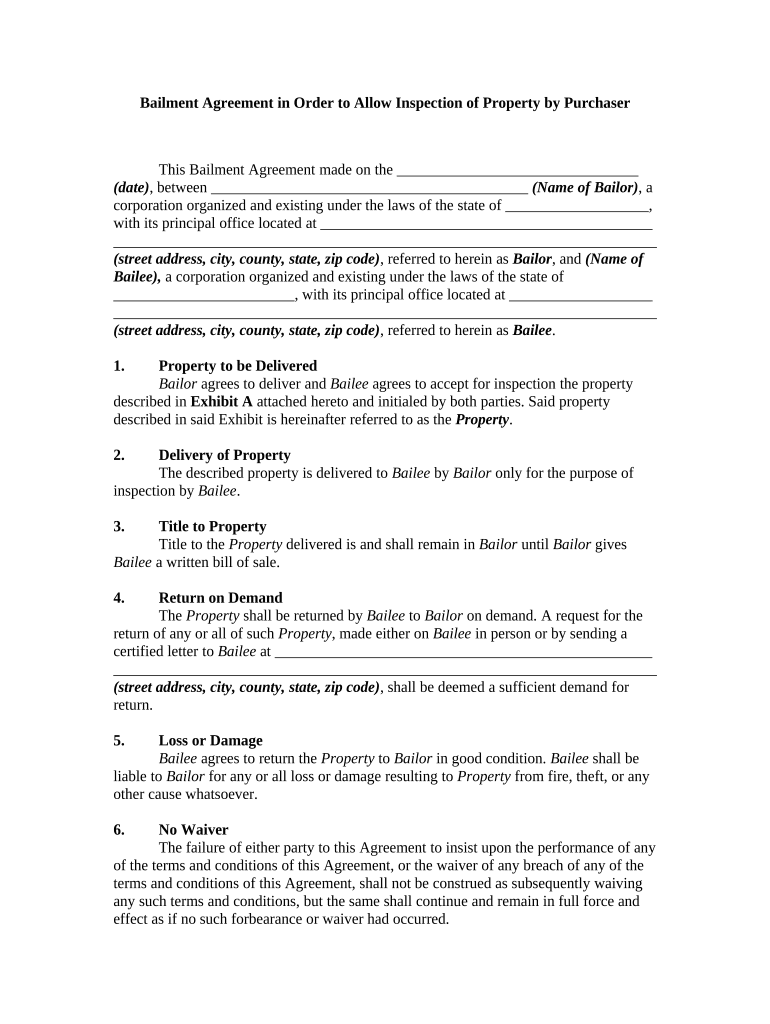
A Bailment Agreement is a written contract where one party (the bailor) transfers possession—but not ownership—of tangible personal property to another party (the bailee) for a defined purpose and limited time. The agreement sets the bailee’s duty of care, permitted uses, return conditions, compensation, and remedies for loss or damage. Typical use cases include storage, repair, delivery, and safekeeping. Precise property descriptions, timelines, insurance allocation, and inspection rights reduce disputes and clarify each party’s legal exposure under state law and common-law bailment principles.

Why a well-drafted Bailment Agreement matters

A clear Bailment Agreement allocates risk, establishes duties of care, and documents return and inspection procedures to reduce disputes and financial exposure.

Why a well-drafted Bailment Agreement matters

Who commonly prepares and signs Bailment Agreements

Businesses and individuals who transfer possession of goods routinely use bailment agreements to manage responsibility and reduce liability.

  • Storage companies and warehouses managing customer goods and inventory custody arrangements.
  • Auto shops and transporters when vehicles or equipment are entrusted for repair or delivery.
  • Legal or logistics teams handling evidence, leased equipment, or third-party custody for clients.

Roles that must be documented and understood

Bailor — Property Owner

The bailor is the owner or lawful possessor who delivers property to the bailee. Document the owner's name, contact information, and any title or lien details so identity and ownership are unambiguous for claims and insurance.

Bailee — Custodian

The bailee receives possession and owes the agreed standard of care. The agreement should state permitted uses, storage conditions, security obligations, and procedures for inspection, return, and liability allocation.

Core sections every professional Bailment Agreement should include

A comprehensive agreement reduces ambiguity. The six components below cover identification, scope, responsibilities, financial terms, risk allocation, and remedies.

Identification

Full legal names and contact details for bailor and bailee plus any third-party agents; include taxpayer or business registration numbers when relevant for tracing and enforcement.
Property Description

Detailed description of the goods by make, model, serial number, quantity, condition, and photos or attached exhibits to prevent later disputes about what was delivered.

Purpose of Bailment

Specify the reason for possession (storage, repair, transport), any permitted uses, and restrictions to limit unauthorized use that could increase liability.

Duration and Return

State effective date, expiration or termination triggers, agreed return procedure, inspection rights, and consequences for late return or failure to retrieve property.

Insurance & Liability

Assign responsibility for insurance, minimum coverage amounts, deductible allocation, and who bears loss from theft, damage, or destruction during custody.

Remedies & Indemnity

Detail damages, repair obligations, replacement value rules, indemnification clauses, and attorney fee recovery for enforcement or recovery actions.

Step-by-step: filling and finalizing the Bailment Agreement

Follow these sequential steps to prepare, review, and execute a enforceable bailment contract that documents possession and return obligations.

  • 01
    Draft terms: Describe property, purpose, period, insurance, and remedies in clear language.
  • 02
    Verify identities: Confirm legal names and authority for parties signing the agreement.
  • 03
    Agree inspection process: Document inspection timing and how condition is recorded on delivery and return.
  • 04
    Execute and distribute: Obtain signatures, date the document, and give copies to all parties.

Configuring a digital workflow for Bailment Agreements

Map each stage of document handling to fields, reminders, authentication, and archival processes for traceable custody.

Field Configuration
Document template Create a reusable template with required fields and exhibits attached.
Signer authentication Use email linking or stronger methods (SMS, ID verification) for high-value bailments.
Notifications Enable reminders for return dates and inspection windows.
Audit trail Capture timestamps, IP, and action logs for each signing event.

Digital signing and technical delivery considerations

Choose tools that support secure signatures, tamper-evident storage, and integrations with your records systems.

  • File formats: PDF and DOCX preferred
  • Integrations: CRM, ERP, cloud storage
  • Authentication: Email, SMS, or advanced methods

Ensure the platform you use preserves a detailed audit trail, supports export in standard formats, offers role-based access, and aligns with any industry-specific compliance obligations such as HIPAA or 21 CFR Part 11 when applicable.

Where to send and who receives the executed Bailment Agreement

Bailment Agreements are private contracts. After execution, distribute signed copies to the bailor, bailee, and any insurer or agent with a direct interest.

  • To Bailor: Provide an original or certified copy for the owner’s records.
  • To Bailee: Retain a signed original at the custody location.
  • To Insurer: Share policy info and signed agreement when insurance is required.
  • To Agents: Send copies to logistics, storage facilities, or legal counsel as needed.

Key stages from execution through return

Track milestones so possession, inspection, and return obligations are met on schedule and documented for enforcement if needed.

01

Execution

Agreement signed and effective; custody transfer scheduled.

02

Delivery of Goods

Property delivered, condition recorded, delivery receipt issued.

03

Inspection Window

Timeframe for bailor or agent to inspect upon return.

04

Return / Close

Property returned, condition noted, obligations discharged or claims opened.

Typical time-sensitive terms to include

Define any calendar-based obligations and notice periods to avoid disputes about timeliness and cure opportunities.

Agreed Return Date:

Specify the exact MM/DD/YYYY return date or termination event.

Inspection Period:

State number of days for inspection after return, e.g., 3–10 days.

Notice of Loss:

Require prompt written notice within a short window, typically 24–72 hours.

Claim Deadline:

Limit claims to a defined period after return, often 30–90 days.

Cure Period:

Allow brief cure for breach before remedies, often 7–30 days.

Practical guidance to reduce disputes and liability

Adopt clear drafting, consistent documentation, and operational controls to protect both parties and preserve evidence.

Use photographed condition reports
Attach dated photos or video at delivery and return. Visual records greatly reduce disagreements about condition and are persuasive in claims or litigation.
Be explicit about permitted use
Limit uses to those agreed in writing. Unauthorized use can change the standard of care and increase bailee liability.
Allocate insurance responsibility
Specify primary insurance carrier, coverage limits, and whether the bailor is an additional insured on the bailee’s policy.
Document chain of custody
Record every transfer, storage movement, and access event. A documented chain helps defend against claims of loss or conversion.

Common drafting and execution mistakes to avoid

  • Vague property descriptions that fail to uniquely identify items often lead to ownership disputes and make recovery difficult.
  • Unspecified return procedures or locations create ambiguity about when possession ends and can trigger litigation over responsibility.
  • No insurance or improperly allocated coverage leaves parties exposed to losses they did not intend to bear.
  • Missing signature authority or unsigned amendments can invalidate terms and prevent enforcement of limitation or indemnity clauses.

Legal risks and potential consequences of errors

Property Loss: Damage or loss damages
Conversion Claim: Civil liability risk
Breach Damages: Compensatory damages possible
Attorney Fees: Costs if contract allows
Insurance Gaps: Out-of-pocket recovery
Regulatory Exposure: Industry-specific penalties

Comparison: eSignature vendor pricing and core features

Price and feature availability vary by plan. The table summarizes starting prices and select capabilities across common vendors.

signNow DocuSign Adobe Sign PandaDoc HelloSign
Starting Price $8/user/mo $15/user/mo $14/user/mo $19/user/mo $15/user/mo
Free Trial 7-day free trial Varies by plan Varies by plan Varies by plan Varies by plan
Bulk Send Yes (plan dependent) Yes Yes Yes Varies by plan
Audit Trail Yes Yes Yes Yes Yes
HIPAA Compliant Yes Yes Yes No No
Envelope Cap No cap 100 envelopes/user/year Varies by plan Varies by plan Varies by plan

Real-world bailment use cases

These condensed examples show how bailment agreements are used in practice across common scenarios.

Automotive Repair

A dealership leaves a vehicle with a repair shop for diagnostics and repair

  • Shop documents vehicle condition on delivery
  • The signed bailment clarifies inspection rights, repair authorization, and liability for loss or further damage.

Commercial Storage

A retailer stores excess inventory in a third-party warehouse for seasonal sales

  • Warehouse issues a receipt and stores photos of goods
  • The agreement sets storage fees, access procedures, insurance responsibility, and return logistics when goods are reclaimed.

Key security and compliance controls to safeguard agreements

Encryption: TLS 1.2/1.3 in transit
At-Rest Protection: AES-256 encryption
Audit Trail: Detailed timestamps and logs
HIPAA Support: BAA available
Regulatory: ESIGN and UETA compliant
Certifications: SOC 2 Type II, ISO 27001

Frequently asked questions about Bailment Agreements

Answers address common legal and practical questions about drafting, signing, and enforcing bailment contracts in the United States.


Need help? Contact support

be ready to get more
Join over 28 million airSlate SignNow users