Establishing secure connection…Loading editor…Preparing document…

Buy-Sell Agreement Between Partners of General Partnership

This template is fully customizable. Edit the text, fill out the fields, and send it for signature. Give it a try!
Buy-Sell Agreement Between Partners of General Partnership

What a Buy-Sell Agreement Between Partners of General Partnership Is

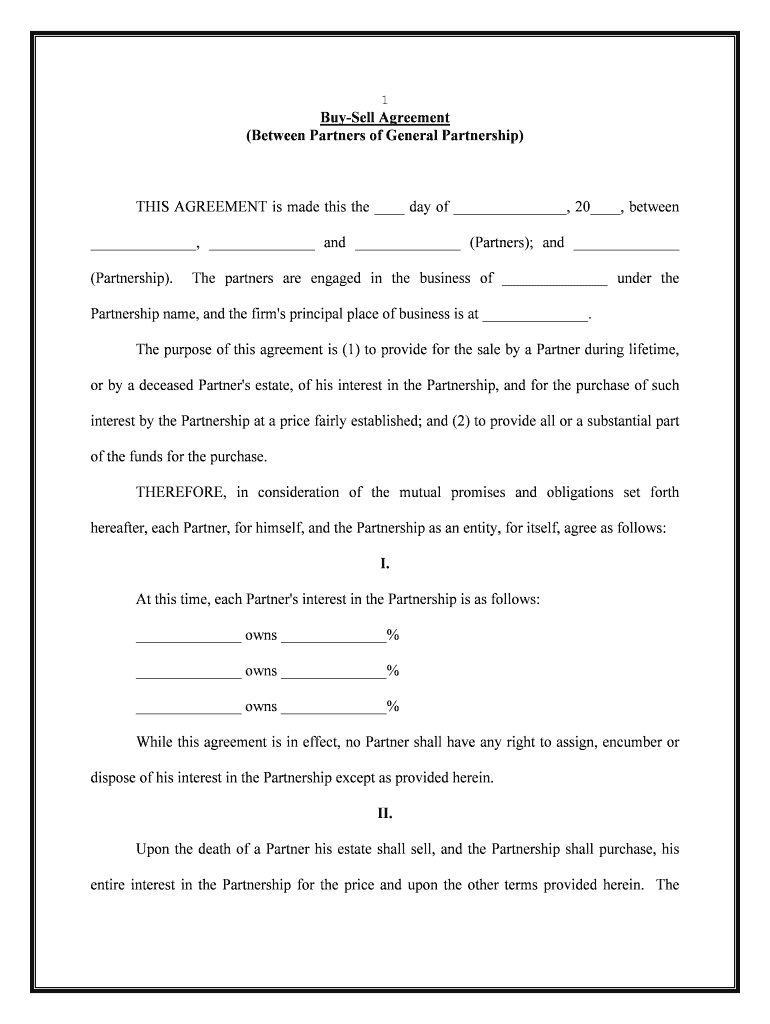
A Buy-Sell Agreement Between Partners of General Partnership is a legally binding contract that sets out how a partner's interest in a general partnership will be transferred on specified triggering events such as death, disability, retirement, bankruptcy, or voluntary exit. The agreement defines valuation methods, purchase funding, notice procedures, and closing mechanics so partners and their heirs know rights and obligations. Well-drafted buy-sell provisions reduce disputes, ensure business continuity, and specify who may acquire the departing partner’s share and under what terms.

Why partners use a Buy-Sell Agreement

A clear buy-sell agreement preserves business continuity, limits disputes among surviving partners, fixes valuation and funding methods ahead of time, and protects third parties and creditors by clarifying ownership transfer rules. It also helps estate planning and tax consistency for departing partners and their beneficiaries.

Why partners use a Buy-Sell Agreement

Who typically uses this agreement and why it matters

Partnerships, advisors, and stakeholders use buy-sell agreements to manage ownership changes and reduce uncertainty.

  • Small partnerships and family businesses seeking orderly ownership transitions and creditor protection.
  • Professional practices (law, medical, accounting) needing continuity and clear buyout funding rules.
  • Investors and lenders who require predictable ownership resolutions before making capital available.

The agreement benefits owners, heirs, attorneys, and lenders by codifying predictable steps for transfer and valuation.

Core elements to include in a professional buy-sell agreement

Include practical, enforceable clauses that address who, when, how, and for how much a partnership interest transfers. Focus on clarity for valuation, funding, notice, and dispute resolution.

Triggering Events

List death, disability, retirement, bankruptcy, divorce, and voluntary withdrawal with clear notice procedures.
Valuation Method

Specify fixed formula, appraisal process, or periodic agreed value and timing for valuation determinations.

Purchase Funding

Describe funding sources such as life insurance proceeds, partner loans, escrow, or installment payments and security interests.

Transfer Restrictions

Include right of first refusal, approval rules, and permitted transferees to control incoming partners.

Closing Mechanics

Set timeline for closing, required documents, escrow instructions, and allocation of closing costs.

Dispute Resolution

Provide mediation/arbitration steps, governing law, and venue for valuation or enforcement disputes.

Step-by-step: completing a buy-sell agreement

Follow a structured sequence to draft, review, and execute the agreement to reduce omissions and ensure enforceability.

  • 01
    Draft Terms: Define triggers, valuation, funding, and transfer restrictions.
  • 02
    Seek Counsel: Have partners and the partnership obtain independent legal and tax advice.
  • 03
    Finalize Language: Resolve ambiguous terms and confirm notice periods and documentation needs.
  • 04
    Execute and Retain: Sign, notarize if required, circulate copies, and store originals securely.

How to prepare a digital signing workflow for this agreement

Design the routing sequence, required fields, and signer authentication so each partner receives the appropriate signing prompts and document copies.

Field Configuration
Signature Blocks Place individual signature and date fields for each partner in signing order.
Initials and Checkboxes Add initial fields at key clauses and checkboxes for consent to arbitration or restrictions.
Authentication Use email link plus SMS code or stronger ID verification for high-value transfers.
Audit Trail Enable audit logging to capture IP, timestamps, and signer actions.

Digital signing and eSubmission requirements

Choose an eSignature workflow that meets legal validity tests and your security needs.

  • Authentication: Email plus SMS or KBA
  • Document Formats: PDF/A or DOCX preferred
  • Integrations: CRM and cloud storage

Ensure the platform supports ESIGN/UETA compliance, a tamper-evident audit trail, and optional notarization or RON integrations where required.

Where to send or record the executed agreement

Identify primary recipients and any offices where an executed copy should be filed, recorded, or placed in escrow.

  • Partnership Records: Keep executed originals in the partnership's corporate records.
  • Attorneys: Provide signed copies to each partner’s counsel.
  • Lenders: Send copies to secured lenders if the agreement affects collateral.
  • Escrow or Title: Deposit funds or documents as required by closing mechanics.

Typical timelines and deadlines to track

Establish clear calendar targets for notice, valuation, funding, and closing to ensure compliance with contract terms.

Effective Date:

Date agreement becomes operative and controls rights.

Trigger Notice Period:

Commonly 30–90 days for buyout initiation.

Valuation Period:

Appraisal typically due 30–60 days after notice.

Closing Date:

Often 30 days after valuation unless extended.

Payment Schedule:

Specify installment dates or lump-sum due dates.

Essential information and fields to include at a glance

Parties: Full legal names
Interest Shares: Percentage or units
Valuation Method: Formula or appraisal
Payment Terms: Timing and security
Trigger Events: Defined list
Signature Blocks: Signed and dated

Key risks and consequences of a flawed agreement

Enforceability Risk: Ambiguity can void buyout provisions
Valuation Dispute: Unclear methods lead to litigation
Funding Shortfall: Insufficient funding can delay closing
Tax Exposure: Incorrect structuring creates tax liabilities
Estate Complications: Heirs may contest transfers
Creditor Claims: Unsecured obligations can be contested

Common drafting and execution mistakes to avoid

  • Using vague valuation language that leaves key terms to future interpretation and invites dispute.
  • Failing to specify funding sources or security for installment buyouts, creating practical inability to close.
  • Not updating the agreement after material changes, such as capital contributions or partner exits.
  • Omitting clear notice procedures and timelines for triggering events, valuation, and closing.

Practical tips for accurate, efficient completion

Adopt a concise drafting checklist, capture signatures correctly, and pair legal review with realistic funding plans.

Use precise definitions
Define 'disability', 'retirement', and other triggers clearly to limit interpretation disputes and litigation risk.
Agree on valuation intervals
Consider periodic agreed valuations or a defined formula to reduce appraisal costs at the time of transfer.
Plan funding sources
Document life insurance, escrow, or loan arrangements in detail and designate who bears costs if funding fails.
Document execution chain
Specify signing order, notary or RON requirements, and distribution list to ensure timely and valid completion.

Real-world scenarios where a buy-sell helps preserve value

Two short examples illustrate how clauses operate in practice and what outcomes they produce.

Small Real Estate Partnership

A partner’s unexpected death triggers a buyout under the agreement

  • Valuation uses the last fiscal year multiple
  • Life insurance funded the purchase, enabling the surviving partner to acquire the interest without disrupting property management or lender covenants.

Medical Practice Partnership

A retiring physician invokes the retirement clause with 90 days’ notice

  • Valuation follows agreed formula with one certified appraisal
  • Installment payments were secured by a promissory note, preserving practice stability while compensating the departing partner.

eSignature vendor comparison for executing buy-sell agreements

Choose an eSignature provider that supports audit trails, notarization or RON integrations, and HIPAA or enterprise compliance where required. signNow is listed first for comparison.

signNow DocuSign Adobe Sign PandaDoc HelloSign
Starting Price $8/user/mo $15/user/mo $14/user/mo $19/user/mo $15/user/mo
Free Trial 7-day free trial No No Yes, limited Yes, limited
Bulk Send Yes Yes Yes Yes No
Audit Trail Yes Yes Yes Yes Yes
HIPAA Compliant Yes Yes Yes No No

Frequently asked questions about buy-sell agreements

Answers to common questions about enforceability, signing, notarization, and updating clauses to reduce risk and improve clarity.


Need help? Contact support

be ready to get more
Join over 28 million airSlate SignNow users