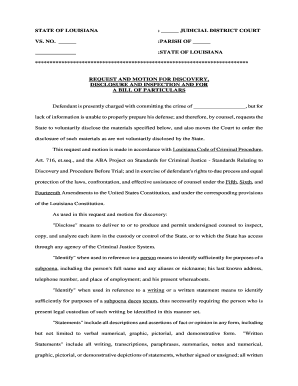
STATE OF LOUISIANA : ______ JUDICIAL DISTRICT COURT
VS. NO. ______ :PARISH OF ______
______________ :STATE OF LOUISIANA
*************************************************************************
REQUEST AND MOTION FOR DISCOVERY,
DISCLOSURE AND INSPECTION AND FOR
A BILL OF PARTICULARS
Defendant is presently charged with committing the crime of __________________ , but for
lack of information is unable to properly prepare his defense; and therefore, by c ounsel, requests the
State to voluntarily disclose the materials specified below, and a lso moves the Court to order the
disclosure of such materials as are not voluntarily disclosed by the State. This request and motion is made in accordance with Louisiana Code of Criminal Procedure,
Art. 716, et.seq., and the ABA Project on Standards for Criminal Justice - Standa rds Relating to
Discovery and Procedure Before Trial; and in exercise of defendant's rights to due process and equal
protection of the laws, confrontation, and effective assistance of counsel under the Fifth, Sixth, and
Fourteenth Amendments to the United States Constitution, and under the corresponding provisions
of the Louisiana Constitution.
As used in this request and motion for discovery:
"Disclose" means to deliver to or to produce and permit undersigned counsel t o inspect,
copy, and analyze each item in the custody or control of the State, or to w hich the State has access
through any agency of the Criminal Justice System. "Identify" when used in reference to a person means to identify sufficiently for purposes of a
subpoena, including the person's full name and any aliases or nickname; his la st known address,
telephone number, and place of employment; and his present whereabouts.
"Identify" when used in reference to a writing or a written statement means to identify
sufficiently for purposes of a subpoena duces tecum, thus necessarily requiring the person who is
present legal custodian of such writing be identified in this manner set.
"Statements" include all descriptions and assertions of fact or opinio n in any form, including
but not limited to verbal numerical, graphic, pictorial, and demonstrative form . "Written
Statements" include all writing, transcriptions, paraphrases, summaries, not es and numerical,
graphic, pictorial, or demonstrative depictions of statements, whether signed or unsigned; all written
materials, including but not limited to records and reports prepared by law enforcement and
prosecuting authorities, their representatives and all professional pers onnel, reflecting the existence,
contents, or nature of statements; all written materials; including but not limited to records and
reports prepared by law enforcement and prosecuting authorities, their representati ves, and all
professional personnel and all recordings and real or physical objects, reflect ing or used in any
assessment of the veracity or reliability of statements by polyg raphic or any other means; and all
reproductions thereof. "Oral Statements" include all oral statements stenographically, mechanic ally, or manually
recorded, or not recorded. "Records and reports" include all records and reports, whether formal or informa l, written or
recorded, and all notes, notations, or memoranda. "Or" is used inclusively.
"Law enforcement authority" includes every municipal Police Department , every Parish
Sheriff's Department, the Louisiana Department of Public Safety, the F ederal Bureau of
Investigation, and every other City, County, Parish, State, Federal or Military agency having
responsibilities for criminal law enforcement or criminal investigati on; and the successors of each.
"Prosecuting authority" includes every City Attorney's Office, every Di strict Attorney's
Office, the Office of the Attorney General of Louisiana, every Uni ted States Attorney's Office, the
United States Department of Justice and every other City, County, Parish, St ate, Federal or Military
agency having responsibility for the prosecution of criminal offenses. "Representative" includes every official, officer, deputy, assistant, agent, servant, or
employee of an authority, whether full-time or part-time, and whether paid or unpaid; every
consultant and every person who has acted at the instance of, or who report s to, any such person; and
the successors of each. "Hearsay" includes an out-of-town statement offered into evidence to prov e the truth of the
matter contained therein. "Professional personnel" includes all persons expert, experienced, or employed in t he fields
of medicine, psychiatry, psychology, mental health, pathology, criminalist ics, forensic science,
toxicology, chemistry, biochemistry, or laboratory science; all persons who conduc t scientific
investigations or examinations of any sort in connection with criminal ma tters; and the
representatives and successors of each.
"District Attorney" includes the District Attorney, his office, every Assistant District
Attorney, and every other representative of that office who has had or has re sponsibility for
preparing or presenting matters connected with the prosecution of this case; and the succe ssors of
each. "Alleged crime' includes the offense charged in the Indictment, all l esser included offenses,
and all offenses that may subsequently be charged against the defendant in connection wi th the
events giving rise to the indictment, together with their lesser included offenses.
THE INCIDENT :
1. With respect to the alleged act of the defendant which serves as the basis of the
charge herein, please disclose the following: a) In what Parish and Municipality did it occur?
b) On what date and at what time did it occur? c) At what location did it occur?
1) If such occurrence happened within a structure describe the exact place or places involved in the incident;
2) If such occurrence happened in more than one place describe
all places which are related to the occurrence and the relation
of the places to one another and by what means the places are
connected to the occurrence.
3) If such occurrence happened or continued to happen within or on a moving object/vessel/missile/mobile home, aircraft
structure, etc., then describe such objects, etc.
4) Describe in detail the route or routes such moving objects, etc., proceeded along, including the location of all
interruptions of their course all persons known to the State, it
agents, etc., who observed or intervened or became involved
with such objects or interrupted the progress of such objects
along such route or routes and describe the location when
such obstruction, involvement, or interruption occurred.
THE STATUTE :
2. Upon what statute or statutes is this prosecution based? a) If this prosecution is based upon any statute or statutes Consisting of
sections, parts, paragraphs, or division of any kind, specify which
section, part, paragraph or division this prosecution is based upon.
State v. Baker, 259 So.2d 306; State v. Mann, 202 So.2d 259; State v.
Wright, 225 So.2d 201; State v. Johnson, 365 So.2d 1267;
b) Does the State allege and intend to prove any physical and/or sexual
act or acts on the part of the defendant as being the crime(s) or part of
the crime(s)?
c) If the answer to "b" above is yes, then state the number of acts,
describe each act, the place where each act took place. State v.
Holmes, 65 So.2d 891; State v. Brooks, 136 So.71.
1) State the date and time of day of the overt act or acts which
constitute the preparation on the attempt to commit the
alleged crime.
2) State the date and time of day that the act which constitutes
the alleged crime occurred.
d) If specific intent is one of the essential elements of the f oregoing
statute then and in that event state whether or not the State will use
any presumption(s) or inference(s) to establish intent and if so state
upon what premise or evidence the State will exhibit to create such
inference(s) or presumption(s). Mullaney v. Wilbur, 421 U.S. 684, 95
S.Ct.1881(1975); In Re: Winship, 397 U.S. 358, 90 S.Ct.1068(1970);
State v. Searle, 339 So.2d 1194, 350 So.2d 370; State v. Montoya,
340 So.2d 557, State v. Coleman, 358 So.2d 289.
THE INITIAL REPORT :
3. To what law enforcement authority was this matter first reported: a) Disclose by what means it was first reported and the date and time of
such report.
b) Identify the person by whom the initial report was made.
4. Identify the law enforcement authority that was principally responsible for the
investigation of this matter. 5. Identify all other law enforcement authorities that participated in the investigation of
this matter.
INFORMATION CONCERNING THE VICTIM :
6. Identify the alleged victim, including his/her: a) Full name and all aliases;
b) Last known address; c) Last known employer;
d) Date of birth; e) Name and address of next of kin.
7. Disclose the juvenile, youthful offender, and adult criminal record of the a lleged
victim, including any charges pending or pending at the time of death of t he alleged victim ("rap
sheet"). 8. Disclose any previous complaints made against the defendant or others by the alleged
victim. 9. Disclose the alleged victim's reputation for violence, if known to any representative
of any law enforcement or prosecuting authority. 10. Disclose whether the alleged victim was taking or under the influenc e of alcohol
and/or any drug at and near the time of the alleged crime, and if so, then what was the amount and
type of the alcohol and or drug. 11. Disclose any mental, psychological, or physical problem (and reports of sa me), that
the alleged victim had, including but not limited to alcoholism, drug abus e, mental illness, or mental
defect or exhibition of as violent, antisocial, or divert act(s).
INFORMATION CONCERNING THE ARREST OF THE DEFENDANT :
12. CONCERNING THE DEFENDANT:
a) On what date and at what time and place was the defendant arrested?
b) Identify the persons who arrested the defendant, and all persons present at the time of the arrest.
c) Was the defendant arrested with a warrant of arrest? If so:
1) On what date and at what time and place was the warrant
issued?
2) By whom was the warrant issued?
3) Identify the persons who obtained the warrant of arrest and who executed the affidavit in connection therewith.
4) Were the allegations set forth in the affidavit supporting the
issuance of the arrest warrant all within the personal
knowledge of the affiants or were these allegations totally or
in part based upon information supplied by another person?
5) If the allegations set forth in the affidavit supporting t he arrest
warrant were supplied totally or in part by a person other than
the affiant:
a) Identify said person;
b) Is this person the victim, the complainant, a police
officer or an informer?
c) If said person is an informer, set forth in detail facts
within the personal knowledge of the affiants at the
time they affidavit executed from which they concluded
the informant was reliable.
6) Set forth in detail the facts alleged in the affidavit upon which
the warrant of arrest was issued.
7) Was the arrest warrant issued in the name of the State of Louisiana?
8) Does the arrest warrant state the name of the person to be
arrested, and if so, what is the name of that person?
9) If the name of the person to be arrested was unknown, does
the arrest warrant designate the person to be arrested by any
name or description by which he can be identified with
reasonable certainty, and if so, set forth that name and/or
description.
10) Does the arrest warrant state the offense charged against the person to be arrested, and if so, what is that charge?
11) Does the arrest warrant command that the person against
whom the complaint was made be arrested and booked?
12) Is the arrest warrant signed by the issuing magistrate with the
title of his office?
13) The defendant moves the court to require the State of
Louisiana to produce and provide the defense attorney a copy
of such arrest warrant.
d) If the defendant was arrested without a warrant of arrest:
1) Were the facts upon which the arresting officers acted in
arresting the defendant all within the personal knowledge of
the arresting officers, or were these facts totally or in part
based upon information supplied by another person?
2) If the facts upon which the arresting officers acted in arres ting
the defendant were supplied totally or in part by a person
other than the arresting officer:
a) What is the name, title and last known residence and
business address of said person?
b) Is this person the victim, the complainant, a police officer, or an informer?
c) If said person is an informer, set forth in detail facts
within the personal knowledge of the arresting officers
at the time of the arrest from which they concluded the
informant was reliable.
IDENTIFICATION OF THE DEFENDANT :
13. By what means was the defendant identified as the alleged perpetrator of the crimes
charged.
14. CONCERNING THE MEANS :
a) If said identification was by real, demonstrative, or tangible ev idence
such as, but not limited to, blood, hair, fingerprints, DNA processes
or analysis , clothing, etc., where, when and by whom was said
evidence and/or identification obtained.
b) If said identification was by said real, tangible, or demonstrativ e
evidence, then the defendant hereby respectfully request the court to
permit him to inspect and/or copy, or photograph said items or
objects and have samples of such properly delivered to such experts
as the defendant names.
15. If said identification was by means of statements implicating the defendant, then the
defendant requests the court to permit him to inspect and/or copy, or photograph said items, objects
and statements in connection therewith. 16. If said identification was by means of a photograph, then: a) What person or persons identified the defendant.
b) Where, when, and under what circumstance was the identification made, and who presented said photographs.
c) On how may occasions was the person or persons requested to view
photographs for purposes of identification and what were the dates
and times of each viewing.
d) How many photographs and what photographs were shown on each
such occasion.
17. a) Was a "line-up" of suspects conducted at any time during the
investigation of this case, either before or after the defendant was
arrested for the charge herein?
b) If so, with respect to each line-up of suspects conducted, please sta te:
1) The date, place, time of beginning and time of ending of each line-up.
2) The number of persons in each line-up.
3) The name and last known residence and business addresses of each and every person in each such line-up.
4) With respect to each person in the line-up, please state and/or
describe that person's (a) sex; (b) age; (c) height; (d)
weight; (e) race; (f) complexion; (g) color of hair; (h) color
of eyes; (i) scars, tattoos or other distinguishing features.
5) The name, title (if any) and last known residence and business address of the person(s) conducting each such line-
up.
6) The name, title (if any) and last know business and residence address of each and every person present at each such line-up
and whether they were present at each such line-up as a
prospective witness or in some other capacity.
7) Was any person identified as the alleged perpetrator of the crime herein charged? If so,
a) At which line-up(s) was such identification made?
b) Which person(s) was identified and by whom?
c) Was any of the persons present representing, as an
attorney for the defendant?
d) Was the defendant or representative of the defendant
allowed to be present when the witness(es) made
response or responses and/or opinion(s) to the police
after viewing the line-up? State v. McGhee, 350 So.2d
370 (1977).
8) Were any photographs made of the participants or "fill-ins" in the-above mentioned line-up ? If so:
a) Please provide a copy of said photograph(s) to the
defendant herein or make such photographs available to
the defense for copying.
b) Were any other photographs taken of defendant while in police custody and if so the defense moves for the name
and address of the person taking the photograph and the
name or names of the person(s) to whom such
photograph or photographs were exhibited. Defendant
further moves the Court to direct the State to provide
copies of such photograph or allow the defendant to
secure such copies by using the negatives of the State.
18.
a) Was a showing of "mug shots" to any witnesses or prospective
witnesses conducted at any time during the investigation of this cas e
either before or after the defendant was arrested for the charge
herein?
b) If so, with respect to each showing of "mug shots" conducted, please state:
1) The date, place, time of beginning and time of ending of each such showing.
2) The number of photographs and or artist's sketches used in
each showing, and whether the photographs and or sketches
were in black and white of color.
3) The name and last known residence and business addresses of
each and every person depicted in each such photograph and
or artist sketch.
4) With respect to each person depicted in each photograph
and/or artist sketch please state and/or describe that person's
(a) sex; (b) age; (c) height; (d) weight; (e) race; (f)
complexion; (g) color of hair; (h) color of eyes; (i) scars,
tatoos and other distinguishing features.
5) The name, title (if any) last known residence and business address of the person(s) conducting each such showing.
6) The name, title (if any) an last known residence and business address of each and every person present at each showing,
and whether they were present as a prospective witness or in
some other capacity.
7) Was any person identified as the alleged perpetrator of the
crime herein charged? If so,
a) At which showing was the identification made?
b) Which person(s) was identified and by whom?
19. Were any descriptions of the perpetrator given by the alleged victim of the crime in
question? If so, a) Please provide a copy of such description to the defendant herein.
20. Were any descriptions of the alleged perpetrator broadcast or in any other wa y
disseminated by the police authority in connection with the alleged offense? If so,
a) Provide a copy of such description to the defendant herein.
21. Defendant moves the Court to order the State of Louisiana to prod uce all handwritten
or transcribed notes of the investigating officer or any other officer wherein the description of the
alleged perpetrator was reduced to writing and filed or any other file, incl uding but not limited to the
personal notes of any officer receiving such description; and any other exculpa tory assertion,
descriptions, or comments which may exist in such notes or files. (Brady v. M aryland, 373 U.S. 83,
S.Ct. 1194. State of LA. v. Falkins, 356 So.2d 415.
22. Defendant moves the Court to order the State of Louisiana to produce the ori gi nal
composite description, if one was made, the name of the person piecing the individual composite
pieces together, the names of all people present and the manner and order in which the compos ite
description was made. 23. Was the defendant interrogated relative to this offense? If so: a) On what date(s) and at what time(s) and place(s) was the defendant
interrogated?
b) How long was each interrogation? c) What are the names, titles and last known residence and business
addresses of the persons who interrogated the defendant, and all
witnesses to each such interrogation?
24. Prior to each such interrogation, or making any confession, statement and/or admission, was
the defendant advised that: a) He was under arrest?
b) He had a right to remain silent and not give any statement if he so
desired?
c) Any statement he made could be used against him in prosecution of
a criminal offense?
d) He had a right to have the assistance of a lawyer and to have a lawyer
present while making the confession, statement and/or admissio n and
that if he could not afforded an lawyer, one would be appointed to
represent him?
e) Identify the specific person who advised the defendant of such right s.
f) Did the defendant waive his Miranda rights and if so the defendant
moves the court to order the State to produce the waiver and the
circumstances under which such waiver came about? Miranda v.
Arizona, 384 U.S. 436, Taque v. Louisiana, No: 79-5836, on the
docket of the U.S. Supreme Court, dated January 21, 1980.
(g) Was the defendant given any promise or inducement to make any
confession, statement and/or admission, and if so, what is the exact
time, date and place each such promise and/or inducement was
offered, and identify persons who offered such promise and/or
inducement and describe fully and in detail the promise and/or
inducement offered.
25. Did the defendant make any requests to communicate with any attorn ey, members of
his family or any one else at the time of or subsequent to his arrest; and if so, what are the exact
times, dates and places each such request was made, the full nature of each request; identify the
person by whom such request was granted or denied and by whom? 26. State whether or not the defendant has made any statement to any repres entative of
any law enforcement or prosecuting authority or to any other person, which state ment contained any
references, or was otherwise relevant, to this matter. If so, then for each such statement: a) State whether it was oral or in writing.
b) State the date, time and place at which it was made. c) Identify all representatives of any law enforcement or prosecuting
authority who were present at, or who witnessed, any part of the making of the statement.
d) For each person identified above, state whether or not he was known to the defendant at the time to be a representative of a law
enforcement or prosecuting authority.
e) Identify all other person who were present at, or who witnessed any
part of the making of the statement.
f) Identify all writings made by any person identified in subsection "c "
or "e" above which writing records or reflects any information
requested in these particulars section.
g) State whether or not the statement, or any part of it, inculpated or
tended to inculpate the defendant as to his guilt or innocence of the
crime with which he is charged, or as to any possible aggravating or
mitigating circumstances or any factor or premise contained therein.
h) State whether the statement, or any part of it, exculpated or tended t o
exculpate the defendant as to his guilt or innocence of the crime with
which he is charged, or as to any possible aggravating or mitigating
circumstances or factor thereof.
i) State whether or not the prosecution intends to introduce such
statement at the trial on the merits, or any hearing.
j) For each oral statement of the defendant:
1) Identify the person or persons to whom it was made;
2) State whether or not it was recorded or transcribed in any manner;
3) Describe the manner in which it was recorded or transcribed;
4) Disclose the substance of such statement;
5) Produce all recordings, transcriptions or written summaries of
each oral statement.
k) Identify the person or persons who actually wrote or typed the
statement;
1) Identify the person or persons who actually wrote or typed the statement;
2) Produce each such statement;
27. In addition to the above, disclose: a) All responses to questions, directions or communications of an y kind,
and all observed behavior of the defendant, which responses or
behavior, if they were written statements, would be requested in
paragraph numbered 23, 24, 25 or 26.
b) All communications of the defendant in any form, that purported to be, or to contain or evidence any waiver of his legal or constitutional
rights, which communications if they were written statements would
be requested in paragraphs numbered 23, 24, 25, or 26.
c) All waiver forms, warnings, cautions, or instructions that were
communicated to the defendant in any form, in connection with:
1) Any written or oral statement response, communication, or observed behavior of the defendant described in paragraphs
23, 24, 25, or 26.
2) Any interview, examination, evaluation or contact with or of the defendant by any representative of any law enforcement
of prosecuting authority or by any person acting under the
supervision of, or reporting to such representative.
d) All written or oral statements, all responses to question s, directions or
communications of any kind, and all observed behavior of the
defendant during any interview, examination, evaluation or contact
described in paragraphs numbered 23, 24, 25 or 26, by through which
the defendant:
1) Indicated that he did not wish to, or would not, respond to any question, direction or communication;
2) Failed to respond to any questions, direction or
communication.
PHYSICAL EVIDENCE :
28) CONCERNING PHYSICAL EVIDENCE:
a) Does the state have in its possession, custody or control any books,
papers, documents, photographs, tangible objects, including but not
limited to any weapons or objects which may be mistaken for a
weapon, buildings, places or copies or portions thereof which are
favorable to the defendant and which are material and relevant to the
issue of guilt or punishment or material to the preparation of the
defense or intended for use by the State as evidence at the trial or
were obtained from or belong to the defendant or the victim or any
person, other than the defendant, who has previously been suspected
of the crime alleged herein? If so, defendant moves to require the
State to authorize the defendant to inspect, copy examine or test,
scientifically, photograph or otherwise reproduce, said documents
and tangible objects. (LSA Code of Criminal Procedure, Art. 718 ).
b) If such evidence was seized pursuant to a search warrant:
1) On what date and at what time and place was the warrant issued?
2) By whom was the warrant issued?
3) Identify the persons who obtained the warrant and who executed the affidavit in connection therewith.
4) Were the allegations set forth in the affidavit supporting the issuance of the search warrant all within the personal
knowledge of the affiants or were these allegations totally or
in part based upon information supplied by another person?
5) If the allegations set forth in the affidavit supporting the
search warrant were supplied totally or in part by a person
other than the affiants:
a) Identify said person;
b) Is this person the victim, the complainant, a police officer or an informer?
c) If said person is an informer set forth in detail facts
within the personal knowledge of the affiants at the time
the affidavit was executed from which they concluded
the informant was reliable.
6) Set forth in detail the facts alleged in the affidavit upon which
the search warrant was issued.
7) Set forth with particularity the designation of the area and/or
name of the person authorized to be searched, and the
description of the things authorized to be seized by the
warrant.
8) The defendant moves the court to require the State of Louisiana to produce and furnish the defendant's attorney
with a copy of such search warrant.
c) If such evidence was seized as a result of a search without warrant:
1) Describe fully and in detail the circumstances precipitating
the search.
2) What person and/or areas were searched?
3) What was the purpose of the search?
4) Upon what facts and circumstances were the persons, the
search, acting at the time of the search without warrant.
5) Were the facts and circumstances upon which such persons were acting at the time of the search without warrant all
within the personal knowledge of said persons, or were these
facts and circumstances totally or in part based upon
information supplied by another person?
6) If the facts and circumstances upon which the persons performing the search were acting at the time of the search
were supplied totally or in part by a person other than the said
person:
a) Identify said person;
b) Is this person the victim the complainant, a police officer, or an informer?
c) If said person is an informer, set forth in detail facts
within the personal knowledge of the persons
performing the search at the time the search was
performed from which the y concluded the informant
was reliable.
29. Was the knife or gun, or other dangerous weapon, or an instrument or object which
could appear to be a weapon or used as a weapon, in the possession of any person pre sent at the
scene of the incident, including but not limited to the alleged victim , at the time of the alleged crime,
referred to in "The Incident", Paragraph 1 supra; and, Was knife or gun or other dangerous weapon,
or an instrument or object which could appear to be a weapon, or an instrument or object which
could appear to be a weapon or used as a weapon, found at such scene and time? If so, then for each
weapon or instrument or object which could appear to be a weapon or used as a weapon: a) Identify all persons by whom it was possessed, and the time of such
possession;
b) Describe it in detail; c) Disclose whether or not it was operable;
1) By whom it was used?
2) In what manner?
3) Describe the nature of any wound, injury, or damage caused, inflicted, or otherwise occasioned by its use.
4) Disclose the location, at the scene such weapon or object was located.
d) State whether or not it was recovered by the State, and if so, state:
1) When it was recovered;
2) Where it was recovered;
3) By whom it was recovered;
30. Disclose the existence of, describe, and produce for inspection and testing by counsel
for the defendant the following items: a) All weapons or instrumentalities referred to in the preceding request;
b) All objects taken in the course of the incident referred to in "The Incident", Paragraph 1, supra.
c) All clothing and personal belongings of the defendant and the alle ged
victim in the possession or control of any law enforcement or
prosecuting authority and which:
1) Are material to the preparation of the defense; or
2) Are intended for use by the prosecuting authority as evidence at trial; or
3) Are not intended for use by the prosecuting authority as
evidence at trial.
31. For each item requested in either of the two preceding requests, state whether or not
any scientific tests, experiments, or comparisons have been made and:
a) Describe each such test, experiment or comparison;
b) State when it was made; c) Identify the person by whom it was made;
d) Disclose its results.
WITNESSES :
32. a) Identify all persons whom the District Attorney intends to call as
witnesses at any trial or hearing of this case;
b) Disclose any relevant written or recorded statement of each; c) Disclose the relevant testimony given by each before the Grand Jury.
33. a) Identify all persons whose names, addresses or telephone numbers
are being retained by the District Attorney as potential witnesses at
any trial or hearing of this case; and,
b) Disclose any relevant written or recorded statement of any such
person.
34. Identify all persons whose names, addresses or telephone numbers are being retained
by any representative of any law enforcement or prosecuting authority as pot ential witnesses at any
trial or hearing of this case. 35. Identify all persons who have given any written statement to any representative of any
law enforcement or prosecuting authority in connection with this case. 36. Identify all persons who have given any oral statement to any repres entative of any
law enforcement or prosecuting authority.
37. Identify all persons who have been contacted by the District Attor ney for the purpose
of securing or confirming information in connection with this case. 38. Identify all persons who have been contacted by any representative of a ny law
enforcement or prosecuting authority for the purpose of securing or confirming any inf ormation in
connection with this case. 39. Identify all persons who are known or believed by the District Attorney t o have been
present at, or to have observed, the events surrounding the alleged crime, or any event or fact to be
proved by the District Attorney at any trial or hearing of this case.
40. Identify all persons who are known or believed by any representative of any law
enforcement or prosecuting authority to have been present at, or to have observed, the events
surrounding the alleged crime, or any event or fact to be proved by the Distri ct Attorney at any trial
or hearing in this case. 41. State whether or not any information has been supplied to any representativ e of any
law enforcement or prosecuting authority in connection with the case by any informant. If so, then:
a) Identify any such informant and state whether he participated and/or
observed the alleged crime; Roviaro v. U.S. 77 S.Ct. 623; State v.
Dotson, 256 So.2d 594, 606.
b) Disclose the juvenile, and adult criminal records of any such informant, including matters pending;
c) Disclose the dates, times, places and the kinds and amounts in volved,
of any financial or other compensation paid or made to any
informant.
d) State whether or not any such informant has supplied information to any law enforcement or prosecuting authority in the past. If so, then:
1) Did such information lead or contribute to the initiation of prosecution;
2) In what court and under what docket number was such
prosecution initiated;
3) Did such prosecution result in a conviction;
4) What kind and amount of compensation was made to such informant;
e) Was the informant offered any immunity, reduction of charge and/or
sentence or other incentive in exchange for his cooperation herein.
42. Identify all persons who the State called, requested or subpoenaed or a ttempted to all
in connection with this case to testify before the Grand Jury, but who did not in fact appear before
the Grand Jury.
43. Identify all persons who appeared before the Grand Jury in connection with the
indictment handed down in this case.
44. For each person whose identity was requested in the preceding particulars: a) Disclose all information relating to any grant or offer of immunity to
any such persons.
b) Disclose any question which any such witness refused to answer. c) State whether or not such witness had given a prior written or oral
statement to any representative of any law enforcement or
prosecuting authority.
d) State whether or not there was any discrepancy between the witne ss's
prior oral or written statement and the testimony given by such
witness before the Grand Jury; and if so:
1) Disclose or produce the prior oral or written statement;
2) Disclose and produce the transcript of the witness's testimony before the Grand Jury.
45. Identify all persons who in connection with this matter or the investigation of it: a) Have been charged by an prosecuting authority;
b) Have been booked by any law enforcement or prosecuting authority; c) Have been arrested or detained by any representative of any
enforcement or prosecuting authority;
d) Have been sought, for purposes of possible arrest or detention, by a ny
representatives of any law enforcement or prosecuting authority;
46. Identify all persons who have given information to the D istrict Attorney or member of
his staff or to any other person who has participated in the investigation or evaluation of this case,
and who either regularly report or with reference to this particular case hav e reported to this office
which information tends to negate the guilt of the accused as to the a lleged crime or would tend to
reduce his punishment therefor, including any information that would be evidence or could lead to
any evidence, of any mitigating circumstances (including but not limit ed to those set out in
C.Cr.P.Art. 905.5) or that would tend to rebut or discredit evidence intended by the prosecut ion to
establish one or more of the aggravating circumstances set forth in C.Cr.P.,Art.905.4.
EXCULPATORY EVIDENCE:
47. Disclose all evidence that tends to negate the guilt of the ac cused as to the alleged
crime, or would tend to reduce his punishment therefor, including information that coul d lead to the
discovery of such evidence, which evidence or information is in the possession or control of: a) The District Attorney; or
b) Any member of his staff; or
c) Any representative of any prosecuting authority that has participated
in the investigation or evaluation of this case and who either regularly
reports or with reference to the alleged crime has reported to the
District Attorney or any member of his staff; or
d) Any representative of any law enforcement authority that has participated in the investigation or evaluation of this case and who either regularly reports, or with reference to the alleged crime has
reported to the District Attorney or any member of his staff; or
e) Any other person who has participated in the investigation or
evaluation of this case, and who either regularly reports or with
reference to this particular case has reported to the District Attorney
or any member of his staff; or
f) Any member of any prosecuting authority; or
g) Any member of any law enforcement authority; or
h) Any other person.
MEDICAL INFORMATION :
48. At what place did the alleged victim allegedly suffer a/an __________________?
49. On what date and at what time did the victim allegedly suffer a/an
__________________? 50. Were any photographs taken or description made of the victim's alleged wound or
wounds, trauma or traumas? If so, please state: a) Identify the person or persons taking such photographs and/or
descriptions;
b) When, where and at what time said photographs and/or descriptions taken?
c) Identify and produce any and all such photographs and/or
descriptions for copying.
51. Was the victim taken to a hospital or other medical treatment f acility after the alleged
crime in question? If so: a) On what date and time was the victim taken to a hospital and/or
medical treatment facility;
b) By whom was the victim seen at the above-named hospital and/or medical treatment facility;
c) What medical assistance was rendered at the abo ve-named hospital
and/or medical treatment facility;
d) Identify and provide copies of all writings prepared by the above mentioned hospital and/or medical treatment facility.
52. Did the victim receive any first aid or other medical assistance or treatment? a) Identify all professional personnel or other persons who participated
in or witnessed such aid, assistance, or treatment.
b) Identify all writings prepared by all such persons in connection with this matter.
53. Were any tests performed, or examinations conducted, on the person or body of the
victim, or on any substance obtained from it? If so, then for each such test: a) Describe it;
b) Disclose its results; c) Identify all professional personnel or other person who par ticipated in
its performance, or who witnessed any part of it;
d) Identify and produce all writings prepared by all such persons in connection with such test or this matter.
e) Was an autopsy performed, if so, by whom, when and where; produ ce
or state where the results of such autopsy can be found, copied and
examined and who has the death certificate.
54. Were any tests performed, or examinations conducted, on the person or body of the
defendant, or any substance obtained from it? If so, then for each such test: a) Describe it;
b) Disclose its results; c) Identify all professional personnel or other persons who participated
in its performance, or who witnessed any part of it;
d) Identify and produce all writings prepared by all such persons in connection with such tests on this matter.
55. Defendant moves the court to order the State, its agents, servants and employees,
including but not limited to the District Attorney to provide the defendant with any and all
information contained in its files and which such information is favorable to the defendant or
exculpatory in any manner; all in accordance with Brady v. Maryland, 373 U.S. 83 S.Ct. 1194; and,
to place the State, its agents, servants and employees including but not limited to the District
Attorney under a continuing duty to disclose such evidence or information. 56. The defendant moves the court to direct the District Attorney for the P arish of
_______ to provide the name, address, and birth date of the alleged victim and the na me, address
and birth date of all witnesses the State intends to use at trial.
57. The defendant moves the court to direct the State of Louisiana, through it s proper
agents, including but not limited to the District Attorney, and the _______ Pa rish Sheriff's Office, to
provide a copy of the alleged victim's criminal arrest and convictions or to direct the District
Attorney to secure same from the _______ Parish Sheriff's Office or order the _______ Parish
Sheriff's Office to provide same to the defendant's attorney. State v. Henderson, 362 So.2d 1358.
58. The defendant moves the court to direct the State of Louisiana through it proper
agents, including but not limited to the District Attorney and the _______ Pari sh Sheriff's office to
provide a copy of the criminal records of the arrest and conviction of all pe rspective state witnesses,
including but not limited to those listed in Particular No. 56 hereinabove. S tate v. Harvey, 358 So.2d
1224, Brady v. Maryland, 393 U.S. 83; U.S.V.Agurs, 427 U.S. 97.
59. Was the defendant taken before a committing magistrate or other judicial officer after
he was taken into custody, and what is the exact time, date and place he was taken before such
magistrate or judicial officer? 60. Does the State intend at the trial of this case to offer evide nce of the commission of
any other crime admissible under the authority of R.S. 15:445 or R.S. 15:466 for the purpose of
establishing system, pattern and intent? (LSA Code of Criminal Procedure, Article 720).
61. Defendant moves to require the State to furnish him a copy of any record of his
criminal arrests and convictions that is in their possession or custody. (L SA Code of Criminal
Procedure, Article 717).
62. Did the State obtain or does the State have any exculpatory evidence or evidence
favorable to the defendant, and if so, defendant moves to require the State to furnish him said
exculpatory evidence. (LSA Code of Criminal Procedure, Article 722 ).
63. Does the State intend, at the trial of this case, to use any writ t en or recorded
confessions or inculpatory statements made by a co-defendant. If so, defendant moves to require the
State to permit or authorize the defendant to inspect and copy, photograph or otherwise reproduce
said confessions or statements. (LSA Code of Criminal Procedure, Article 722 ).
64. Does the State intend, at the trial of this case, to use hearsay statements of co -
conspirators pursuant to R.S. 15:455, (LSA Code of Criminal Procedure, Art. 721 ).
65. The defendant moves the court to order the District Attorney and th e Police authority
concerned herein to produce for examination by the defense all police reports, notes , personal or
otherwise, including but not limited to all grand jury testimony, relating to this matter for the
purpose of extracting exculpatory material and/or evidence which relates to this issue of guilt or
punishment or impeachment of State witnesses herein or in the alternativ e the court is moved to
examine all such material in camera, including but not limited to Grand Jury Testimony, and deliver
to the defense all such exculpatory material, in advance of trial or at least, after the State's witness
has testified but before the defendant cross-examines. Martinez v. Wainwright, 621 F.2d 184 (5th
Cir. 1980). 66. The defendant moves the court to order the State and the Police Authority herein
concerned to deliver to the defense a list of the names, birthdays, and addre sses of all people
interviewed or contacted relative to this matter whether or not the Sta te intends to use such people or
witnesses and whether or not such people gave statements. 67. The defendant moves the court to order the State and police authority concerne d to
provide the defense with criminal records of all people it intends to use as witnesses at trial. Brady v.
Maryland, 393 U.S. 83 (1963), U.S. Agurs, 427 U.S. 97, Lewis v. U.S., 393 A.2d 109 (1978).
68. State names and addresses of all persons who have been suggested, suspe cted,
implicated, accused, questioned, investigated, booked, arrested, charged, indicted, or who have
confessed to the alleged crime herein. 69. State whether or not the State intends to make the character of the de fendant or any
other witnesses known to the State an issue by introducing prior convictions. 70. Describe the weapon or weapons allegedly used by the defendant.
71. In reference to the weapon described in Paragraph 70, please state: a) The manner in which said weapon was allegedly used;
b) The name of the owner of said weapon; c) The date, time and place said weapon was recovered;
d) By whom said weapon was recovered; e) The name of the person or persons who presently have custody of
said weapon.
72. In reference to the weapon described in Paragraph 70 the defendant moves the State
to allow the defense to inspect said weapon. 73. Does the State or any of its officers, agents and employees have in its custody any
photographs and/or descriptions of the weapon referred to in Paragraph 70. If so, a) Please identify the person or persons who took said photograph
and/or description;
b) The date, time and place such photograph and/or descriptions were taken;
c) The person or persons who have custody of said photograph and/or
descriptions;
d) Identify and provide said photographs and/or descriptions for inspection by the defense.
74. Does the State intend to introduce any out-of-court statement or stat ements that form
part of the res gestae of the alleged offense in question. If so, please state: a) Who made such statement or statements;
b) The date and time and place such statements were made; c) The substance of each such statement;
d) State whether or not such statement is exculpatory or inculpatory as it relates to the defendant (See Art.I, Sect. 16
of the La. Const. of 1974 ; Sixth Amendment to the Const. of
United States ; California v. Green, 339 U.S. 149, 90 S. Ct.
1930; State v. Johnson, 381 So.2d 436; State of New Mexico
v. Lunn, 484 P.2d 368.) (State v. Jackson, 381 So.2d 485 (La.
1980).
75. The Court is moved to order the State, its agents, officers, servants a nd personnel,
including but not limited to the District Attorney to produce any evidence favorable to the accused,
including but not limited to statements of witnesses contradictory to a ny alleged eye -witness
accounts, records of arrests and convictions of the State's principal witne sses; evidence of hostile
demonstrations or overt act on part of the victim toward the accused; evidence of dangerous
character of threats of victim against the accused; evidence adve rsely affecting credibility of the
State's witnesses. State v. Bailey, 367 So.2d 368 (La.1979); State v. Roussel , 381 So2d 796
(La.1980); Giles v. Maryland, 386 U.S. 75, 97 S.Ct. 793 (1967).
76. The Court is moved to direct the State, its agents, employees, officers and personnel,
including but not limited to the District Attorney, to honor their co ntinuing duty to promptly disclose
to the Defense Attorney, such material and evidence upon learning of same , even during the course
of any hearing or trial concerned herein. State v. Bailey, 367 So.2d 368 (La.1979); Stat e v. Roussel,
381 So.2d 796 (La.1980); State v. Falkins, 356 So.2d 415 (La.1978).
77. The Court is moved to direct the State, its agents, employees, officers and personnel,
including but not limited to the District Attorney, to disclose to the de fense all ex perts consulted in
this matter, their names, addresses, birthdays, qualifications, and credentia ls, including but not
limited to the experts the State intends to use at trial and whether t hey are on the State's payroll or
have been privately retained by the State. 78. The Court is moved to direct the State, its agents, deputies, servants and employees,
including but not limited to the District Attorney, to inform all witnes ses, including witnesses who
have appeared before the Grand Jury, that the Defense has a right to inquire into their knowledge of
this matter and they may answer to the defense inquires if they so choose. 79. The Court is moved to direct the State, its agents, deputies, servants and employees,
including but not limited to the District Attorney and the Law Enforcem ent Agency, concerned
herein, to disclose to the defense whether or not they have informed any wit ness or potential witness
not to discuss this matter with the defendant's attorneys or investigat ors or whether or not any such
witness has called the District Attorney or any member of the law enforcement agency, concerned
herein, and informed either of them that the Defendant's Attorney or his inves tigators has requested
to talk to him or attempted to talk to him, if so, then it is moved t hat the District Attorney or the Law
Enforcement Agency, concerned herein, inform the defense what the witness w as told by the either
of them.
80. If the answer to part "THE STATUTE", particular No. 2, relates to LSA-R.S. 14:30,
relative to "FIRST DEGREE MURDER" then and in that event the Court is moved to direct the
State, its agents, deputies, servants and employees, including but not limited to the District Attorney,
to disclose, specifically and fully, to the defense, the essential element or eleme nts, set out in LSA-
14:30, which distinguishes it from the crime set out in LSA-R.S. 14:30.1, relative to "SECOND
DEGREE MURDER".
81. If the answer to part "THE STATUTE", particular No. 2, relates to LSA-R.S. 14:30,
relative to "FIRST DEGREE MURDER" then and in that event the Court is moved to direct the
State, its agents, deputies, servants and employees to disclose, spec ifically and fully, to the defense
and to deliver to the defense, any evidence of provocation which may be use ful to the defense in
presenting a "heat of blood or sudden passion" defense or the defense of self defense.
82. If the answer to part "THE STATUTE", particular No. 2,relates to LSA-R.S. 14:30,
relative to "FIRST DEGREE MURDER" then and in that event the Court is moved to direct the
State, its agents, deputies, servants and employees, including but no lim ited to the District Attorney,
to disclose, specifically and fully, to the defense, the specific a ggravating circumstances, one or
more, listed in LSA-C.Cr.P. Article 905.4, which the State intends to prove in the sentencing phase
thereof.
83. If the answer to part "THE STATUTE", particular No. 2, relates to LSA-R.S. 14:30,
relative to "FIRST DEGREE MURDER" then and in that event the Court is moved to direct the
State, its agents, deputies, servants and employees, including but not limited to the District Attorney,
to disclose, specifically and fully, to the defense, what evidence i t has or intends to use to rebut the
defendant's premise, presented under the authority of LSA-C.Cr.P. Article 905.5 , that he:
a) Has "No significant prior history of criminal activity"; and/or;
b) "The offense was committed while the offender was under the influence of extreme mental or emotional disturbance"; and/or,
c) "The offense was under the influence or under the domination of
another person"; and/or;
d) "The offense was committed under circumstances which the off ender
reasonably believed to provide a moral justification or extenuation
for his conduct; and/or;
e) "At the time of the offense the capacity of the offender to appreciat e
the criminality of his conduct or to conform his conduct to the
requirements of law was impaired as a result of mental disease or
defect or intoxication"; and/or;
f) "The youth of the offender at the time of the offense"; and/or;
g) "The offender was a principal whose participation was relatively
minor"; and/or;
h) "Any other relevant mitigating circumstances".
84. The Court is moved to direct the State, through the District Attorney, to notify each
and every law enforcement officer and any other person involved in the inves tigation of the Crime
Alleged herein, including but not limited to any experts or crime lab pe rsonnel , to file any notes,
memorandum, comments, pictures, diagrams, names of persons interviewed and not inte rviewed,
consulted and otherwise contacted in connection with the investigation of the alleged crime herein
with the District Attorney's Office. 85. The Court is further moved to direct the State, through the District Attorne y, to
examine the material cited in paragraph 84, and deliver any exculpatory mat erial to the defense,
including the name and address of any witnesses or potential witnesses the State through its agents,
officers, deputies and investigators have not interviewed or any such wit nesses, interview or not, the
State does not intend to use at trial. 86. The Court is further moved to direct the State, through the District Attorne y, to file
with the Court prior to trial every written statement, by any witness i ntended to be used by the State
at trial, the substance of any oral statement of any witness intende d to be used by the State at trial,
the Grand Jury Testimony of each of said witnesses and the complete pol ice report, with all
supplemental and subsequent police reports, for the purpose of granting access to the Defense,
during trial, of any impeaching material contained in such statements, t estimony, and police reports,
concerning any of said witnesses. IT IS SO MOVED.
Respectfully submitted,
_______________________________ _________________ _________________
ATTORNEY FOR DEFENDANT
_____________
_______, Louisiana _______
(___)_______
STATE OF LOUISIANA : ______TH JUDICIAL DISTRICT COURT
VS. NO. ______ :PARISH OF IBERIA
______________ :STATE OF LOUISIANA
______________________________________________________________________________ ORDER
Considering the foregoing motion;
IT IS ORDERED BY THE COURT that the State of Louisiana, through its proper agents,
including but not limited to ____________, District Attorney for the Parish of _______, St ate of
Louisiana, and ____________, Sheriff of the Parish of _______, State of Louisiana, answer, i n
writing, the foregoing Motion for Discovery, Bill of Particulars and Motion for Production, and
cause a copy of such answer to be furnished to defendant through his counsel of record on or before
th e ____ day of _______, 20___, at ________ o'clock __.M., or show cause on the said date a nd said
hour why the said Motion for Discovery, Bill of Particulars and Motion for Pr oduction should not be
answered and complied herewith. SIGNED at ____________, _______ Parish, Louisiana, on this _____ day of ____________,
20___. ________________________________
DISTRICT JUDGE
PLEASE SERVE:
____________
ASSISTANT DISTRICT ATTORNEY