Establishing secure connection…Loading editor…Preparing document…

Bill of Sale

This template is fully customizable. Edit the text, fill out the fields, and send it for signature. Give it a try!
Bill of Sale

What a Bill of Sale Is and when it’s used

A Bill of Sale is a written record documenting the transfer of ownership of personal property from a seller to a buyer. It describes the parties, the item being sold, the purchase price or other consideration, and the effective date of transfer. In the U.S. a Bill of Sale is commonly used for vehicles, boats, equipment, furniture, and business asset sales; it supports registration, title transfer, and tax reporting. State rules vary on notarization, witness requirements, and whether a separate title or certificate is also required; retain the original for your records.

Why a clear Bill of Sale matters

A professional Bill of Sale protects buyer and seller by documenting exactly what was transferred, the terms of transfer, and the date of sale. It helps establish proof of ownership, supports registration and tax reporting, and reduces later disputes over condition, price, or liability.

Why a clear Bill of Sale matters

Who typically completes a Bill of Sale

Bills of Sale are used by consumers and businesses whenever ownership of a tangible asset changes hands; use one whenever a clear, dated record is needed.

  • Private seller to buyer: Use for one-off sales of vehicles, equipment, or collectibles; includes price, condition, and 'as-is' language when applicable.
  • Dealers and brokers: Standardized Bills of Sale support inventory control, customer receipts, and downstream title processing in dealership workflows.
  • Businesses transferring assets: Use for asset sales between companies, subsidiaries, or at liquidation to document value and chain of title.

Essential elements to include in a professional Bill of Sale

A complete Bill of Sale is concise but precise: identify parties, describe the item, record consideration, state conditions, note the date, and include signatures and authentication where required.

Parties

Full legal names and contact information for seller and buyer, matching government ID or business registration records; avoid nicknames or initials.
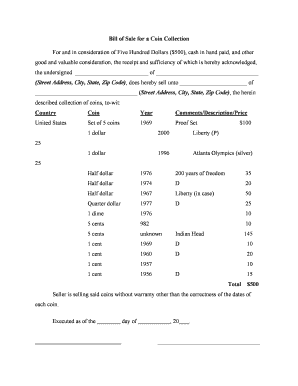
Item description

A clear description including make, model, year, color, VIN/serial number, odometer reading (if vehicle), and any unique identifiers to avoid ambiguity.

Consideration

Exact sale price in dollars or a detailed statement of non-monetary exchange; specify currency and whether taxes are included or excluded.

Condition and warranties

State whether the item is sold 'as is' or with specific warranties; describe known defects and any repair commitments explicitly.

Signatures and dates

Signature blocks for buyer and seller with printed names and dates; include witness or notary lines if state law or the transaction requires them.

Governing law

Name the state whose laws will govern interpretation and disputes; this matters for registration and consumer rights.

Step-by-step: filling out a Bill of Sale

Follow these steps in order to create a clear, enforceable Bill of Sale suitable for registration or tax records.

  • 01
    Gather IDs: Collect government IDs and title documents for verification.
  • 02
    Describe item: Record VIN/serial number, make, model, year, and condition.
  • 03
    Record consideration: Enter exact sale price and payment method.
  • 04
    Sign and notarize: Sign in presence of required witnesses or notary if state law requires.

Where to file or send the completed Bill of Sale

After signing, route copies to the parties and to any agency that requires it for registration or tax reporting.

  • Buyer copy: Buyer retains original for registration and proof of ownership.
  • Seller copy: Seller keeps a signed copy for tax and liability records.
  • DMV or registry: Submit copy with title application where title transfer is required.
  • Taxpayer records: Keep a copy for IRS and state tax reporting as applicable.

Customizing an online Bill of Sale workflow

Configure fields and routing to match your transaction type and any state-specific authentication requirements.

Field Configuration
Required signer fields Make name, signature, and date mandatory for all signers.
Conditional fields Show lienholder fields only if seller indicates an existing lien.
Authentication method Use email link or SMS code; choose stronger ID verification if required.
Document retention Store signed PDF and audit trail for compliance and retrieval.

Digital signing and eSubmission essentials

Choose a platform that supports secure eSignatures, standard file formats, and the authentication level your jurisdiction requires.

  • Supported formats: PDF, DOCX, and printable image formats supported for signed output.
  • Integrations: Common integrations include Salesforce, NetSuite, Google Workspace, and Box for storage.
  • Authentication: Options typically include email link, SMS code, knowledge-based, or multi-factor authentication.

Confirm the chosen platform’s retention, audit trail, and export capabilities to satisfy registration, tax, or legal recordkeeping needs.

Comparison: common eSignature vendors for Bills of Sale

Basic capability and price differences among widely used eSignature vendors can affect cost and compliance; signNow appears first for reference.

signNow DocuSign Adobe Sign PandaDoc HelloSign
Starting Price $8/user/mo $15/user/mo $14/user/mo $19/user/mo $15/user/mo
Free Trial Yes, 7-day trial No No Yes, limited Yes, limited
Bulk Send Yes Yes Yes Yes No
Audit Trail Yes Yes Yes Yes Yes
HIPAA Compliant Yes Yes Yes No No
Envelope Cap No cap 100 envelopes/user/year Varies by plan Varies by plan Varies by plan

Real-world examples of Bills of Sale in practice

Examples show how organizations and owners use Bills of Sale to streamline ownership transfer and recordkeeping.

Tim Martin — Martin Properties

Tim Martin used an online Bill of Sale workflow to record asset transfers quickly and securely.

  • 'I can process and execute all of these documents online...'
  • The digital workflow reduced turnaround time and ensured signed records were stored with clear audit trails for later verification.

Dan Rotelli — BIS

BIS standardized Bills of Sale across departments to document equipment and inventory transfers.

  • 'We felt most comfortable with airSlate SignNow given their SOC 2 certification...'
  • Standardized signed records improved internal controls and simplified audits by keeping searchable signed PDFs and completion certificates.

Key data points to record on the Bill of Sale

Buyer name: Full legal name
Seller name: Full legal name
Item ID: VIN or serial number
Sale price: Exact dollar amount
Effective date: MM/DD/YYYY format
Signatures: Signed and dated

Penalties and risks of an incorrect or incomplete Bill of Sale

Registration denial: Vehicle title issues
Tax consequences: Backup withholding risk
Liability exposure: Ongoing seller liability
Title disputes: Ownership ambiguity
Invalid sale: Missing signatures
Audit issues: Insufficient records

Common mistakes to avoid when preparing a Bill of Sale

  • Using informal identifiers or nicknames instead of full legal names, which can prevent agencies from accepting the document for registration or title transfer.
  • Omitting key item identifiers such as VIN or serial number, producing ambiguity that complicates ownership verification or leads to title rejections.
  • Failing to indicate whether the sale is 'as is' or includes warranties, which can result in later disputes over condition and repairs.
  • Not confirming lien status or failing to note existing liens, which can transfer unexpected liabilities to the buyer or block title transfer.

Practical tips for accurate and efficient completion

Follow these practical steps to reduce errors, speed processing, and produce a legally defensible Bill of Sale.

Verify identities before signing
Confirm government IDs for buyer and seller and use consistent legal names to avoid registration delays and reduce fraud risk during title transfers.
Document exact identifiers
Include VINs, serial numbers, odometer readings, and any unique marks; accurate identifiers prevent mismatches and streamline agency acceptance.
Use clear consideration language
State the exact dollar amount or the detailed description of traded items; clarify taxes and fees responsibility to avoid later tax or payment disputes.
Store signed records securely
Retain signed originals and digital copies with an audit trail; ensure access controls and backups to meet retention and evidentiary needs.

FAQs and common issues with Bills of Sale

Answers to frequent questions about validity, notarization, registration, and how to correct common errors.


Need help? Contact support

be ready to get more
Join over 28 million airSlate SignNow users