Policy Purpose
Brief statement of intent and overview of who and when the policy applies, setting expectations for managers and staff.
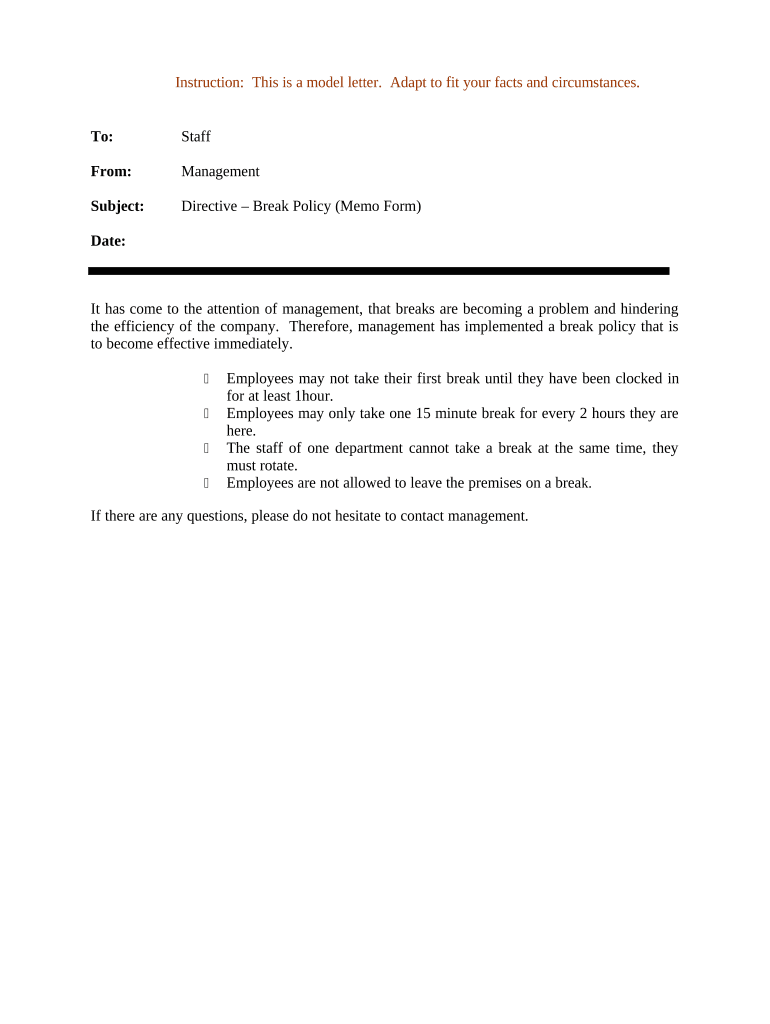
A clear Directive on Break Policy reduces compliance risk, sets consistent expectations for managers and staff, and supports payroll accuracy across exempt and nonexempt classifications. It helps document employer intent and operational practice if a dispute arises.

Human resources, operations managers, and legal counsel typically draft and approve a Directive on Break Policy; supervisors implement it; payroll and timekeeping teams enforce it.
Keep the policy accessible to all staff and include an acknowledgement or signature block to document receipt and understanding.
Brief statement of intent and overview of who and when the policy applies, setting expectations for managers and staff.
Clear definitions for rest breaks, meal breaks, on-call time, and compensable work to reduce ambiguity in application.
Specific break lengths and when they must be taken during a shift; include rules for split shifts and overtime days.
State whether breaks are paid or unpaid, how short breaks under 20 minutes are handled, and overtime calculation impacts.
Procedures for clock-in/out, exception reporting, manager approvals, and disciplinary consequences for misuse.
How employees acknowledge receipt, and the process for policy updates, effective dates, and communications.
| Field | Configuration |
|---|---|
| Signature Field | Require signer name, signature, and date |
| Authentication | Email link or SMS code for signer identity |
| Retention | Store signed record with audit trail |
| Notifications | Auto-notify HR and payroll on completion |
Choose an eSignature platform that supports audit trails, role-based access, and secure storage for signed directives.
Ensure the chosen platform meets regulatory requirements (ESIGN/UETA) and organizational policies for encryption and access control.
Complete initial draft at least 4 weeks before planned enforcement
Allow 1–2 weeks for in-house or external legal review
Provide at least 7 days’ notice for policy changes in many jurisdictions
Allow 7–14 days for employee signature or acknowledgement
Update timekeeping and payroll rules before the effective date
Finalize wording and secure leadership sign-off.
Confirm compliance with federal and state wage laws.
Update timekeeping and payroll settings.
Distribute policy and collect signed acknowledgements.
| signNow | DocuSign | Adobe Sign | PandaDoc | HelloSign | |
|---|---|---|---|---|---|
| Starting Price | $8/user/mo | $15/user/mo | $14/user/mo | $19/user/mo | $15/user/mo |
| Free Trial | 7-day free trial, no credit card required | Varies by plan | Varies by plan | Varies by plan | Varies by plan |
| Bulk Send | Yes (Business Premium+) | Yes | Yes | Yes | Yes |
| Audit Trail | Yes | Yes | Yes | Yes | Yes |
| HIPAA Compliant | Yes (BAA available) | Yes (BAA available) | Yes (BAA available) | No | No |
| Envelope Cap | No cap | 100 envelopes/user/year limit | Depends on plan | Depends on plan | Depends on plan |
A mid-sized retailer standardized staggered 15-minute rest breaks for floor staff to maintain coverage.
A healthcare clinic created a temporary break directive for overnight staff requiring relief coverage.