Parties
Identify full legal names, business entity types, addresses, and contact information for each party. If an agent signs, include a statement of authority and attach corporate resolution when applicable.
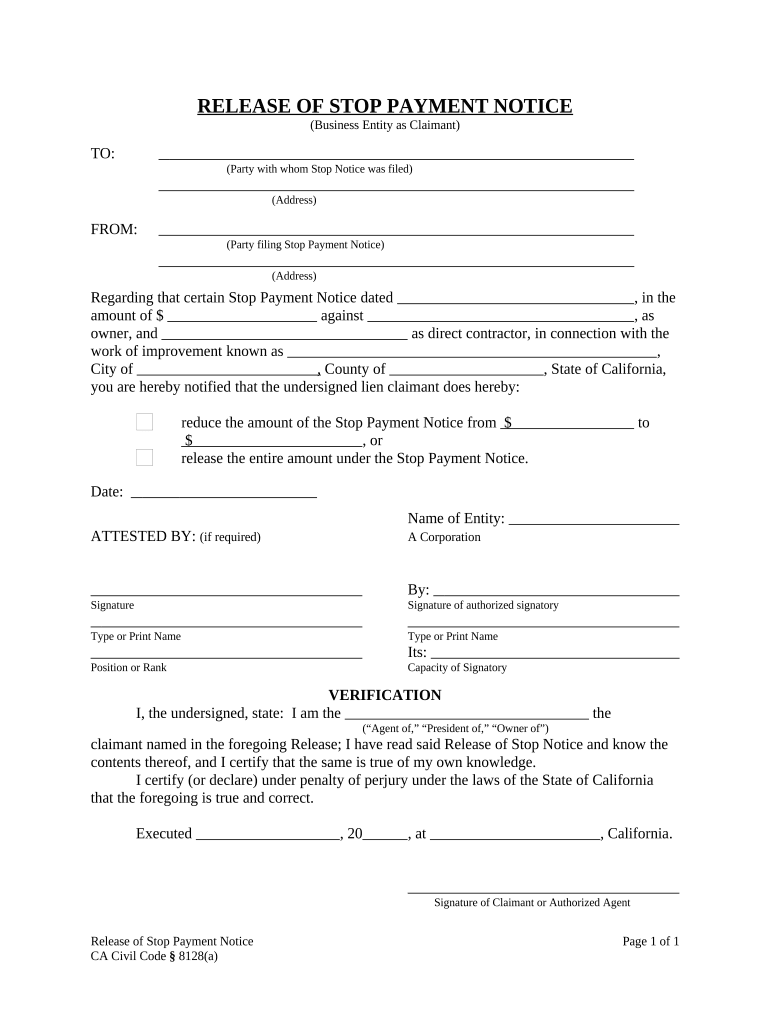
A clear California Release of Liability reduces dispute risk by documenting consent, scope, and date of waiver. It clarifies responsibilities, supports insurance defenses, and creates a written record for courts. Proper drafting avoids ambiguous terms that could render the release unenforceable.

Individuals, businesses, landlords, event organizers, contractors, and vehicle sellers commonly use a California Release of Liability when transferring risk or limiting claims.
An individual seller signs when transferring personal property or adding a liability waiver to a recreational activity release. Provide government ID to match name. Courts evaluate voluntariness and clarity; vague or broad language can be invalidated under California contract law.
A business signs through an authorized officer or agent. Include printed name, title, and authority statement. For corporations or LLCs, attach corporate resolution or power of attorney if representative lacks apparent authority; missing authorization can render the release unenforceable.
Identify full legal names, business entity types, addresses, and contact information for each party. If an agent signs, include a statement of authority and attach corporate resolution when applicable.
Define the specific activities, locations, dates, and types of claims released. State whether the release includes negligence, property damage, personal injury, or only specified liabilities to avoid ambiguity.
Document the consideration exchanged, whether monetary, services, or non-monetary. Courts look for bargained-for exchange; gratuitous releases without consideration may be treated as unsupported promises under California law.
List any excluded claims such as future statutory claims, intentional torts, or rights that cannot be waived under California law. Be explicit to avoid judicial narrowing of the release's effect.
Specify signature requirements: printed name, handwritten or electronic signature, date, and whether notarization or witness signatures are required for this transaction and any ID verification steps.
Include precise definitions for terms used repeatedly (e.g., 'Claim', 'Release', 'Participant'). Clear definitions reduce ambiguity and support enforceability under contract interpretation rules in California courts.
Date determines when obligations begin and limitations apply.
Notify insurer per policy terms to preserve coverage.
Execution date may affect accrual; consult counsel.
Record only if transaction requires public notice, e.g., real property.
Keep signed copies per retention schedule and insurer requirements.
A private seller transfers a used car and asks the buyer to sign a Release of Liability documenting the date and odometer.
A climbing gym requires participants to sign a California Release of Liability before using equipment or attending guided classes.
| Workflow field name and purpose | Configuration value or recommended setting |
|---|---|
| Authentication method and required strength | Email link, SMS code, or KBA; choose per risk |
| Signature placement and mandatory fields | Place signature, date, and printed name fields; mark required |
| Routing order and storage destinations | Send copies to signer, sender, and insurer; save final PDF |
| Audit and retention settings | Enable audit trail, tamper-evident storage, and retention policies |
For eSubmission, verify signer authentication, supported file formats, and whether notarization or witnesses are required by the transaction.
Prepare clear terms, parties, scope, and consideration.
Verify signer authority and obtain required approvals.
Collect signatures, dates, and notarization if applicable.
Store signed originals and audit trails securely for retention period.
| Comparison Criteria for Document Types | Release | Waiver | Indemnity |
|---|---|---|---|
| Typical Use | injury/property | general activity risk | third-party liability |
| Primary Legal Effect | bar claimant suits | limit claimant remedies | shift financial responsibility |
| Consideration Required | often yes | ||
| Enforceability Caveat | no gross negligence | public policy limit | insurance policy terms |
| signNow | DocuSign | Adobe Sign | PandaDoc | HelloSign | |
|---|---|---|---|---|---|
| Starting Price | $8/user/mo | $15/user/mo | $14/user/mo | $19/user/mo | $15/user/mo |
| Free Trial | 7-day free trial, no credit card required | Varies by plan and vendor | Varies by plan and vendor | Varies by plan and vendor | Varies by plan and vendor |
| Bulk Send | Yes; available on most paid plans | Yes; available on most paid plans | Yes; available on most paid plans | Yes; available on most paid plans | No; bulk send not supported |
| Audit Trail | Yes; detailed audit trail and certificate | Yes; detailed audit trail and certificate | Yes; detailed audit trail and certificate | Yes; detailed audit trail and certificate | Yes; basic audit records |
| HIPAA Compliant | Yes; BAA available upon request | Yes; BAA available upon request | Yes; BAA available upon request | No; HIPAA BAA not offered | No; HIPAA BAA not offered |
| Envelope Cap | No envelope cap; unlimited envelopes | 100 envelopes per user per year | Varies by plan and subscription | Varies by plan and subscription | Varies by plan and subscription |