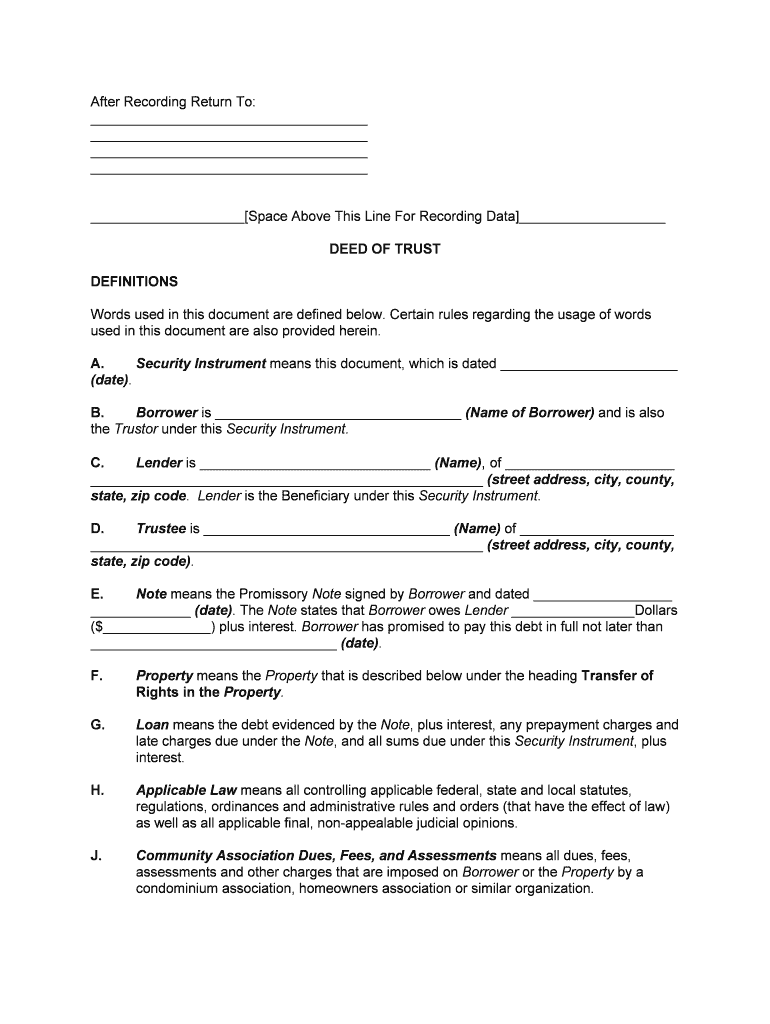
After Recording Return To: ________________________________________________________________________________________________________________________________________________
____________________[Space Above This Line For Recording Data]___________________DEED OF TRUST
DEFINITIONS
Words used in this document are defined below. Certain rules regarding the usage of words
used in this document are also provided herein.
A. Security Instrument means this document, which is dated _______________________
(date) .
B. Borrower is ________________________________ (Name of Borrower) and is also
the Trustor under this Security Instrument .
C. Lender is ______________________________ (Name), of ______________________
___________________________________________________ (street address, city, county,
state, zip code . Lender is the Beneficiary under this Security Instrument.
D. Trustee is ________________________________ (Name) of ____________________
___________________________________________________ (street address, city, county,
state, zip code) .
E. Note means the Promissory Note signed by Borrower and dated __________________
_____________ (date). The Note states that Borrower owes Lender ________________Dollars
($______________) plus interest. Borrower has promised to pay this debt in full not later than
________________________________ (date).
F. Property means the Property that is described below under the heading Transfer of
Rights in the Property.
G. Loan means the debt evidenced by the Note, plus interest, any prepayment charges and
late charges due under the Note, and all sums due under this Security Instrument, plus
interest.
H. Applicable Law means all controlling applicable federal, state and local statutes,
regulations, ordinances and administrative rules and orders (that have the effect of law)
as well as all applicable final, non-appealable judicial opinions.
J. Community Association Dues, Fees, and Assessments means all dues, fees,
assessments and other charges that are imposed on Borrower or the Property by a
condominium association, homeowners association or similar organization.
K.Electronic Funds Transfer means any transfer of funds, other than a transaction
originated by check, draft, or similar paper instrument, which is initiated through an
electronic terminal, telephonic instrument, computer, or magnetic tape so as to order,
instruct, or authorize a financial institution to debit or credit an account. Such term
includes, but is not limited to, point-of-sale transfers, automated teller machine
transactions, transfers initiated by telephone, wire transfers, and automated
clearinghouse transfers.
L. Miscellaneous Proceeds means any compensation, settlement, award of damages, or
proceeds paid by any third party (other than insurance proceeds paid under the
coverages described in Section 5) for: (i) damage to, or destruction of, the Property; (ii)
condemnation or other taking of all or any part of the Property; (iii) conveyance in lieu of
condemnation; or (iv) misrepresentations of, or omissions as to, the value and/or
condition of the Property.
M. Successor in Interest of Borrower means any party that has taken title to the Property,
whether or not that party has assumed Borrower’s obligations under the Note and/or this
Security Instrument .
TRANSFER OF RIGHTS IN THE PROPERTY
This Security Instrument secures to Lender: (i) the repayment of the Loan, and all renewals,
extensions and modifications of the Note; and (ii) the performance of Borrower’s covenants and
agreements under this Security Instrument and the Note. For this purpose, Borrower
irrevocably grants and conveys to Trustee, in trust, with power of sale, the following described
Property located at ____________________________________________________________
____________________________ (street address, city, county, state, zip code ), and being
more particularly described as follows:
(Legal Description)
______________________________________________________________________ ____________________________________________________________________________________________________________________________________________
TOGETHER WITH all the improvements now or hereafter erected on the Property, and all
easements, appurtenances, and fixtures now or hereafter a part of the Property. All
replacements and additions shall also be covered by this Security Instrument. All of the
foregoing is referred to in this Security Instrument as the “Property .”
BORROWER COVENANTS that Borrower is lawfully seized of the estate hereby conveyed and
has the right to grant and convey the Property and that the Property is unencumbered, except
for encumbrances of record. Borrower warrants and will defend generally the title to the
Property against all claims and demands, subject to any encumbrances of record.
Borrower and Lender covenant and agree as follows:
1. Payment of Principal and Interest. Borrower shall pay when due the principal of, and
interest on, the debt evidenced by the Note and any prepayment charges and late charges due
under the Note. Payments due under the Note and this Security Instrument shall be made in
U.S. currency. However, if any check or other instrument received by Lender as payment under
the Note or this Security Instrument is returned to Lender unpaid, Lender may require that any
or all subsequent payments due under the Note and this Security Instrument be made in one or
more of the following forms, as selected by Lender: (a) cash; (b) money order; (c) certified
check, bank check, treasurer’s check or cashier’s check, provided any such check is drawn
upon an institution whose deposits are insured by a federal agency, instrumentality, or entity; or
(d) Electronic Funds Transfer. Payments are deemed received by Lender when received at the
location designated in the Note or at such other location as may be designated by Lender in
accordance with the notice provisions in Section 13. Lender may return any payment or partial
payment if the payment or partial payments are insufficient to bring the Loan current. Lender
may accept any payment or partial payment insufficient to bring the Loan current, without waiver
of any rights hereunder or prejudice to its rights to refuse such payment or partial payments in
the future, but Lender is not obligated to apply such payments at the time such payments are
accepted.
2. Application of Payments or Proceeds. All payments accepted and applied by Lender
shall be applied in the following order of priority: (a) interest due under the Note; and (b)
principal due under the Note. Such payments shall be applied to each Payment in the order in
which it became due. Any remaining amounts shall be applied first to late charges, second to
any other amounts due under this Security Instrument, and then to reduce the principal balance
of the Note. If Lender receives a payment from Borrower for a delinquent Payment which
includes a sufficient amount to pay any late charge due, the payment may be applied to the
delinquent payment and the late charge. If more than one Payment is outstanding, Lender may
apply any payment received from Borrower to the repayment of the Payments if, and to the
extent that, each payment can be paid in full. To the extent that any excess exists after the
payment is applied to the full payment of one or more Payments, such excess may be applied to
any late charges due. Voluntary prepayments shall be applied first to any prepayment charges
and then as described in the Note. Any application of payments, insurance proceeds, or
Miscellaneous Proceeds to principal due under the Note shall not extend or postpone the due
date, or change the amount, of the Payments.
3. Charges; Liens. Borrower shall pay all taxes, assessments, charges, fines, and
impositions attributable to the Property which can attain priority over this Security Instrument,
leasehold payments or ground rents on the Property, if any, and Community Association Dues,
Fees, and Assessments, if any. Borrower shall promptly discharge any lien which has priority
over this Security Instrument unless Borrower : (a) agrees in writing to the payment of the
obligation secured by the lien in a manner acceptable to Lender, but only so long as Borrower is
performing such agreement; (b) contests the lien in good faith by, or defends against
enforcement of the lien in, legal proceedings which in Lender’s opinion operate to prevent the
enforcement of the lien while those proceedings are pending, but only until such proceedings
are concluded; or (c) secures from the holder of the lien an agreement satisfactory to Lender
subordinating the lien to this Security Instrument. If Lender determines that any part of the
Property is subject to a lien which can attain priority over this Security Instrument, Lender may
give Borrower a notice identifying the lien. Within 10 days of the date on which that notice is
given, Borrower shall satisfy the lien or take one or more of the actions set forth above in this
Section 3 .
4. Property Insurance. Borrower shall keep the improvements now existing or hereafter
erected on the Property insured against loss by fire, hazards included within the term “extended
coverage,” and any other hazards including, but not limited to, earthquakes and floods, for
which Lender requires insurance. This insurance shall be maintained in the amounts (including
deductible levels) and for the periods that Lender requires. What Lender requires pursuant to
the preceding sentences can change during the term of the Loan. The insurance carrier
providing the insurance shall be chosen by Borrower subject to Lender’s right to disapprove
Borrower ’s choice, which right shall not be exercised unreasonably. Lender may require
Borrower to pay, in connection with this Loan, either: (a) a one-time charge for flood zone
determination, certification and tracking services; or (b) a one-time charge for flood zone
determination and certification services and subsequent charges each time remappings or
similar changes occur which reasonably might affect such determination or certification.
Borrower shall also be responsible for the payment of any fees imposed by the Federal
Emergency Management Agency in connection with the review of any flood zone determination
resulting from an objection by Borrower. If Borrower fails to maintain any of the coverages
described above, Lender may obtain insurance coverage, at Lender’s option and Borrower’s
expense. Lender is under no obligation to purchase any particular type or amount of coverage.
Therefore, such coverage shall cover Lender, but might or might not protect Borrower,
Borrower ’s equity in the Property, or the contents of the Property, against any risk, hazard or
liability and might provide greater or lesser coverage than was previously in effect. Borrower
acknowledges that the cost of the insurance coverage so obtained might significantly exceed
the cost of insurance that Borrower could have obtained. Any amounts disbursed by Lender
under this Section 4 shall become additional debt of Borrower secured by this Security
Instrument . These amounts shall bear interest at the Note rate from the date of disbursement
and shall be payable, with such interest, upon notice from Lender to Borrower requesting
payment. All insurance policies required by Lender and renewals of such policies shall be
subject to Lender’s right to disapprove such policies, shall include a standard mortgage clause,
and shall name Lender as mortgagee and/or as an additional loss payee and Borrower further
agrees to generally assign rights to insurance proceeds to the holder of the Note up to the
amount of the outstanding Loan balance. Lender shall have the right to hold the policies and
renewal certificates. If Lender requires, Borrower shall promptly give to Lender all receipts of
paid premiums and renewal notices. If Borrower obtains any form of insurance coverage, not
otherwise required by Lender, for damage to, or destruction of, the Property, such policy shall
include a standard mortgage clause and shall name Lender as mortgagee and/or as an
additional loss payee and Borrower further agrees to generally assign rights to insurance
proceeds to the holder of the Note up to the amount of the outstanding Loan balance.
In the event of loss, Borrower shall give prompt notice to the insurance carrier and Lender.
Lender may make proof of loss if not made promptly by Borrower. Unless Lender and Borrower
otherwise agree in writing, any insurance proceeds, whether or not the underlying insurance
was required by Lender, shall be applied to restoration or repair of the Property, if the
restoration or repair is economically feasible and Lender’s security is not lessened. During such
repair and restoration period, Lender shall have the right to hold such insurance proceeds until
Lender has had an opportunity to inspect such Property to ensure the work has been completed
to Lender ’s satisfaction, provided that such inspection shall be undertaken promptly. Lender
may disburse proceeds for the repairs and restoration in a single payment or in a series of
progress payments as the work is completed. Unless an agreement is made in writing or
Applicable Law requires interest to be paid on such insurance proceeds, Lender shall not be
required to pay Borrower any interest or earnings on such proceeds. Fees for public adjusters,
or other third parties, retained by Borrower shall not be paid out of the insurance proceeds and
shall be the sole obligation of Borrower. If the restoration or repair is not economically feasible
or Lender ’s security would be lessened, the insurance proceeds shall be applied to the sums
secured by this Security Instrument , whether or not then due, with the excess, if any, paid to
Borrower . Such insurance proceeds shall be applied in the order provided for in Section 2.
If Borrower abandons the Property, Lender may file, negotiate and settle any available
insurance claim and related matters. If Borrower does not respond within 30 days to a notice
from Lender that the insurance carrier has offered to settle a claim, then Lender may negotiate
and settle the claim. The 30-day period will begin when the notice is given. In either event, or if Lender acquires the Property under Section 22 or otherwise, Borrower hereby assigns to
Lender (a) Borrower ’s rights to any insurance proceeds in an amount not to exceed the amounts
unpaid under the Note or this Security Instrument , and (b) any other of Borrower’s rights (other
than the right to any refund of unearned premiums paid by Borrower) under all insurance
policies covering the Property, insofar as such rights are applicable to the coverage of the
Property . Lender may use the insurance proceeds either to repair or restore the Property or to
pay amounts unpaid under the Note or this Security Instrument , whether or not then due.
6. Preservation, Maintenance and Protection of the Property; Inspections. Borrower
shall not destroy, damage or impair the Property, allow the Property to deteriorate or commit
waste on the Property. Whether or not Borrower is residing in the Property, Borrower shall
maintain the Property in order to prevent the Property from deteriorating or decreasing in value
due to its condition. Unless it is determined hat repair or restoration is not economically
feasible, Borrower shall promptly repair the Property if damaged to avoid further deterioration or
damage. If insurance or condemnation proceeds are paid in connection with damage to, or the
taking of, the Property, Borrower shall be responsible for repairing or restoring the Property only
if Lender has released proceeds for such purposes. Lender may disburse proceeds for the
repairs and restoration in a single payment or in a series of progress payments as the work is
completed. If the insurance or condemnation proceeds are not sufficient to repair or restore the
Property , Borrower is not relieved of Borrower’s obligation for the completion of such repair or
restoration. Lender or its agent may make reasonable entries upon and inspections of the
Property . If it has reasonable cause, Lender may inspect the interior of the improvements on
the Property . Lender shall give Borrower notice at the time of or prior to such an interior
inspection specifying such reasonable cause.
8. Protection of Lender’s Interest in the Property and Rights Under this Security
Instrument . If (a) Borrower fails to perform the covenants and agreements contained in this
Security Instrument , (b) there is a legal proceeding that might significantly affect Lender’s
interest in the Property and/or rights under this Security Instrument (such as a proceeding in
bankruptcy, probate, for condemnation or forfeiture, for enforcement of a lien which may attain
priority over this Security Instrument or to enforce laws or regulations), or (c) Borrower has
abandoned the Property, then Lender may do and pay for whatever is reasonable or appropriate
to protect Lender’s interest in the Property and rights under this Security Instrument, including
protecting and/or assessing the value of the Property, and securing and/or repairing the
Property . Lender ’s actions can include, but are not limited to: (a) paying any sums secured by a
lien which has priority over this Security Instrument; (b) appearing in court; and (c) paying
reasonable attorneys’ fees to protect its interest in the Property and/or rights under this Security
Instrument , including its secured position in a bankruptcy proceeding. Securing the Property
includes, but is not limited to, entering the Property to make repairs, change locks, replace or
board up doors and windows, drain water from pipes, eliminate building or other code violations
or dangerous conditions, and have utilities turned on or off. Although Lender may take action
under this Section 6, Lender does not have to do so and is not under any duty or obligation to
do so. It is agreed that Lender incurs no liability for not taking any or all actions authorized
under this S ection 6. Any amounts disbursed by Lender under this Section 6 shall become
additional debt of Borrower secured by this Security Instrument . These amounts shall bear
interest at the Note rate from the date of disbursement and shall be payable, with such interest,
upon notice from Lender to Borrower requesting payment.
9. Assignment of Miscellaneous Proceeds; Forfeiture . All Miscellaneous Proceeds are
hereby assigned to and shall be paid to Lender. If the Property is damaged, such
Miscellaneous Proceeds shall be applied to restoration or repair of the Property, if the
restoration or repair is economically feasible and Lender’s security is not lessened. During such
repair and restoration period, Lender shall have the right to hold such Miscellaneous Proceeds
until Lender has had an opportunity to inspect such Property to ensure the work has been
completed to Lender’s satisfaction, provided that such inspection shall be undertaken promptly.
Lender may pay for the repairs and restoration in a single disbursement or in a series of
progress payments as the work is completed. Unless an agreement is made in writing or
Applicable Law requires interest to be paid on such Miscellaneous Proceeds, Lender shall not
be required to pay Borrower any interest or earnings on such Miscellaneous Proceeds. If the
restoration or repair is not economically feasible or Lender’s security would be lessened, the
Miscellaneous Proceeds shall be applied to the sums secured by this Security Instrument,
whether or not then due, with the excess, if any, paid to Borrower. Such Miscellaneous
Proceeds shall be applied in the order provided for in Section 2. In the event of a total taking,
destruction, or loss in value of the Property, the Miscellaneous Proceeds shall be applied to the
sums secured by this Security Instrument, whether or not then due, with the excess, if any, paid
to Borrower . In the event of a partial taking, destruction, or loss in value of the Property in which
the fair market value of the Property immediately before the partial taking, destruction, or loss in
value is equal to or greater than the amount of the sums secured by this Security Instrument
immediately before the partial taking, destruction, or loss in value, unless Borrower and Lender
otherwise agree in writing, the sums secured by this Security Instrument shall be reduced by the
amount of the Miscellaneous Proceeds multiplied by the following fraction: (a) the total amount
of the sums secured immediately before the partial taking, destruction, or loss in value divided
by (b) the fair market value of the Property immediately before the partial taking, destruction, or
loss in value. Any balance shall be paid to Borrower. In the event of a partial taking,
destruction, or loss in value of the Property in which the fair market value of the Property
immediately before the partial taking, destruction, or loss in value is less than the amount of the
sums secured immediately before the partial taking, destruction, or loss in value, unless
Borrower and Lender otherwise agree in writing, the Miscellaneous Proceeds shall be applied to
the sums secured by this Security Instrument whether or not the sums are then due.
If the Property is abandoned by Borrower, or if, after notice by Lender to Borrower that the
Opposing Party (as defined in the next sentence) offers to make an award to settle a claim for
damages, Borrower fails to respond to Lender within 30 days after the date the notice is given,
Lender is authorized to collect and apply the Miscellaneous Proceeds either to restoration or
repair of the Property or to the sums secured by this Security Instrument, whether or not then
due. Opposing Party means the third party that owes Borrower Miscellaneous Proceeds or the
party against whom Borrower has a right of action in regard to Miscellaneous Proceeds.
Borrower shall be in default if any action or proceeding, whether civil or criminal, is begun that,
in Lender ’s judgment, could result in forfeiture of the Property or other material impairment of
Lender ’s interest in the Property or rights under this Security Instrument. Borrower can cure
such a default and, if acceleration has occurred, reinstate as provided in Section 17, by causing
the action or proceeding to be dismissed with a ruling that, in Lender’s judgment, precludes
forfeiture of the Property or other material impairment of Lender’s interest in the Property or
rights under this Security Instrument . The proceeds of any award or claim for damages that are
attributable to the impairment of Lender’s interest in the Property are hereby assigned and shall
be paid to Lender. All Miscellaneous Proceeds that are not applied to restoration or repair of the
Property shall be applied in the order provided for in Section 2.
10. Borrower Not Released; Forbearance By Lender Not a Waiver. Extension of the
time for payment or modification of amortization of the sums secured by this Security Instrument
granted by Lender to Borrower or any Successor in Interest of Borrower shall not operate to
release the liability of Borrower or any Successors in Interest of Borrower. Lender shall not be
required to commence proceedings against any Successor in Interest of Borrower or to refuse
to extend time for payment or otherwise modify amortization of the sums secured by this
Security Instrument by reason of any demand made by the original Borrower or any Successors
in Interest of Borrower. Any forbearance by Lender in exercising any right or remedy including,
without limitation, Lender’s acceptance of payments from third persons, entities or Successors
in Interest of Borrower or in amounts less than the amount then due, shall not be a waiver of or
preclude the exercise of any right or remedy.
11. Joint and Several Liability; Co-signers; Successors and Assigns Bound. Borrower
covenants and agrees that Borrower’s obligations and liability shall be joint and several.
However, any Borrower who co-signs this Security Instrument but does not execute the Note (a
“co-signer”): (a) is co-signing this Security Instrument only to mortgage, grant and convey the
co-signer’s interest in the Property under the terms of this Security Instrument; (b) is not
personally obligated to pay the sums secured by this Security Instrument; and (c) agrees that
Lender and any other Borrower can agree to extend, modify, forbear or make any
accommodations with regard to the terms of this Security Instrument or the Note without the co-
signer’s consent. Any Successor in Interest of Borrower who assumes Borrower’s obligations
under this Security Instrument in writing, and is approved by Lender, shall obtain all of
Borrower ’s rights and benefits under this Security Instrument. Borrower shall not be released
from Borrower ’s obligations and liability under this Security Instrument unless Lender agrees to
such release in writing. The covenants and agreements of this Security Instrument shall bind
and benefit the successors and assigns of Lender.
12 Loan Charges. Lender may charge Borrower fees for services performed in connection
with Borrower ’s default, for the purpose of protecting Lender’s interest in the Property and rights
under this Security Instrument , including, but not limited to, attorneys’ fees, Property inspection
and valuation fees. In regard to any other fees, the absence of express authority in this Security
Instrument to charge a specific fee to Borrower shall not be construed as a prohibition on the
charging of such fee. Lender may not charge fees that are expressly prohibited by this Security
Instrument or by Applicable Law. If the Loan is subject to a law which sets maximum Loan
charges, and that law is finally interpreted so that the interest or other Loan charges collected or
to be collected in connection with the Loan exceed the permitted limits, then: (a) any such Loan
charge shall be reduced by the amount necessary to reduce the charge to the permitted limit;
and (b) any sums already collected from Borrower which exceeded permitted limits will be
refunded to Borrower. Lender may choose to make this refund by reducing the principal owed
under the Note or by making a direct payment to Borrower. If a refund reduces principal, the
reduction will be treated as a partial prepayment without any prepayment charge (whether or not
a prepayment charge is provided for under the Note). Borrower ’s acceptance of any such
refund made by direct payment to Borrower will constitute a waiver of any right of action
Borrower might have arising out of such overcharge.
13. Notices. All notices given by Borrower or Lender in connection with this Security
Instrument must be in writing. Any notice to Borrower in connection with this Security
Instrument shall be deemed to have been given to Borrower when mailed by first class mail or
when actually delivered to Borrower’s notice address if sent by other means. Notice to any one
Borrower shall constitute notice to all Borrowers unless Applicable Law expressly requires
otherwise. The notice address shall be the Property Address unless Borrower has designated a
substitute notice address by notice to Lender. Borrower shall promptly notify Lender of
Borrower ’s change of address. If Lender specifies a procedure for reporting Borrower’s change
of address, then Borrower shall only report a change of address through that specified
procedure. There may be only one designated notice address under this Security Instrument at
any one time. Any notice to Lender shall be given by delivering it or by mailing it by first class
mail to Lender’s address stated herein unless Lender has designated another address by notice
to Borrower . Any notice in connection with this Security Instrument shall not be deemed to have
been given to Lender until actually received by Lender. If any notice required by this Security
Instrument is also required under Applicable Law, the Applicable Law requirement will satisfy
the corresponding requirement under this Security Instrument.
14. Governing Law; Severability; Rules of Construction. This Security Instrument shall
be governed by federal law and the law of the jurisdiction in which the Property is located. All
rights and obligations contained in this Security Instrument are subject to any requirements and
limitations of Applicable Law. Applicable Law might explicitly or implicitly allow the parties to
agree by contract or it might be silent, but such silence shall not be construed as a prohibition
against agreement by contract. In the event that any provision or clause of this Security
Instrument or the Note conflicts with Applicable Law, such conflict shall not affect other
provisions of this Security Instrument or the Note which can be given effect without the
conflicting provision. As used in this Security Instrument: (a) words of the masculine gender
shall mean and include corresponding neuter words or words of the feminine gender; (b) words
in the singular shall mean and include the plural and vice versa; and (c) the word “may” gives
sole discretion without any obligation to take any action.
15. Borrower ’s Copy. Borrower shall be given one copy of the Note and of this Security
Instrument .
16. Transfer of the Property or a Beneficial Interest in Borrower. As used in this
Section 16 , “Interest in the Property” means any legal or beneficial interest in the Property,
including, but not limited to, those beneficial interests transferred in a bond for deed, contract for
deed, installment sales contract or escrow agreement, the intent of which is the transfer of title
by Borrower at a future date to a purchaser. If all or any part of the Property or any Interest in
the Property is sold or transferred (or if Borrower is not a natural person and a beneficial interest
in Borrower is sold or transferred) without Lender’s prior written consent, Lender may require
immediate payment in full of all sums secured by this Security Instrument. However, this option
shall not be exercised by Lender if such exercise is prohibited by Applicable Law. If Lender
exercises this option, Lender shall give Borrower notice of acceleration. The notice shall
provide a period of not less than 30 days from the date the notice is given within which Borrower
must pay all sums secured by this Security Instrument. If Borrower fails to pay these sums prior
to the expiration of this period, Lender may invoke any remedies permitted by this Security
Instrument without further notice or demand on Borrower.
17. Borrower’s Right to Reinstate after Acceleration. If Borrower meets certain
conditions, Borrower shall have the right to have enforcement of this Security Instrument
discontinued at any time prior to the earliest of: (a) five days before sale of the Property
pursuant to any power of sale contained in this Security Instrument; (b ) such other period as
Applicable Law might specify for the termination of Borrower’s right to reinstate; or (c) entry of a
judgment enforcing this Security Instrument. Those conditions are that Borrower: (a) pays
Lender all sums which then would be due under this Security Instrument and the Note as if no
acceleration had occurred; (b) cures any default of any other covenants or agreements; (c) pays
all expenses incurred in enforcing this Security Instrument, including, but not limited to,
reasonable attorneys’ fees, Property inspection and valuation fees, and other fees incurred for
the purpose of protecting Lender’s interest in the Property and rights under this Security
Instrument ; and (d) takes such action as Lender may reasonably require to assure that Lender’s
interest in the Property and rights under this Security Instrument, and Borrower ’s obligation to
pay the sums secured by this Security Instrument, shall continue unchanged. Lender may
require that Borrower pay such reinstatement sums and expenses in one or more of the
following forms, as selected by Lender: (a) cash; (b) money order; (c) certified check, bank
check, treasurer’s check or cashier’s check, provided any such check is drawn upon an
institution whose deposits are insured by a federal agency, instrumentality or entity; or (d)
Electronic Funds Transfer. Upon reinstatement by Borrower, this Security Instrument and
obligations secured hereby shall remain fully effective as if no acceleration had occurred.
However, this right to reinstate shall not apply in the case of acceleration under Section 19.
18. Hazardous Substances . As used in this Section 18: (a) Hazardous Substances are
those substances defined as toxic or hazardous substances, pollutants, or wastes by
Environmental Law and the following substances: gasoline, kerosene, other flammable or toxic
petroleum products, toxic pesticides and herbicides, volatile solvents, materials containing
asbestos or formaldehyde, and radioactive materials; (b) Environmental Law means federal
laws and laws of the jurisdiction where the Property is located that relate to health, safety or
environmental protection; (c) Environmental Cleanup includes any response action, remedial
action, or removal action, as defined in Environmental Law; and (d) an Environmental Condition
means a condition that can cause, contribute to, or otherwise trigger an Environmental Cleanup.
Borrower shall not cause or permit the presence, use, disposal, storage, or release of any
Hazardous Substances, or threaten to release any Hazardous Substances, on or in the
Property . Borrower shall not do, nor allow anyone else to do, anything affecting the Property (a)
that is in violation of any Environmental Law, (b) which creates an Environmental Condition, or
(c) which, due to the presence, use, or release of a Hazardous Substance, creates a condition
that adversely affects the value of the Property. The preceding two sentences shall not apply to
the presence, use, or storage on the Property of small quantities of Hazardous Substances that
are generally recognized to be appropriate to normal residential uses and to maintenance of the
Property (including, but not limited to, hazardous substances in consumer products).
Borrower shall promptly give Lender written notice of (a) any investigation, claim, demand,
lawsuit or other action by any governmental or regulatory agency or private party involving the
Property and any Hazardous Substance or Environmental Law of which Borrower has actual
knowledge, (b) any Environmental Condition, including but not limited to, any spilling, leaking,
discharge, release or threat of release of any Hazardous Substance, and (c) any condition
caused by the presence, use or release of a Hazardous Substance which adversely affects the
value of the Property. If Borrower learns, or is notified by any governmental or regulatory
authority, or any private party, that any removal or other remediation of any Hazardous
Substance affecting the Property is necessary, Borrower shall promptly take all necessary
remedial actions in accordance with Environmental Law. Nothing herein shall create any
obligation on Lender for an Environmental Cleanup.
19. Acceleration; Remedies. Lender shall give notice to Borrower prior to acceleration
following Borrower’s breach of any covenant or agreement in this Security Instrument (but not
prior to acceleration unless Applicable Law provides otherwise). The notice shall specify: (a)
the default; (b) the action required to cure the default; (c) a date, not less than 30 days from the
date the notice is given to Borrower, by which the default must be cured; and (d) that failure to
cure the default on or before the date specified in the notice may result in acceleration of the
sums secured by this Security Instrument and sale of the Property. The notice shall further
inform Borrower of the right to reinstate after acceleration and the right to bring a court action to
assert the non-existence of a default or any other defense of Borrower to acceleration and sale.
If the default is not cured on or before the date specified in the notice, Lender at its option may
require immediate payment in full of all sums secured by this Security Instrument without further
demand and may invoke the power of sale and any other remedies permitted by Applicable
Law. Lender shall be entitled to collect all expenses incurred in pursuing the remedies provided
in this Section 19 , including, but not limited to, reasonable attorneys’ fees and costs of title
evidence. If Lender invokes the power of sale, Lender shall execute or cause Trustee to execute
a written notice of the occurrence of an event of default and of Lender’s election to cause the
Property to be sold. Trustee shall cause this notice to be recorded in each county in which any
part of the Property is located. Lender or Trustee shall mail copies of the notice as prescribed
by Applicable Law to Borrower and to the other persons prescribed by Applicable Law. Trustee
shall give public notice of sale to the persons and in the manner prescribed by Applicable Law.
After the time required by Applicable Law, Trustee, without demand on Borrower, shall sell the
Property at public auction to the highest bidder at the time and place and under the terms
designated in the notice of sale in one or more parcels and in any order Trustee determines.
Trustee may postpone sale of all or any parcel of the Property by public announcement at the
time and place of any previously scheduled sale. Lender or its designee may purchase the
Property at any sale. Trustee shall deliver to the purchaser Trustee’s deed conveying the
Property without any covenant or warranty, expressed or implied. The recitals in the Trustee’s
deed shall be prima facie evidence of the truth of the statements made therein. Trustee shall
apply the proceeds of the sale in the following order: (a) to all expenses of the sale, including,
but not limited to, reasonable Trustee’s and attorneys’ fees; (b) to all sums secured by this
Security Instrument ; and (c) any excess to the person or persons legally entitled to it.
20. Reconveyance. Upon payment of all sums secured by this Security Instrument, Lender
shall request Trustee to reconvey the Property and shall surrender this Security Instrument and
all Note s evidencing debt secured by this Security Instrument to Trustee . Trustee shall
reconvey the Property without warranty to the person or persons legally entitled to it. Lender
may charge such person or persons a reasonable fee for reconveying the Property, but only if
the fee is paid to a third party (such as the Trustee) for services rendered and the charging of
the fee is permitted under Applicable Law. If the fee charged does not exceed the fee set by
Applicable Law, the fee is conclusively presumed to be reasonable.
21. Substitute Trustee. Lender , at its option, may from time to time appoint a successor
Trustee to any Trustee appointed hereunder by an instrument executed and acknowledged by
Lender and recorded in the office of the Recorder of the county in which the Property is located.
The instrument shall contain the name of the original Lender, Trustee and Borrower , the book
and page where this Security Instrument is recorded and the name and address of the
successor Trustee. Without conveyance of the Property, the successor Trustee shall succeed
to all the title, powers and duties conferred upon the Trustee herein and by Applicable Law.
This procedure for substitution of Trustee shall govern to the exclusion of all other provisions for
substitution.
22. Statement of Obligation Fee. Lender may collect a fee not to exceed the maximum
amount permitted by Applicable Law for furnishing the statement of obligation as provided by
Section 2943 of the Civil Code of California.
WITNESS my signature as of the _____day of ___________________, 20____.
_________________________________
Borrower and Trustor
State of California
County of _______________________On ____________________________ (date) before me, ________________________
(Name of Notary Public) , personally appeared ________________________________ (Name
of Borrower) , who proved to me on the basis of satisfactory evidence to be the person whose
name is subscribed to the within instrument and acknowledged to me that he executed the
same in his authorized capacity, and that by his signature on the instrument, I certify under
PENALTY OF PERJURY under the laws of the State of California that the foregoing paragraph
is true and correct.
WITNESS my hand and official seal.
_____________________________
Notary Public