Establishing secure connection…Loading editor…Preparing document…

Cash Deed Louisiana

This template is fully customizable. Edit the text, fill out the fields, and send it for signature. Give it a try!
Cash Deed Louisiana

What a Cash Deed in Louisiana Is and when it applies

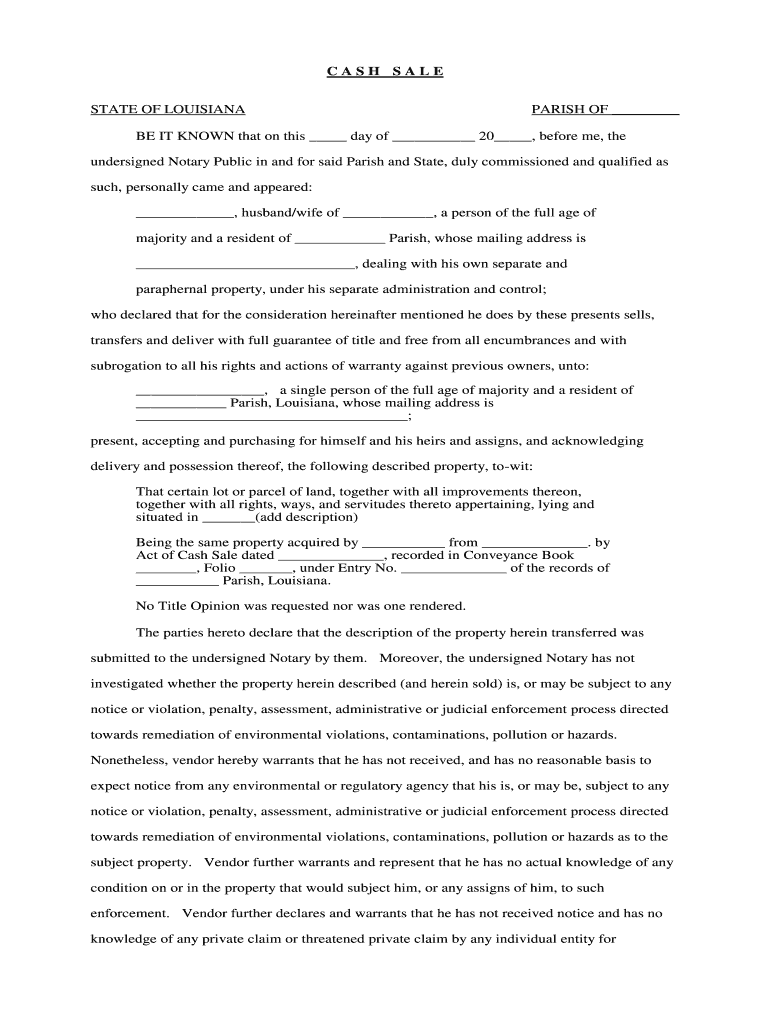
A Cash Deed Louisiana is a written instrument used to transfer ownership of immovable property in Louisiana where the stated consideration is cash. It names the grantor and grantee, provides the precise legal description of the property, states the consideration, and contains the execution and notary acknowledgement required for recordation with the parish clerk of court. Electronic signatures generally meet federal ESIGN (15 U.S.C. §7001) and UETA standards, but recording and notary requirements are controlled by state and parish rules and may require wet or RON notarization.

Why a properly prepared Cash Deed matters

A correctly completed Cash Deed Louisiana provides clear evidence of title transfer and the cash consideration, helps prevent competing claims, and when recorded establishes priority against later purchasers or creditors. Accurate legal description, notarization, and timely recordation are essential for enforceability and marketable title.

Why a properly prepared Cash Deed matters

Who commonly prepares and signs a Cash Deed in Louisiana

Typical users include private sellers and buyers, real estate attorneys, title professionals, and closing agents handling cash-only transfers.

  • Private sellers — Individuals transferring property outright for cash without mortgage involvement.
  • Buyers — Purchasers who need a recorded deed to establish ownership and defend against later claims.
  • Title professionals — Attorneys and title agents who verify description, liens, and prepare recording instructions.

Core elements every professional Cash Deed Louisiana should include

A professional cash deed balances concise drafting with full legal detail: identify parties, show consideration, include the precise recorded legal description, provide habendum and warranty language as applicable, and leave space for the notary acknowledgement and recording return address.

Parties

Full legal names of grantor(s) and grantee(s) exactly as they appear on IDs or formation documents to avoid name mismatches affecting title.
Consideration

Clear statement of the cash amount in numerals and words; this documents the exchange and supports tax reporting and recording requirements.

Legal Description

Precise metes-and-bounds or lot-and-block description copied from prior recorded instrument; street addresses alone are legally insufficient.

Habendum/Warranties

Clauses that define estate granted and any covenants of title; choose language appropriate for a cash sale (warranty, quitclaim, or special warranty).

Notary Acknowledgement

Designated block for notary signature, commission details, and any required parish certification for recordation.

Return Instructions

Clerk return address and mailing instructions so the recorded deed is returned to the correct party or agent.

Required information and essential fields at a glance

Grantor Name: Full legal name(s) of seller(s)
Grantee Name: Full legal name(s) of buyer(s)
Legal Description: Exact recorded property description
Consideration: Cash amount in numbers and words
Notary Block: Acknowledgement, signature, commission info
Recording Parish: Parish clerk and return address

Step-by-step: complete and record a Louisiana Cash Deed

Follow this sequential checklist to prepare, execute, notarize, and record a Cash Deed Louisiana with minimal risk of rejection or title issues.

  • 01
    Prepare Deed: Obtain accurate legal description and full legal names of parties.
  • 02
    State Consideration: Record the exact cash amount in numerals and words to avoid ambiguity.
  • 03
    Notarize: Sign before a notary public and complete the required acknowledgement block.
  • 04
    Record: File the deed with the parish clerk of court where the property is located.

How to configure an online workflow for a Cash Deed

When using a digital platform, set up fields and authentication to capture signatures, notary data, and delivery instructions before sending the document for execution.

Field Configuration
Document Upload PDF preferred; upload final signed version
Signature Method Wet signature or RON/KBA where permitted
Authentication Email + SMS or ID verification for RON
Final Delivery Send recorded copy to grantor and grantee

Process overview: from drafting to recorded deed

A concise flow: create the deed, capture signatures, notarize properly, and record the instrument to perfect transfer and notice to third parties.

  • Draft: Prepare deed wording and legal description
  • Sign: Grantor signs in presence of notary or via RON
  • Notarize: Notary completes acknowledgement and certification
  • Record: File with parish clerk and obtain stamped copy

Digital signing and technical requirements for recording

Electronic completion is possible, but ensure the platform supports required file formats, audit trails, and notarization workflows that your parish accepts.

  • File Formats: PDF/A recommended for recording
  • Authentication: Multi-factor or ID verification
  • Integrations: Connectors for storage and CRM

Consequences and risks of filing an incorrect Cash Deed

Recording Rejection: Improper form or missing notary
Title Defects: Incorrect description or omitted parties
Tax Liability: Unreported transfer taxes or penalties
Fraud Exposure: Unauthorized signatures or forged documents
Lien Surprise: Undisclosed liens attach to title
Priority Loss: Delay can permit third-party claims

Common mistakes to avoid when preparing a Cash Deed Louisiana

  • Using a street address instead of the legal description often causes clerk rejection and ambiguous boundaries; always use the recorded metes-and-bounds or lot description.
  • Failing to notarize or misplacing the notary acknowledgement typically prevents acceptance by the parish clerk and delays recording and title transfer.
  • Entering mismatched grantor or grantee names relative to identification or formation documents creates insurance issues and may require corrective instruments.
  • Skipping a title search risks undisclosed liens, servitude claims, or succession issues that can cloud the title after transfer.

Realistic scenarios showing how Cash Deeds are used in practice

Two concise examples show typical uses of a Louisiana cash deed and the key actions that ensured a clean transfer and recording.

Neighbor Sale

A homeowner sold an adjacent vacant lot to a neighbor for cash and drafted a simple cash deed referencing the prior recorded description.

  • Notarized at a local notary office with both parties present.
  • After recording at the parish clerk the buyer received the stamped deed, avoiding title disputes and enabling immediate development or resale without lender encumbrance.

Estate Transfer

An heir acquired property from an estate by cash purchase and used a cash deed to transfer title directly to the buyer.

  • Attorney-reviewed prior to execution for succession issues and correct descriptor.
  • The attorney confirmed the legal description and cleared a potential succession claim, then the deed was recorded to establish a clear chain of title for future transactions.

Timing and processing expectations for execution and recordation

Plan execution, notarization, and recording to protect priority and avoid delays; parish processing time and tax reporting schedules influence timing.

Execution Date:

Enter as MM/DD/YYYY; effective when signed by grantor

Notarization Deadline:

Notarize at signing or immediately thereafter in presence of notary

Recommended Recording Window:

Record as soon as practicable, ideally within 30 days of execution

Parish Processing Time:

Expect 1–4 weeks depending on local workload

Tax Reporting:

Report transfers for property tax and possible income tax implications

Who has authority to sign and what proof is needed

Grantor — Owner

The grantor must be the legal owner authorized to convey the property. If acting through an agent, present a valid, recorded power of attorney. For married owners, include spouse where community property rules require.

Notary / Agent

A notary public authenticates the grantor's signature and completes the acknowledgement. Closing attorneys or authorized agents may prepare or sign documents when proper authority is documented.

eSignature vendor pricing and feature overview for deed workflows

Compare common eSignature vendor starting prices and feature indicators relevant to preparing and storing Cash Deed Louisiana documents; signNow is listed first for comparison clarity.

signNow DocuSign Adobe Sign PandaDoc HelloSign
Starting Price $8/user/mo $15/user/mo $14/user/mo $19/user/mo $15/user/mo
Free Trial 7-day trial Varies by plan Varies by plan Varies by plan Varies by plan
Bulk Send Available (Business Premium+) Varies by plan Varies by plan Available on some plans Varies by plan
Audit Trail Yes Yes Yes Yes Yes
HIPAA Compliant Yes (BAA) Varies/BAA available Varies/BAA available Varies/Contact vendor Varies/Contact vendor
Envelope Cap No cap 100 envelopes/user/year limit Varies by plan Varies by plan Varies by plan

FAQs: validity, notarization, corrections, and revocation

Answers to the most common questions about executing, notarizing, recording, correcting, and revoking a Cash Deed Louisiana.


Need help? Contact support

be ready to get more
Join over 28 million airSlate SignNow users