Establishing secure connection…Loading editor…Preparing document…

Colorado Notice of Non-Responsibility

This template is fully customizable. Edit the text, fill out the fields, and send it for signature. Give it a try!
Colorado Notice of Non-Responsibility

What the Colorado Notice of Non-Responsibility Does

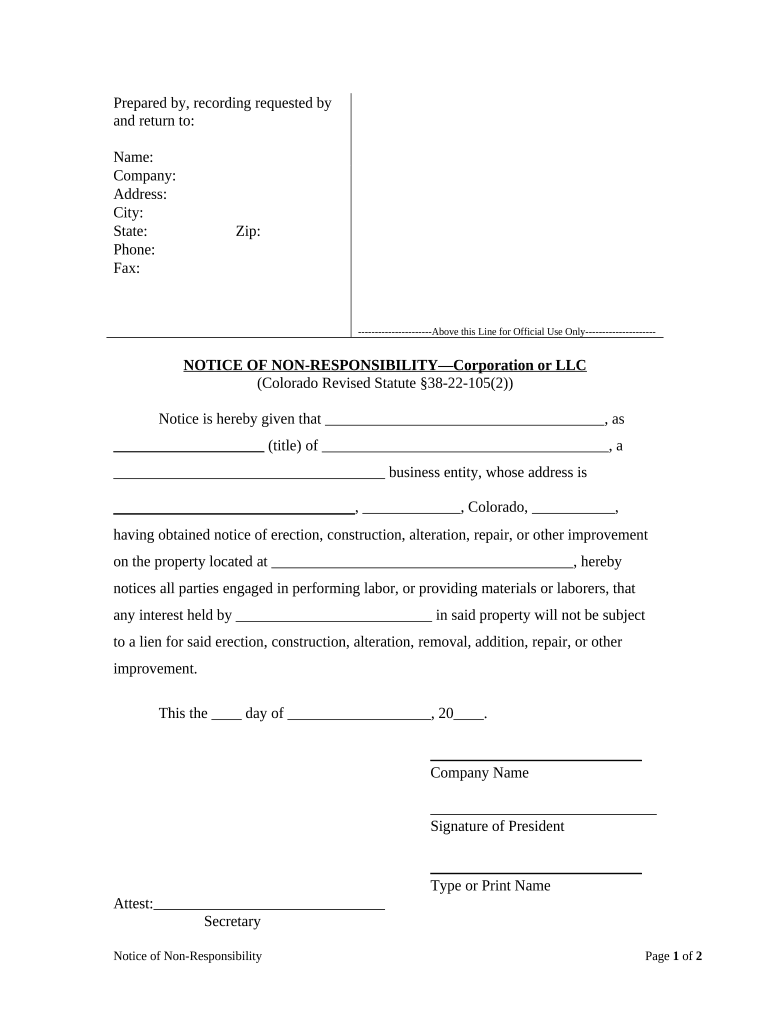
A Colorado Notice of Non-Responsibility is a written declaration filed or served to clarify that a property owner did not authorize specified labor or materials to be provided to their real property and does not accept responsibility for those improvements. Typically used in construction and property disputes, the notice creates a public record that can limit or challenge mechanics' lien claims arising from work performed without the owner’s consent. It identifies the property, describes the unauthorized work, and provides contact and service information for parties involved.

Why filing a Notice can protect property owners

Filing a clear Notice of Non-Responsibility preserves the owner’s ability to dispute liens, notifies claimants and the public of the owner’s position, and can narrow the universe of parties who may later assert a claim against the property.

Why filing a Notice can protect property owners

Who commonly prepares or receives this notice

Property owners and managers most often use the notice to disavow unauthorized work and prompt proper claimants to pursue remedies against the actual contracting party.

  • Residential and commercial property owners who did not authorize on-site contractors or vendors.
  • Property managers and homeowners associations addressing off-contract improvements or trespass work.
  • Construction lenders and title companies managing risk before closing or insuring a transaction.

When used correctly, the notice helps interested parties identify the responsible contractor and can reduce the risk of clouded title or improper lien attachments.

Step-by-step: preparing and issuing the notice

Follow these core steps to prepare and serve a Colorado Notice of Non-Responsibility so the record is clear and defensible.

  • 01
    Confirm facts: Identify unauthorized work, dates, and involved contractors.
  • 02
    Draft notice: Describe property, work, and reasons for non-responsibility.
  • 03
    Authenticate: Sign and notarize if county rules require acknowledgement.
  • 04
    Serve and record: Deliver per statute and record with county recorder or file as required.

Essential elements to include in a professional notice

A complete Notice of Non-Responsibility contains a concise record of the owner’s non-consent, property identification, and reliable contact information to reduce ambiguity for record searches and lien claimants.

Clear Title

State the declarant’s full legal name and, if applicable, the capacity in which the declarant acts (owner, trustee, agent) to confirm authority and standing.
Precise Property ID

Include legal description and parcel or lot number so county recorders and title companies can unambiguously match the notice to the affected real property.

Nature of Work

Describe the labor and materials for which responsibility is denied, including approximate dates and locations on the property to limit potential lien scope.

Claimant Identification

If known, list the contractor, supplier, or agent who performed the work so claimants can be informed and claim resolution can target responsible parties.

Notarization and Signature

Include an owner signature and notary acknowledgement when required by local recording rules to enhance proof of authenticity.

Service and Recording Details

Record how and when the notice was served and where it was filed or recorded to create an evidentiary trail for title searches and disputes.

Configuring a digital workflow for the notice

Set up a simple, auditable digital workflow to prepare, sign, notarize if needed, and distribute the notice electronically and by mail.

Field Configuration
Signer Authentication Email link or SMS code; consider stronger ID for disputed matters
Template Fields Predefine owner, property ID, description, and signature fields for consistency
Notarization Step Include remote or in-person notarization stage if the county requires acknowledgement
Delivery Method Combine recorded filing, certified mail, and digital delivery for proof

Digital platform essentials for filing and service

Choose a platform that supports PDF, DOCX uploads, secure signer authentication, and audit trails to document each action reliably.

  • File formats: PDF and Word DOCX supported
  • Integrations: Sync with cloud storage and title systems
  • Audit trail: Capture IP, timestamps, and actions

Ensure the platform can export a tamper-evident signed copy for recording and generate certificates of completion for service disputes.

Typical process flow from draft to recorded notice

This sequence outlines the common path for a notice: prepare, authenticate, serve, and record to create an effective public record.

  • Draft Notice: Populate property and work details in a standard template
  • Sign & Notarize: Owner signs; obtain notarization if recording requires it
  • Serve Parties: Send certified mail or personal service to claimant and related parties
  • Record Notice: File with county recorder or clerk as required

Security and compliance considerations

Data Encryption: TLS 1.2/1.3; AES-256 at rest
Access Controls: Role-based permissions limit access
Audit Trail: Immutable logs of signer actions
HIPAA Readiness: BAA available when required
ESIGN/UETA: Electronic signature legal frameworks supported
ISO/SOC Standards: ISO 27001 and SOC 2 Type II compliance

Consequences of flawed notices or improper service

Invalid Notice: May be disregarded
Unaddressed Liens: Lien may remain enforceable
Title Risk: Clouded title on sale or refinance
Perjury Risk: False statements risk civil or criminal exposure
Service Defects: Improper service can void notice effects
Filing Errors: Clerical mistakes delay resolution

Common mistakes to avoid when preparing the notice

  • Using an incomplete legal description that does not match county records, making the notice difficult to associate with the correct parcel.
  • Failing to notarize or obtain the required acknowledgment where local recording offices demand it, resulting in rejected filings.
  • Serving the wrong party or omitting proof of service, which undermines the notice’s ability to redirect claims to the responsible contractor.
  • Submitting a vague description of the work or dates, creating room for claimants to argue the notice does not cover contested improvements.

Frequently asked questions about Notices of Non-Responsibility

These answers address common procedural and legal questions property owners and practitioners raise when preparing and serving a notice.


Need help? Contact support

be ready to get more
Join over 28 million airSlate SignNow users