Establishing secure connection…Loading editor…Preparing document…

Commission Agreement

This template is fully customizable. Edit the text, fill out the fields, and send it for signature. Give it a try!
Commission Agreement

What a Commission Agreement Is and when it applies

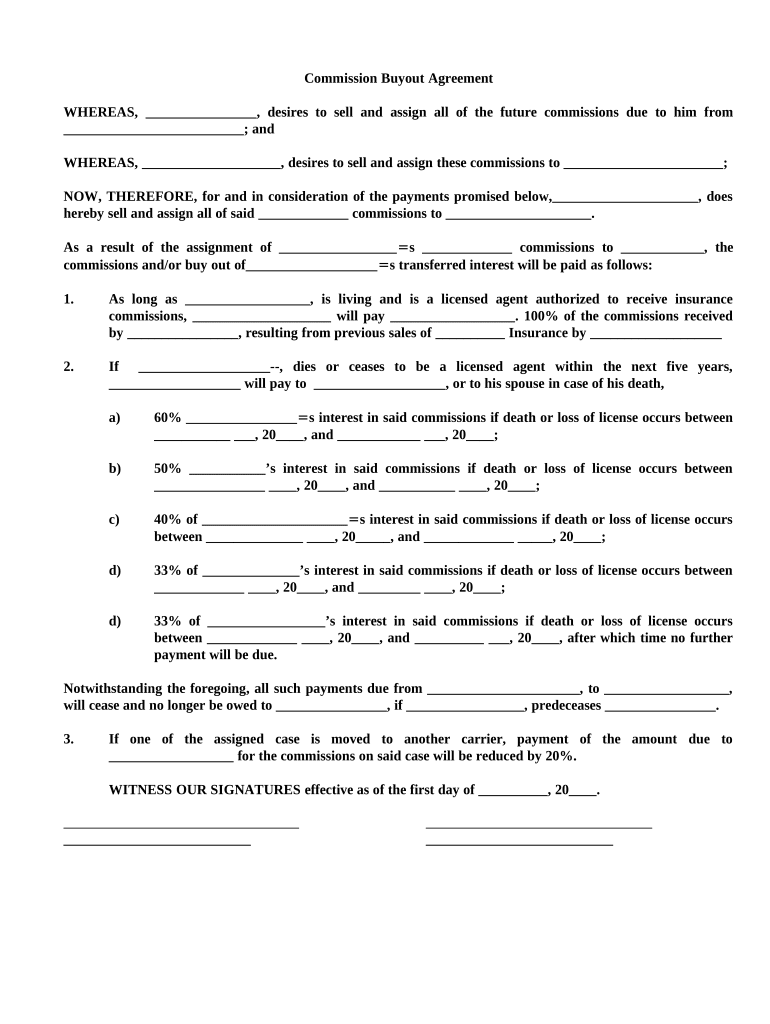
A Commission Agreement is a written contract between a principal and an agent that defines the terms for paying commissions on sales, referrals, or other specified transactions. It identifies the parties, the commissionable activities, the calculation method or percentage, payment schedule, reporting and recordkeeping obligations, and conditions for adjustments or clawbacks. The agreement also addresses territory, exclusivity, confidentiality, duration, termination rights, and dispute resolution. Clear commission provisions reduce disputes, set tax reporting responsibilities, and provide an auditable record for payroll and finance teams.

Why a clear Commission Agreement matters

A Commission Agreement clarifies compensation mechanics, protects both parties from unexpected liabilities, and documents performance expectations. It aids payroll compliance, tax reporting, and dispute avoidance by establishing clear earning, payment, and adjustment rules prior to commission events.

Why a clear Commission Agreement matters

Who typically prepares and signs these agreements

Typical users who prepare or sign Commission Agreements include employers, sales representatives, brokers, and independent contractors involved in commission arrangements.

  • Sales representatives and agents who earn commission-based compensation under sales or referral arrangements.
  • Employers, principals, and brokerages that set pay rules, territories, and reporting requirements.
  • HR, payroll, and finance teams responsible for calculating, withholding, and reporting commission payments.

Core sections to include in a professional Commission Agreement

Core sections of a professional Commission Agreement define parties, payment formulas, performance metrics, timelines, termination rights, and post-termination obligations in clear, enforceable language.

Parties

Identify each party by full legal name, business entity type, and contact details; include principal place of business and any DBA names to prevent ambiguity in enforcement.
Compensation

Specify commission rate or formula, thresholds, caps, prorations, bonus structures, and how mixed compensation applies; include calculation examples for common scenarios.

Payment Terms

State payment intervals, invoicing procedures, timing relative to sale recognition, net terms, withholding for taxes or advances, and remedies for disputed amounts.

Performance

Define covered sales, excluded revenue, performance targets, territory limits, quota credits, reporting obligations, and acceptable documentation for proof of sale.

Termination

Set termination notice periods, post-termination commission entitlement, clawback conditions, and handling of uncollected or chargeback-prone transactions.

Legal Provisions

Include confidentiality, non-solicitation, governing law, dispute resolution, assignment restrictions, and signatures with dates to establish enforceability.

Essential data to collect in the agreement

Party Names: Full legal names and entity types
Addresses: Street, city, state, ZIP
Tax IDs: TIN or EIN for reporting
Commission Formula: Percentage, tiers, or fixed amounts
Payment Schedule: Net terms, frequency, method
Signatures: Typed or handwritten with date

Step-by-step: completing and executing a Commission Agreement

Follow these steps to complete a Commission Agreement accurately and in a sequence suitable for eSigning and filing.

  • 01
    Draft: Draft terms, coverage, and commission formulas.
  • 02
    Review: Have legal and finance review the draft.
  • 03
    Sign: Obtain signatures from authorized signers.
  • 04
    Record: Store executed copy and update payroll entries.

Configure your online signing workflow

Configure an online workflow to place fields, route signers, and collect audit data for e-signed Commission Agreements.

Field Configuration
Signature Field Require name, title, date
Authentication Email link or SMS code
Routing Order Sequential or parallel signer order
Reminders Auto reminders at set intervals

Where signed agreements typically go after execution

Common submission paths and final destinations for signed Commission Agreements in typical business workflows and recordkeeping.

  • To Payroll: Provide executed agreement for commission calculation and tax withholding.
  • To Finance: Upload to accounting system for accrual and payment scheduling.
  • To Agent: Send signed PDF and certificate of completion to agent.
  • To Legal: Retain copy for compliance and dispute evidence.

Platform capabilities to support Commission Agreement workflows

Ensure your eSignature platform supports conditional fields, audit trails, and secure storage for signed Commission Agreements.

  • Authentication: Email, SMS, or KBA options
  • Encryption: TLS in transit, AES-256 at rest
  • Integrations: Connects to CRM, payroll, storage

Timelines, deadlines, and processing expectations

Typical timing, deadlines, and processing expectations tied to Commission Agreements, payroll cycles, and tax reporting obligations.

Effective Date for Commission Accruals:

Use MM/DD/YYYY to determine when amounts become payable.

Payment Cycle and Pay Date:

Align with payroll cutoffs and clearing times.

Invoice Submission and Documentation Deadlines:

Provide invoices within 30 days of sale closure.

Tax Reporting and Form Dates:

Maintain records for IRS reporting and issue 1099s as required.

Timeframes for Dispute Resolution and Appeals:

Establish short windows for disputes, e.g., 30–60 days.

Common mistakes when preparing Commission Agreements

  • Vague commission formulas that omit tiers, rounding rules, or treatment of discounts lead to calculation disputes and delayed payments, burdening payroll and sales relationships.
  • Failing to specify who bears chargebacks, refunds, or returned goods creates retroactive clawbacks and unexpected deductions from future commissions.
  • Missing signer authority or titles can render a corporate signature invalid and expose parties to enforcement risks and contested obligations.
  • Improperly recorded effective dates, or backdating without clear consent, causes audit problems, tax reporting errors, and potential regulatory scrutiny.

Penalties and risks tied to errors or omissions

Tax Penalties: Backup withholding at 24%
Incorrect 1099s: Penalties starting at $60 per form
Clawbacks: Repayment obligations and deductions
Contract Disputes: Litigation or arbitration costs
Payroll Errors: Withholding and reporting mistakes
Notary Failures: Invalid notarization risks unenforceability

Typical signers and their roles

Alex Carter, Sales Rep

A sales representative signs to accept the terms for commission calculation, territory, and reporting. They must confirm performance metrics and provide any required documentation to claim commissions; accurate contact and taxpayer information helps ensure timely payment.

Marta Ruiz, VP Finance

Finance or payroll leaders review formulas, approve payment schedules, and ensure tax reporting accuracy. They confirm withholding, reconcile commission accruals, and retain executed agreements for audit and compliance purposes during retention periods.

Comparing signNow and common eSignature vendors for Commission Agreements

A concise vendor comparison focused on starting price, trial availability, bulk-send capability, audit trails, HIPAA support, and envelope limits relevant to commission workflows.

signNow DocuSign Adobe Sign PandaDoc HelloSign
Starting Price $8/user/mo $15/user/mo $14/user/mo $19/user/mo $15/user/mo
Free Trial 7-day free trial Varies Varies Varies Varies
Bulk Send Yes Yes Yes Yes No
Audit Trail Yes Yes Yes Yes Yes
HIPAA Compliant Yes Yes Yes No No
Envelope Cap No cap 100 envelopes/user/year Varies by plan Varies by plan Varies by plan

Frequently asked questions about Commission Agreements

Common questions about preparing, signing, and enforcing Commission Agreements, including eSignature and recordkeeping issues and compliance considerations.


Need help? Contact support

be ready to get more
Join over 28 million airSlate SignNow users