Establishing secure connection…Loading editor…Preparing document…

Competition Agreement

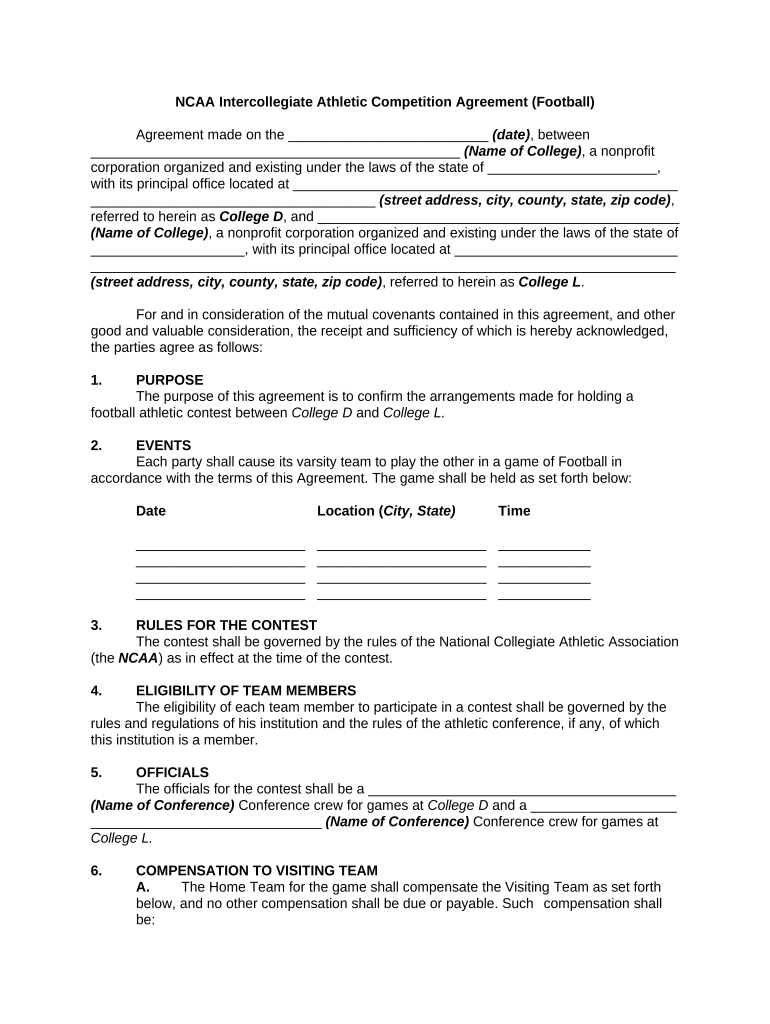
This template is fully customizable. Edit the text, fill out the fields, and send it for signature. Give it a try!
Competition Agreement

What a Competition Agreement Is and when it applies

A Competition Agreement is a written contract used to set terms for a competitive process between parties, such as bidding, contests, or procurement rounds. It defines participant eligibility, submission requirements, evaluation criteria, scoring, award conditions, confidentiality obligations, and dispute resolution. The document clarifies schedules, deliverables, intellectual property ownership of submissions, and remedies for noncompliance. Organizations use it to reduce ambiguity, standardize evaluation, and protect sensitive information exchanged during a competition. Properly drafted Competition Agreements help ensure fair process, transparent criteria, and enforceable outcomes between sponsors and entrants.

Why a clear Competition Agreement matters

A well-drafted Competition Agreement reduces legal risk, sets objective selection rules, protects confidential materials, and records mutual expectations. It provides a defensible basis for award decisions and limits post-selection disputes, benefiting both sponsors and participants by creating predictable procedures and measurable obligations.

Why a clear Competition Agreement matters

Typical users and stakeholders

All signatories should confirm authority to bind their organization and keep a signed copy for audit and dispute resolution purposes.

  • Procurement teams and contracting officers who manage bids and vendor selection for public and private projects.
  • Legal and compliance teams that review terms, confidentiality, IP ownership, and dispute resolution provisions.
  • Contest organizers and participants who need clarity on eligibility, scoring, deadlines, and award conditions.

Who signs and their authority

Sponsor Representative

Chief procurement officers, program managers, or authorized contracting officers typically sign for the sponsor. Their signature confirms the competition rules, award authority, funding availability, and obligations to notify winners and disburse awards according to the agreement terms.

Participant Signatory

An authorized officer, owner, or signatory for the submitting organization must sign to accept terms, certify eligibility, and grant any IP licenses described in the agreement. Individuals signing for sole proprietors must use their legal business name.

Step-by-step: completing a Competition Agreement

Follow these sequential steps to prepare, review, and execute the agreement accurately.

  • 01
    Prepare draft: Populate sponsor and event specifics, deadlines, and evaluation criteria.
  • 02
    Internal review: Have legal and procurement review terms, IP, and confidentiality clauses.
  • 03
    Distribute to participants: Share via secure channel with clear submission instructions.
  • 04
    Execute signatures: Collect authorized signatures and store fully executed copies.

Configuring an online signing workflow

Set up routing, authentication, and fields before sending to ensure correct signatory order and data capture.

Field Configuration
Signer Order Sequential or parallel routing depending on review needs
Authentication Level Email link, SMS code, or KBA where permitted
Required Fields Signature, date, printed name, title, and disclosure checkboxes
Audit Evidence Enable full audit trail with timestamps and IP addresses

Delivering and signing electronically

Ensure the platform captures an audit trail, stores records securely, and supports export to common formats for retention.

  • Supported Formats: PDF, DOCX, and fillable forms
  • Authentication Options: Email link, SMS code, or higher-assurance methods
  • Integrations: CRM and cloud storage connectivity

Typical electronic signing flow for a Competition Agreement

A standard online workflow reduces turnaround time and preserves an evidentiary record of consent and actions.

  • Upload document: Add the final PDF or DOCX to the signing platform.
  • Place fields: Insert signature, date, and data fields for each signer.
  • Send to signers: Send individual or bulk invites with signing order.
  • Record completion: Signed copies and audit trail saved automatically.

Core clauses to include in a professional Competition Agreement

Ensure the agreement covers rules, confidentiality, intellectual property, evaluation metrics, award mechanics, and dispute procedures in clear, enforceable language.

Eligibility

Define who may enter, required qualifications, and prohibited parties to avoid later challenges over participant eligibility or conflicts of interest.
Submission Rules

Specify format, delivery method, file types, timing, and the effect of late or incomplete entries to create objective acceptance criteria.

Evaluation Criteria

List scoring categories, weighting, evaluation panel composition, and any tie-breaker rules to support defensible award decisions.

Intellectual Property

State whether submissions remain participant-owned or if a license or assignment is required; include permitted use and duration of any license granted.

Confidentiality

Describe what materials are confidential, the handling obligations, permitted disclosures, and the duration of nondisclosure requirements.

Award Terms

Clarify prize amount, payment timing, conditionality, tax reporting obligations, and any post-award deliverables or acceptance testing.

Supporting provisions often required

Include practical clauses that manage risk, administration, and legal compliance for the competition lifecycle.

Data Protection

Address storage, access, and processing of personal data and consider HIPAA or state privacy rules if health information is involved.

Indemnity and Liability

Specify limits on liability, indemnification for third-party claims, and exclusions for consequential damages where appropriate.

Withdrawal and Cancellation

State the sponsor's right to cancel or modify the competition and the process for notifying entrants and returning materials.

Governing Law

Identify the state law that will govern interpretation and dispute resolution, and whether arbitration is required.

Key milestones in a competition lifecycle

Track milestones from announcement through award and appeals so stakeholders understand timing and responsibilities.

01

Announcement

Release rules and timeline to prospective participants.

02

Submission Deadline

Cutoff for complete entries in the specified time zone.

03

Evaluation Period

Evaluators score entries according to published criteria.

04

Award and Notification

Notify winners and finalize any award paperwork.

Typical dates and processing expectations

Establish definitive dates for submission, evaluation, award, and any protest or appeal windows to avoid ambiguity.

Submission Deadline Format:

MM/DD/YYYY HH:MM TZ — precise time zone required.

Evaluation Window:

Typically 2–6 weeks depending on volume and complexity.

Award Notification:

Often within 7–14 days after evaluation completion.

Protest Period:

Commonly 10–30 days for formal challenges to award decisions.

Record Retention Start:

Begin retention on the effective or award date per policy.

Common mistakes to avoid when preparing this agreement

  • Vague submission rules that omit format or delivery details, causing inconsistent entries and disputes.
  • Unclear IP language that fails to state whether submitters retain ownership or grant licenses to the sponsor.
  • Missing or ambiguous scoring criteria that give rise to claims of unfair evaluation or bias.
  • Failure to specify governing law and dispute resolution, increasing litigation risk and jurisdictional uncertainty.

Consequences of errors or noncompliance

Disqualification Risk: Late or nonconforming submissions may be voided.
IP Disputes: Ambiguous ownership increases litigation exposure.
Data Privacy Violations: Potential HIPAA or state privacy penalties.
Contract Claims: Breach may lead to damages or injunctive relief.
Procurement Audit Findings: Noncompliance can trigger corrective actions for sponsors.
Reputational Harm: Perceived unfairness or leaks can damage credibility.

How a Competition Agreement compares to related contracts

Use this quick comparison to distinguish a Competition Agreement from similar contract types and to pick the right document for your process.

Document Comparison Competition Agreement Confidentiality Agreement Procurement Contract
Primary Purpose manage competition protect secrets bind long-term supplier
Confidentiality Included often sometimes
Award Mechanism
Typical Use contests and bids nda exchanges supplier engagement

Representative eSignature vendor comparison for executing Competition Agreements

This table lists common plan and feature distinctions among popular eSignature providers to inform platform selection when executing Competition Agreements electronically.

signNow DocuSign Adobe Sign PandaDoc HelloSign
Starting Price $8/user/mo $15/user/mo $14/user/mo $19/user/mo $15/user/mo
Free Trial 7-day free trial Varies by plan Varies by plan Varies by plan Varies by plan
Bulk Send Yes (premium) Yes Yes Yes No
Audit Trail Yes Yes Yes Yes Yes
HIPAA Compliant Yes (BAA) Yes (BAA) Yes (BAA) No No

Real-world examples of Competition Agreement use

These case snapshots show how organizations apply Competition Agreements to real procurement and contest scenarios.

Optica Ventures procurement

Optica issued a standardized competition rules document to streamline vendor bids and reduce negotiation time.

  • The template limited ambiguity in scoring.
  • As a result, procurement reported clearer award justification, fewer bid protests, and a documented audit trail for compliance and financial review.

Tech Data partner contest

Tech Data used a Competition Agreement to define IP handling for submitted solutions.

  • The agreement required explicit IP license terms.
  • That clarity reduced post-award disputes, clarified ownership of prototypes, and enabled faster contracting with the selected partner.

Practical tips for accurate and efficient completion

Apply these best practices to reduce errors, speed execution, and strengthen enforceability of Competition Agreements.

Use consistent legal names
Always enter the full legal entity name and authorized signatory title to prevent later challenges; confirm via corporate records.
Specify exact deadlines
Include date, time, and time zone for submission cutoffs to eliminate ambiguity and support automated validation.
Document evaluation steps
Publish scoring rubrics and panel composition in the agreement so award decisions are reproducible and defensible.
Retain full audit trails
Keep executed copies, signer metadata, and any A/V records (for RON) to support compliance and dispute resolution.

Frequently asked questions about Competition Agreements

Answers to common questions about validity, electronic execution, amendments, and recordkeeping for Competition Agreements.


Need help? Contact support

be ready to get more
Join over 28 million airSlate SignNow users