Establishing secure connection…Loading editor…Preparing document…

Complaint Federal Court

This template is fully customizable. Edit the text, fill out the fields, and send it for signature. Give it a try!
Complaint Federal Court

What a Complaint in Federal Court Is and When it's Used

A Complaint for Federal Court is the initiating pleading that starts a civil lawsuit in a United States district court. It names the parties, states the court’s subject-matter and personal jurisdiction, sets out factual allegations and legal claims, and requests specific relief. Complaints must comply with the Federal Rules of Civil Procedure, be signed by counsel or an unrepresented plaintiff, and include any required civil-cover or local-court forms before filing.

Why the Complaint Matters for Case Control and Judicial Review

The complaint frames the dispute, establishes the legal and factual basis for relief, and sets jurisdictional boundaries. A clear, well-pled complaint reduces the risk of early dismissal, helps define discovery scope, and preserves issues for appeal.

Why the Complaint Matters for Case Control and Judicial Review

Who Prepares and Files Federal Complaints

Plaintiffs or their attorneys prepare federal complaints; pro se litigants also may file without counsel.

  • Private litigants and businesses filing civil suits in district court
  • Government counsel and agencies pursuing federal claims
  • Pro se plaintiffs representing themselves without an attorney

Courts and opposing parties rely on the complaint to identify issues, so accuracy at filing is essential.

Core Components of a Professional Federal Complaint

A federal complaint should be concise, organized, and include required jurisdictional statements and factual allegations linked to legal claims under governing statutes or common law.

Caption

Court name, case number (assigned at filing), and party names in the required local format; miscaptioning can delay processing.
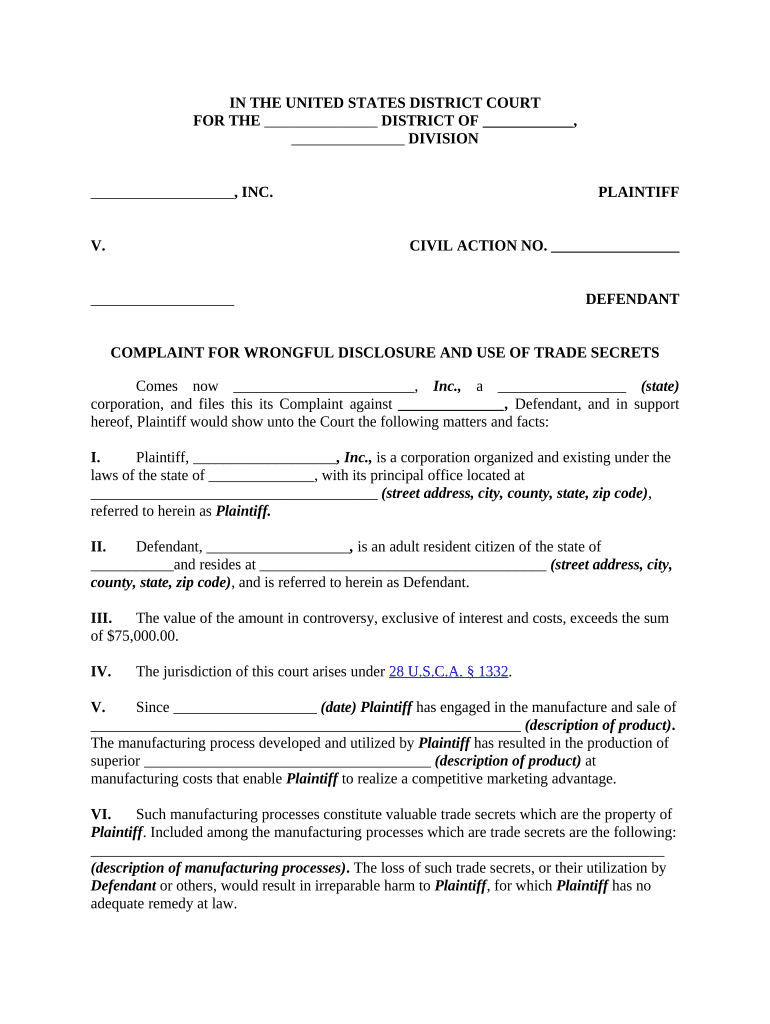
Jurisdiction

A jurisdictional paragraph citing subject-matter and personal jurisdiction (diversity, federal question, statutory basis) and the factual basis for venue.

Parties

Clear identification of plaintiffs and defendants with addresses and corporate status; inaccuracies can affect service and jurisdictional analysis.

Factual Allegations

Numbered paragraphs stating relevant facts, dates, actions, and causal links that support each legal claim without unnecessary repetition.

Claims for Relief

Counted causes of action that cite legal authority and link the facts to the statutory or common-law elements required for each claim.

Prayer

Specific relief requested (monetary damages, injunctive relief, declaratory relief) and any demand for jury trial if applicable.

Step-by-Step: Prepare, Sign, and File the Complaint

Follow a consistent sequence to reduce filing errors and preserve procedural rights.

  • 01
    Draft Complaint: Assemble caption, jurisdiction, facts, and claims.
  • 02
    Review Local Rules: Check district local rules and required civil-cover forms.
  • 03
    Sign and Verify: Attorney or pro se signer signs; include verification if required.
  • 04
    File and Serve: File with the clerk and serve defendants per FRCP and local rules.

Typical Filing and Service Flow for Federal Complaints

The federal filing process is sequential: filing with the clerk, issuance of a case number, and service of process on defendants according to FRCP rules.

  • File with Clerk: Submit complaint and civil-cover sheet to the district court clerk.
  • Receive Case Number: Clerk assigns a case number and docketing information.
  • Serve Defendants: Serve process per FRCP 4 and local rules; proof of service must be filed.
  • Monitor Deadlines: Track answer dates, motions, and scheduling order timelines.

Configuring an Online Complaint Workflow

When using an e-filing or e-sign platform, configure fields and routing to match the federal complaint sequence and required attachments.

Field Configuration
Caption Field Auto-populate court and party names
Signature Field Require signer name, bar number, date
Attachment Handling Include exhibits and civil-cover forms as PDFs
Service Proof Generate and store proof of service templates

Digital Filing and eSignature Considerations

Confirm the platform supports required formats, audit trails, and any court-specific e-filing specifications before use.

  • File Formats: PDF/A and searchable PDFs preferred
  • Audit Trail: Timestamp, IP, and signer metadata
  • Court E-Filing: Compatibility with CM/ECF or local e-file portals

Ensure the platform’s export and evidence features preserve authenticity for later motions, service disputes, or appeals.

Key Deadlines to Track After Filing a Complaint

Federal procedure imposes specific time limits for service, responsive pleadings, and certain post-filing actions; track each to protect rights.

Service Deadline:

Serve defendants within 90 days after filing (FRCP 4(m)); extensions require good cause.

Answer Deadline:

Defendant typically must answer within 21 days after service (FRCP 12(a)(1)(A)(i)).

Removal Window:

Defendant seeking removal typically must act within 30 days of receipt (28 U.S.C. §1446).

Notice of Appeal:

File notice of appeal within 30 days of final judgment (28 U.S.C. §2107).

Local Rule Requirements:

Some districts require additional forms or scheduling report deadlines at filing.

Sequential Milestones from Filing to Initial Response

Track these numbered milestones as your case moves from filing toward an initial court response and scheduling conference.

01

Drafting and Review

Finalize factual allegations and legal claims before filing.

02

Filing with Clerk

Clerk dockets the complaint and assigns a case number.

03

Service of Process

Serve defendants and file proof of service with the court.

04

Responsive Pleading

Defendant files an answer or Rule 12 motion within statutory deadlines.

Common Preparation Mistakes to Avoid

  • Failing to plead jurisdictional facts clearly, which can lead to dismissal for lack of subject-matter jurisdiction.
  • Using inconsistent party names or incorrect corporate details that complicate service and jurisdictional assertions.
  • Submitting unsigned complaints or missing required local forms, causing the clerk to reject or delay docketing.
  • Overlooking service rules or proof-of-service requirements that permit default judgments if unmet.

Consequences of Procedural or Factual Errors

Dismissal Risk: Case dismissal for lack of jurisdiction or failure to state a claim.
Sanctions: Monetary sanctions under FRCP 11 for frivolous filings.
Default Judgment: Default entered for failure to serve or prosecute.
Appeal Limitations: Preservation failures can bar appellate review of issues.
Delay Costs: Extended litigation timelines and increased legal fees.
Evidentiary Risk: Lost or inadequate documentation can weaken damages proof.

Security and Compliance for eFiling and eSigning

In-Transit Encryption: TLS 1.2/1.3
At-Rest Encryption: AES-256
Regulatory Standards: ESIGN and UETA compliance
Audit Trails: Timestamped signer metadata
Healthcare Compliance: HIPAA available (BAA required)
Enterprise Certifications: SOC 2 Type II, ISO 27001

Real-World Examples: How Teams Handle Federal Complaints

These brief examples show how different organizations use digital tools and standard procedures to prepare and file federal complaints.

Optica Ventures LLC — COO

When preparing complaints, the team standardized templates and review checklists for accuracy.

  • Reduced drafting friction by standardizing exhibits and captions.
  • The interface is simple and easy-to-use for our team; more importantly, it is just as easy for our customers.

Fertility Centers of Illinois — Founder

The organization centralized legal intake and document retention for litigation matters.

  • Centralization ensured consistent jurisdictional statements and exhibits.
  • The team highlighted responsiveness and compliance with signature and recordkeeping requirements for patient-related documentation.

Best Practices for Accurate, Efficient Complaint Preparation

Adopt standardized templates, preflight checks, and a documented review workflow to reduce rejection and preserve rights.

Use a Verified Template and Checklist
Maintain a jurisdiction-specific complaint template that incorporates local rules, required civil-cover sheets, and a pre-filing checklist to catch caption, jurisdiction, and signature errors.
Confirm Party Identities and Citizenship
Verify corporate formation documents and individual citizenship details to support diversity jurisdiction and avoid later jurisdictional challenges.
Preserve Evidence and Exhibits
Attach contemporaneous records and exhibits with clear labels and maintain original electronic files to support discovery and evidentiary authentication.
Track Service and Responsive Deadlines
Log service dates immediately and calendar responsive pleading and motion deadlines in your matter-management system to prevent defaults or waiver of defenses.

eSignature Vendor Comparison for Complaint Preparation and Filing Support

Common vendor features for preparing and signing legal filings vary by price and compliance capabilities; signNow is listed first for comparison purposes.

signNow DocuSign Adobe Sign PandaDoc HelloSign
Starting Price $8/user/mo $15/user/mo $14/user/mo $19/user/mo $15/user/mo
Free Trial 7-day free trial Free trial available Free trial available Free trial available Free trial available
Bulk Send Yes Yes Yes Yes No
Audit Trail Yes Yes Yes Yes Yes
HIPAA Compliant Yes Yes Yes No No

Frequently Asked Questions About Federal Complaints

Answers to common procedural and technical questions when drafting, signing, and filing a complaint in federal court.


Need help? Contact support

be ready to get more
Join over 28 million airSlate SignNow users