Establishing secure connection…Loading editor…Preparing document…

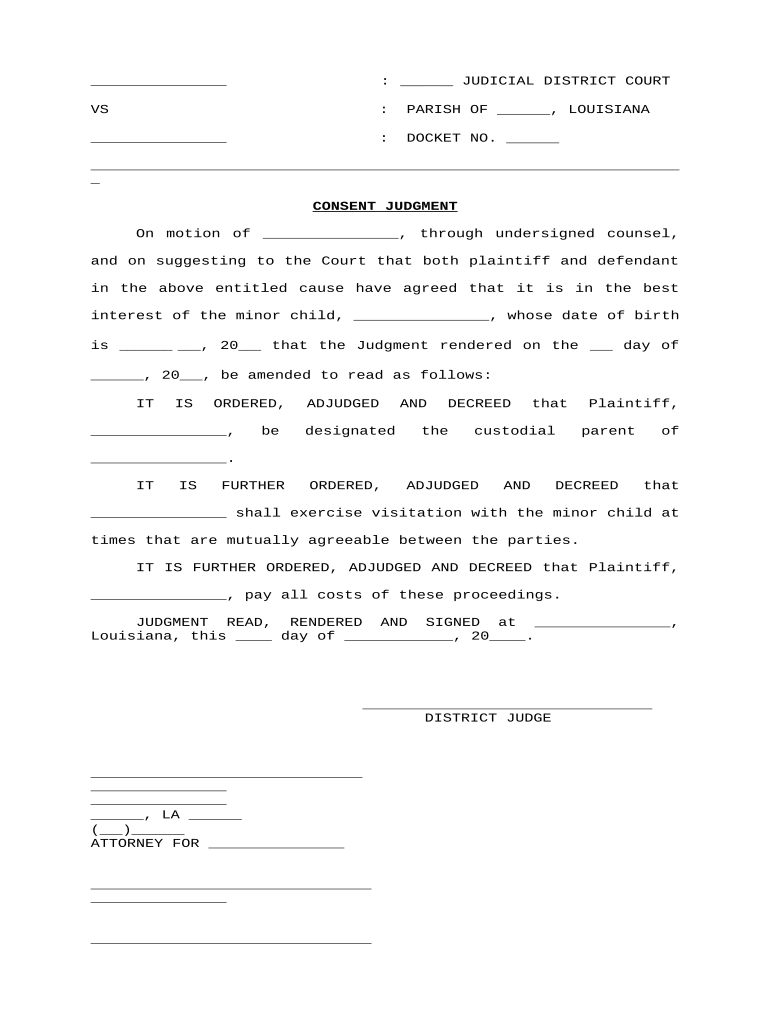
Consent Judgment

This template is fully customizable. Edit the text, fill out the fields, and send it for signature. Give it a try!
Consent Judgment

What a Consent Judgment Is and when it applies

A Consent Judgment is a court-approved order that records the terms of a settlement agreed to by the parties in litigation and converts those terms into a binding judgment. It resolves underlying claims without a trial, may include injunctive relief, monetary payments, or other obligations, and is enforceable as a court order once entered. Because it combines contractual promises with judicial authority, a Consent Judgment can be enforced by contempt, garnishment, or other post-judgment remedies available under state procedure and federal rule sets.

Why parties use a Consent Judgment instead of continuing litigation

A Consent Judgment gives parties certainty and a single enforceable court order that avoids the cost and delay of trial, preserves settlement confidentiality where allowed, and creates clear enforcement pathways under court authority.

Why parties use a Consent Judgment instead of continuing litigation

Who commonly prepares and signs Consent Judgments

Consent Judgments are used by litigants, their attorneys, and courts to finalize settlements across civil matters.

  • Plaintiffs and defendants who reached a negotiated settlement and want a court order enforcing the terms
  • Corporate legal teams and in-house counsel handling commercial disputes and regulatory settlements
  • Private attorneys and mediators who draft the settlement terms for court approval

After court approval, the judgment is docketed and becomes enforceable; parties typically retain counsel for enforcement and compliance monitoring.

Step-by-step: Completing a Consent Judgment

Follow a predictable sequence to draft, agree, and have the court enter a Consent Judgment to reduce risk and avoid delays.

  • 01
    Gather Case Details: Confirm case caption, court, docket number, and authorized signers before drafting.
  • 02
    Draft Agreement Terms: Translate settlement terms into precise judgment language, including remedies and timelines.
  • 03
    Obtain Party Signatures: Have all parties or their authorized representatives sign and date the document.
  • 04
    Submit for Court Entry: File or present the executed Consent Judgment to the judge for signature and docketing.

Typical workflow for converting a settlement into a Consent Judgment

A smooth workflow reduces clerical issues and shortens the time between agreement and enforceability.

  • Draft: Prepare judgment language reflecting settlement terms precisely.
  • Review: Counsel for all parties review and confirm language and exhibits.
  • Execute: Parties sign the judgment; notary or witness requirements fulfilled when necessary.
  • Entry: File with the clerk or present to the court for signature and docketing.

Core elements to include in a professional Consent Judgment

Each element below should be present or addressed explicitly so the judgment is clear, enforceable, and administrable by the court.

Case Identification

Full court name, docket number, and parties to ensure the judgment attaches to the proper lawsuit and clerk records.
Recitals

Brief background statements that identify the settlement, mediation, or negotiation that produced the agreement without creating new operative obligations.

Payment Terms

Explicit payment amounts, schedules, interest on late payments, escrow instructions, and any conditions for release of funds.

Injunctive Provisions

Specific prohibitions or affirmative actions with measurable standards and timelines to avoid ambiguity when enforcing.

Release and Reservation

Clearly state what claims are released, what claims are reserved, and the scope of the release (e.g., known or unknown claims).

Enforcement & Jurisdiction

Language confirming court retains jurisdiction for enforcement, contempt, or to resolve compliance disputes.

Security and compliance details to protect the signed record

Encryption: TLS 1.2/1.3 in transit; AES-256 at rest
Audit Trail: Comprehensive timestamps, IP addresses, and action logs
ESIGN / UETA: Conforms to ESIGN Act and UETA requirements
HIPAA: HIPAA-compliant with BAA available
21 CFR Part 11: Supports FDA-regulated electronic records
Certifications: SOC 2 Type II, ISO 27001, PCI DSS

Common preparation errors to avoid

  • Using inconsistent party names that prevent clerk matching and lead to re-filing delays or docketing errors.
  • Vague terms for obligations or deadlines that allow differing interpretations and complicate enforcement actions.
  • Failing to secure authorized signatures or approvals, which can result in a judge refusing entry or a party seeking vacatur.
  • Omitting court identifiers or docket numbers that cause the clerk to misfile the document or delay entry.

Consequences of errors or noncompliance with a Consent Judgment

Vacatur Risk: Court may set aside judgment
Contempt Exposure: Civil contempt sanctions possible
Monetary Liability: Damages or interest accruals
Enforcement Cost: Attorney fees and collection expenses
Appeal Delay: Extended litigation if terms ambiguous
Record Errors: Clerk corrections and re-filing

Recommended digital workflow settings for Consent Judgments

Configure your signing workflow to match court and local practice requirements before sending the document for signatures.

Field Configuration
Authentication Email + SMS code or stronger KBA where court/local rule requires higher assurance
Notarization Enable RON or require in-person notarization per jurisdiction
Routing Set signer order: counsel -> parties -> judge submission
Retention Enable tamper-evident PDF with audit trail retention settings

Distribution and eSubmission options for executed Consent Judgments

Courts and clerks accept different submission formats—confirm local rules before e-submitting the executed judgment.

  • Court Filing: PDF/A with embedded audit trail preferred in many clerks' offices
  • Email to Counsel: Provide final signed PDF and certificate of completion to each party and counsel
  • Remote Notarization: Use RON where permitted and record the audio-video session per state rules

Check the clerk's electronic filing requirements (format, cover sheet, and submission portal) and preserve a certified copy for enforcement purposes.

Typical timing and scheduling considerations

Plan around negotiation, execution, court scheduling, and any payment or performance timelines specified in the judgment.

Negotiation Window:

Days to weeks depending on complexity and counsel availability

Execution Deadline:

Specify specific calendar date or number of days after agreement

Court Hearing:

Allow several weeks for a court review or signing calendar slot

Payment Schedule:

State milestone dates, interest start, and cure periods

Enforcement Timeline:

Court retains jurisdiction for enforcement term as specified

Key milestones from settlement to enforceable judgment

Track these sequential stages to ensure timely entry and reduce risk of administrative delay.

01

Pre-filing Negotiation

Finalize settlement terms and draft consent language.

02

Execution by Parties

All parties sign and complete any required notarizations or witness steps.

03

Submission to Court

File the executed judgment or present it at a scheduled hearing.

04

Entry and Docketing

Judge signs, clerk enters judgment, and enforcement mechanisms become available.

eSignature vendor comparison for executing Consent Judgments

Basic vendor pricing and capability indicators that matter for executing legal documents and preserving evidentiary trails. Confirm plan details with each vendor.

signNow DocuSign Adobe Sign PandaDoc HelloSign
Starting Price $8/user/mo $15/user/mo $14/user/mo $19/user/mo $15/user/mo
Free Trial Yes, 7-day trial Varies Varies Varies Varies
Bulk Send Varies by plan Varies Varies Varies Varies
Audit Trail Yes Yes Yes Yes Yes
HIPAA Compliant Yes Varies Varies Varies Varies
Envelope Cap No cap 100 envelopes/user/year Varies Varies Varies

Frequently asked questions about Consent Judgments

Answers to common legal, procedural, and technical questions about drafting, signing, and enforcing Consent Judgments.


Need help? Contact support

be ready to get more
Join over 28 million airSlate SignNow users