Petitioner Details
Provide full legal name, relationship to the respondent, contact information, and declaration of interest. Accurate identification helps the court assess standing and potential conflicts before appointing a conservator.
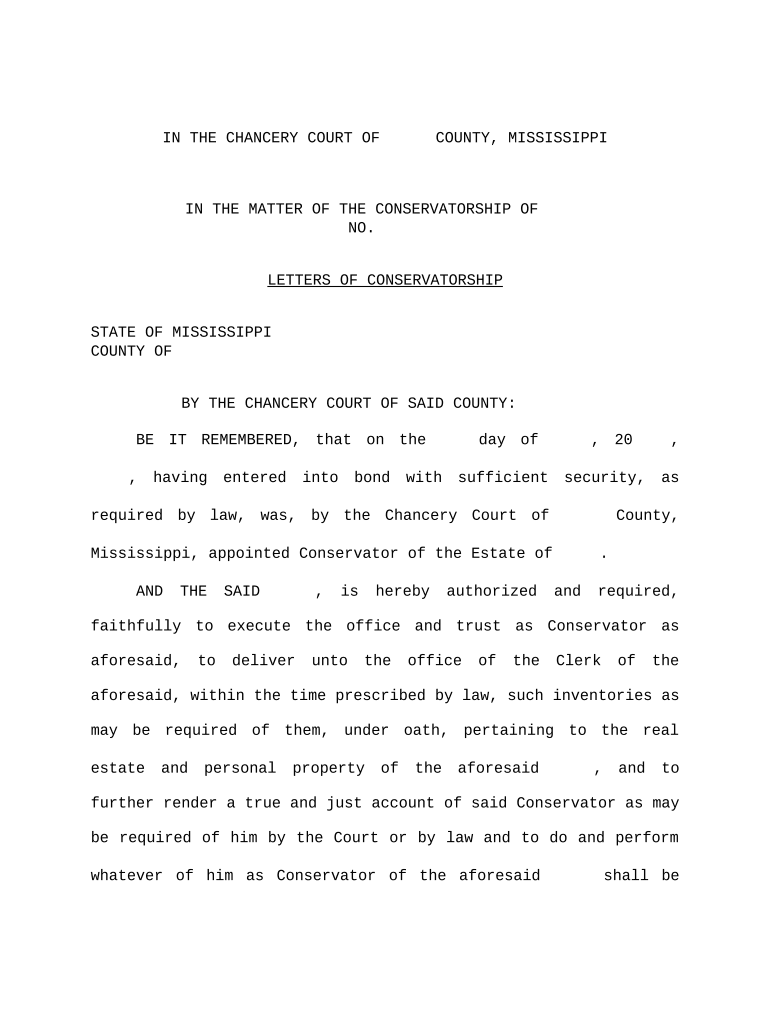
Filing the Mississippi Conservatorship Form starts the court-supervised process to protect an incapacitated adult, establish decision-making authority, and secure financial oversight. It clarifies scope of powers requested, preserves legal rights, and provides a formal record the court uses to balance autonomy and protection.

Family members, licensed attorneys, social workers, and occasionally medical providers prepare and file the Mississippi Conservatorship Form to request court appointment of a conservator.
Typically an adult child or spouse who files the conservatorship petition on behalf of the alleged incapacitated person. They must supply factual support, proposed care plans, and contact details; courts evaluate family relationships, motive, and suitability before appointing a conservator.
An attorney, guardian ad litem, or examiner appointed to assess capacity and recommend powers. Their reports, medical affidavits, and testimony carry significant weight in hearings and influence the scope of conservatorship ordered.
Provide full legal name, relationship to the respondent, contact information, and declaration of interest. Accurate identification helps the court assess standing and potential conflicts before appointing a conservator.
State the alleged incapacitated person's full legal name, date of birth, current address, and any prior orders. Include aliases and recent medical facility locations to avoid misidentification.
Specify exactly which powers are sought — medical decisions, financial management, property transactions — and justify each as necessary to protect the respondent's welfare or estate.
Attach physician affidavits, cognitive evaluations, and treatment summaries describing incapacity, prognosis, and recommended protective measures to support the petition.
Include bank accounts, investments, real property, debts, and an initial proposed budget or bond amount to allow the court to evaluate financial oversight needs.
Describe living arrangements, healthcare decision protocols, visitation plans, and proposed conservator qualifications to demonstrate a practical and least-restrictive approach.
| Document Template and Field Mapping | Use PDF form with fillable fields |
|---|---|
| Signer Authentication and Verification | Enable email+SMS or KBA per court requirements |
| Role-Based Routing and Approvals | Sequential routing: attorney, petitioner, court clerk |
| Exhibit Attachment and Indexing | Require uploads: medical affidavit, financial inventory |
| Retention and Export Settings | Export signed PDF/A and store encrypted archive |
For eSubmission and sharing, ensure platform supports secure e-signatures, PDF/A export, and identity verification methods acceptable to court.
Serve interested parties within the timeline set by local rules or court order, often 7–30 days
Court schedules a hearing; timing varies by docket availability and case complexity
Emergency temporary conservatorship may be granted pending full hearing
Court typically requires initial inventory and periodic accountings; deadlines set by judge
Appeals or objections follow state civil procedure timelines after final order entry
| signNow | DocuSign | Adobe Sign | PandaDoc | HelloSign | |
|---|---|---|---|---|---|
| Starting Price | $8/user/mo | $15/user/mo | $14/user/mo | $19/user/mo | $15/user/mo |
| Free Trial | 7-day free trial | Varies by vendor | Varies by vendor | Varies by vendor | Varies by vendor |
| Bulk Send | Yes (Premium plan) | Yes | Yes | Yes | No |
| Audit Trail | Yes | Yes | Yes | Yes | Yes |
| HIPAA Compliant | Yes | Yes | Yes | No | No |
| Envelope Cap | No cap | 100 envelopes/user/year | Varies by plan | Varies by plan | Varies by plan |