Establishing secure connection…Loading editor…Preparing document…

Georgia Petition for Citation of Contempt

This template is fully customizable. Edit the text, fill out the fields, and send it for signature. Give it a try!
Georgia Petition for Citation of Contempt

What the Georgia Petition for Citation of Contempt Is

A Georgia Petition for Citation of Contempt is a court filing used to ask a judge to hold a person or entity in contempt for failing to comply with a prior court order or judgment. Typical uses include enforcing child support orders, visitation or custody directives, domestic relations decrees, court-ordered discovery, or injunctions. The petition sets out the specific order allegedly violated, the facts showing the violation, and the relief requested such as sanctions, compliance directives, or incarceration. It initiates a contempt proceeding under Georgia practice rules in the superior, juvenile, or magistrate court with jurisdiction.

Why a Petition for Citation of Contempt Matters

Filing a petition provides a formal legal mechanism to enforce court orders, compel compliance, and seek sanctions or other remedies. It creates a court record, triggers notice and a hearing, and gives the judge authority to impose coercive or punitive measures to secure performance.

Why a Petition for Citation of Contempt Matters

Who Commonly Prepares and Files This Petition

Individuals and organizations use the petition to enforce court orders when informal efforts have failed.

  • Private Litigants — Individuals pursuing enforcement of family court, custody, or civil judgments who need formal judicial intervention.
  • Attorneys — Family law, civil litigation, and collection attorneys who draft pleading, prepare affidavits, and present evidence at hearing.
  • Government or Agencies — Child support enforcement units, prosecutors, or administrative agencies seeking contempt for compliance with administrative or court orders.

Parties should confirm the correct court, local filing rules, and service requirements before filing to avoid delays or dismissal.

Step-by-Step: Preparing and Filing the Petition

Follow these steps to assemble the petition, supporting evidence, and service documents before filing with the correct court clerk.

  • 01
    Gather Orders: Collect the original order, docket entries, and certified copies where available.
  • 02
    Prepare Petition: Draft the petition with a clear facts section and specific relief requested.
  • 03
    Attach Evidence: Include affidavits, payment records, communications, and exhibits supporting the violation.
  • 04
    File and Serve: File with the clerk and serve the respondent per Georgia service rules before the hearing.

Essential Parts of a Professional Petition

A complete petition follows court conventions, provides concise factual support, and attaches proof. Include these sections and formal elements to help the clerk accept the filing and the judge understand the issues.

Caption & Jurisdiction

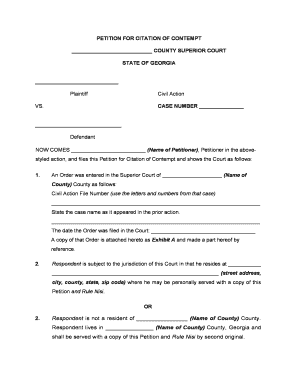
Court name, county, case number, and party designations showing the clerk and judge the proper forum and subject matter jurisdiction.
Statement of Order

Identify the controlling order by name and entry date so the alleged violations are legally tied to an enforceable directive.

Factual Allegations

Chronological, specific facts showing noncompliance with dates, amounts, or actions; avoid conclusory language without detail.

Affidavit or Verification

Sworn affidavit from the petitioner or witness attesting to facts; required to establish credibility and formality.

Supporting Exhibits

Attach documents such as payment records, emails, transcripts, or certified orders that corroborate allegations.

Request for Relief

State the sanctions or remedial orders sought and whether you request expedited hearing or temporary relief.

Required Information and Short Checklist

Case Number: Existing docket number
Court Name: Superior, Juvenile, or Magistrate
Petitioner: Full legal name
Respondent: Full legal name
Attached Evidence: Affidavits and exhibits
Service Info: Proof of proper service

Where to File and What Happens Next

Filing and processing follow a predictable path: clerk review, service on respondent, scheduling, and a contempt hearing where the judge rules on sanctions or orders for compliance.

  • File with Clerk: Submit petition to the clerk in the county with case jurisdiction.
  • Serve Respondent: Provide notice by personal service or method authorized by court rules.
  • Return Hearing: Court schedules a hearing for respondent to appear and respond.
  • Judicial Ruling: Judge may order compliance, fines, fees, or other sanctions.

Digital Filing, Signatures, and File Formats

Use PDF or Word formats per local clerk guidance; include an audit trail and signed affidavits when filing or e-submitting documents.

  • Accepted Formats: PDF, DOCX, and scanned TIFF are widely accepted
  • eSignature Needs: Signatures must meet ESIGN/UETA validity criteria
  • Integrations: Supports cloud storage and court e-filing portals

Verify local clerk e-filing rules and whether the court accepts electronic filings, registered user accounts, or requires in-person paper submissions for contempt matters.

How to Configure an Online Contempt Petition Workflow

When using an eSignature or document platform, configure fields and authentication to match court requirements and streamline service and evidence collection.

Field Configuration
Signers Petitioner and attorney roles defined
Authentication Email link or SMS code options
Attachments Upload exhibits and sworn affidavits
Notifications Automate clerk and counsel alerts

Timing and Scheduling Considerations

Timing depends on the court's calendar and service rules; some matters require expedited treatment while others follow routine scheduling.

Filing Timing:

File promptly after discovering noncompliance; no universal statutory delay

Service Deadline:

Serve respondent with sufficient time before hearing per local rules

Hearing Scheduling:

Clerk sets a hearing date; timelines vary by county and court

Compliance Deadlines:

Judge may set specific compliance dates during or after hearing

Appeal Window:

Post-judgment appeals follow Georgia civil appeal timeframes

Key Milestones in a Contempt Proceeding

Track these sequential milestones to monitor progress from filing to enforcement and any appellate steps.

01

Prepare Petition

Draft petition with clear facts and sworn affidavit.

02

File with Clerk

Clerk accepts filing and assigns a hearing date.

03

Serve Respondent

Provide required process and file proof of service.

04

Attend Hearing

Present evidence; judge issues ruling or orders.

Common Mistakes to Avoid When Preparing the Petition

  • Using an incorrect case caption or wrong docket number, which may lead the clerk to reject the filing and delay the hearing.
  • Failing to attach the prior order or judgment being enforced, leaving the petition unsupported and vulnerable to dismissal.
  • Insufficient service information or serving at an expired or incorrect address, which can void notice and the court’s ability to proceed.
  • Relying on hearsay without sworn affidavits or documentary proof, reducing the petition's credibility at the contempt hearing.

Penalties and Legal Risks of an Incorrect Petition

Case Dismissal: Insufficient facts may result in dismissal
Sanctions: Court may impose monetary sanctions
Perjury Risk: False affidavits can lead to criminal charges
I-9/Tax Exposure: Separate compliance errors can trigger fines
Delay Costs: Additional attorney fees and court costs
Reputational Harm: Public filings can affect reputation

Real-World Use Examples (Illustrative)

Illustrative examples show typical contempt petition scenarios and the kinds of evidence judges find persuasive.

Family Law Example

A custodial parent files after the noncustodial parent repeatedly misses court-ordered visitation dates, documented by calendar entries and communications.

  • Case files include dated messages and affidavits from witnesses confirming missed exchanges.
  • At hearing, the court ordered make-up time, attorney fees, and a compliance deadline; the respondent was warned of further sanctions for continued refusal.

Landlord–Tenant Example

A landlord files to enforce a prior possession order after a tenant fails to vacate by the deadline, supported by certified mail notices and utility records.

  • Evidence includes written notices, move-out deadlines, and photographs of forced-entry lockout steps.
  • The court enforced the order with a writ of possession and awarded landlord costs; the tenant faced further contempt exposure if noncompliant.

Practical Tips for an Accurate and Persuasive Petition

Adopt practices that reduce delays and strengthen your position at hearing; these approaches help the court assess compliance and appropriate remedies.

Confirm Court and Docket
Verify the case caption and docket number on the original order; mismatches can cause rejection and unnecessary delay in scheduling a contempt hearing.
Provide Sworn Evidence
Use affidavits with dates and exhibits rather than unsworn summaries; sworn testimony increases evidentiary weight and helps the judge evaluate credibility.
Document Service Carefully
Follow statutory service methods and file proof of service promptly; inadequate service often requires re-serving and rescheduling the hearing.
Be Specific About Relief
Request precise remedies and timelines for compliance; vague or open-ended requests make it harder for the court to grant enforceable orders.

eSignature Vendor Pricing Comparison for Filing and Managing the Petition

For e-signature and document workflows used to assemble, sign, and store petitions and affidavits, compare starting price, trial availability, bulk-send, audit trail, and HIPAA support across vendors.

signNow DocuSign Adobe Sign PandaDoc HelloSign
Starting Price $8/user/mo $15/user/mo $14/user/mo $19/user/mo $15/user/mo
Free Trial 7-day free trial, no credit card Varies by vendor Varies by vendor Varies by vendor Varies by vendor
Bulk Send Yes Yes Yes Yes No
Audit Trail Yes Yes Yes Yes Yes
HIPAA Compliant Yes Yes Yes No No

Frequently Asked Questions About the Georgia Petition for Citation of Contempt

Answers below address common procedural questions, authentication and service concerns, and evidence best practices to help you prepare a well-documented petition.


Need help? Contact support

be ready to get more
Join over 28 million airSlate SignNow users