Establishing secure connection…Loading editor…Preparing document…

Letter Regarding Amended Responses to Discovery Requests

This template is fully customizable. Edit the text, fill out the fields, and send it for signature. Give it a try!
Letter Regarding Amended Responses to Discovery Requests

What the Letter Regarding Amended Responses to Discovery Requests Is

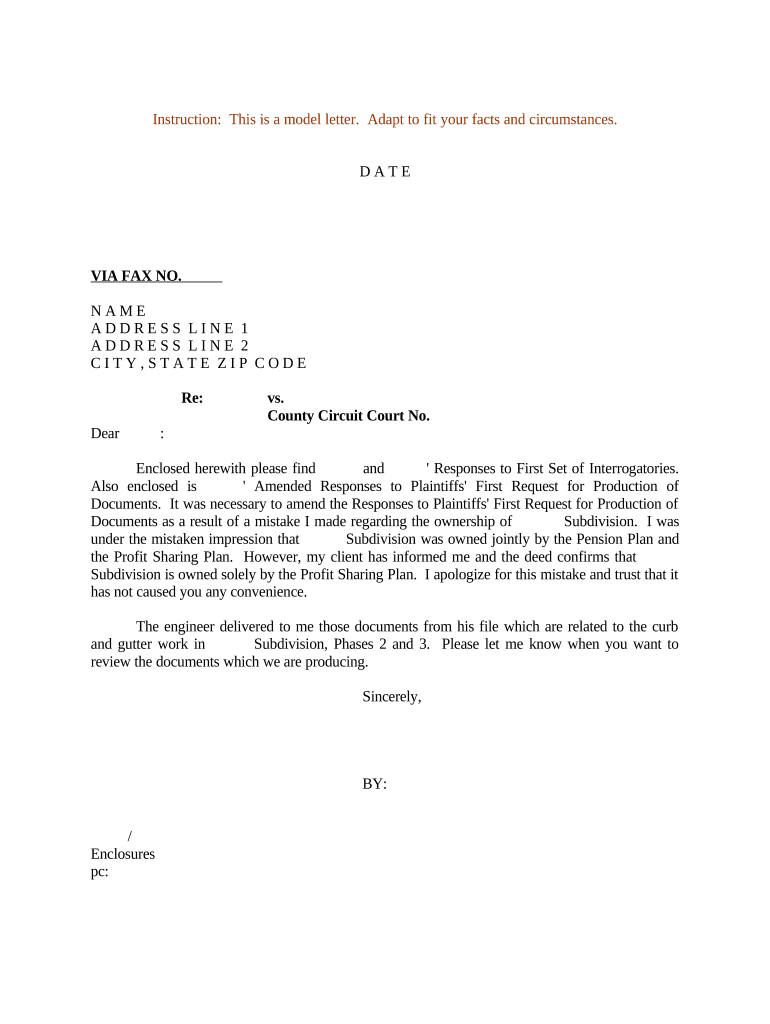
A Letter Regarding Amended Responses to Discovery Requests is a formal communication used in litigation to notify opposing parties and the court that previously served discovery answers, responses, or produced documents have been corrected, expanded, or otherwise changed. The letter explains which interrogatories, requests for admission, or document production responses are amended, provides the amended answers or identifies newly produced documents, and establishes the date the amendment is effective. Parties use this letter to maintain the discovery record, preserve transparency, and reduce disputes over completeness of disclosures during pretrial preparation.

Why Sending an Amended-Response Letter Matters

Issuing a clear, documented amendment reduces ambiguity and shows good-faith compliance with discovery obligations under the rules of civil procedure. It helps avoid sanctions, narrows disputed issues, and creates an auditable record that counsel and the court can review.

Why Sending an Amended-Response Letter Matters

Who Typically Prepares and Receives This Letter

The court and case administrators also receive copies when local rules or court orders require filing or lodging of supplemental discovery.

  • Plaintiff counsel serving amended interrogatory answers and producing new documents to defense counsel during fact discovery.
  • Defense counsel notifying opposing counsel of corrected admissions or supplemental privilege logs.
  • Litigation support teams tracking amended productions and updating Bates ranges and index files for review.

Step-by-Step: Preparing and Serving the Amended-Response Letter

Use this sequence to prepare a compliant, auditable amendment and to reduce chances of dispute about timeliness or content.

  • 01
    Confirm Scope: Review the original responses and identify specific items requiring amendment.
  • 02
    Draft Amendments: Prepare revised answers or descriptions of newly produced documents with Bates references.
  • 03
    Internal Review: Have counsel and litigation support verify privilege designations and redactions.
  • 04
    Serve and Document: Serve the letter via agreed methods (email, e-service), retain delivery proof and update the discovery index.

Typical Workflow for Issuing an Amended-Response Letter

This high-level flow shows the practical steps from discovery gap identification to delivery and recordkeeping.

  • Identify Change: Detect omitted facts, documents, or errors during review or new findings.
  • Prepare Amendment: Draft corrected responses, log new documents, and reference Bates numbers.
  • Counsel Approval: Obtain client and attorney sign-off on content and privilege assertions.
  • Serve & Archive: Deliver by agreed method, update docket entry, and archive signed copy with audit trail.

Document Configuration When Using an eSigning or Case-Management Workflow

Set these workflow options to ensure secure service, authentication, and an auditable record when sending amended letters electronically.

Field Configuration
Signature Method Typed name with audit trail, or digital certificate for higher assurance.
Authentication Email link and optional SMS code for recipient verification.
Delivery Receipt Enable read and completion receipts and retain logs.
Document Retention Export signed PDF and metadata to case folder and document repository.

Technical Considerations for Electronic Transmission and eSigning

Maintain encrypted storage and export a copy with complete metadata; if using third-party eSignature services, ensure they meet required compliance standards for your jurisdiction and case type.

  • File Formats: PDF or DOCX preferred
  • Audit Trail: IP, timestamp, and signer info
  • Authentication: Email or SMS code

Timing and Deadlines to Consider When Amending Discovery

Deadline expectations depend on local rules and the timing of the newly discovered information; treat amendments as promptly as possible after discovery.

Promptness Obligation:

Amend 'promptly' after learning of new facts; courts may penalize delay.

Local Rule Variations:

Local civil rules may require filing or service of supplements within set periods.

Court Orders:

Comply with any deadlines or meet-and-confer schedules set by the court.

Expert Disclosures:

Coordinate amended factual disclosures with expert report schedules.

Preservation Impact:

Act quickly to preserve newly relevant materials once discovered.

Key Milestones After Discovering a Need to Amend Responses

Track these milestones in sequence to create a clear audit trail and to comply with procedural duties.

01

Discovery of New Information

Document when and how the information was identified.

02

Internal Review and Draft

Draft the amended responses and assess privilege or confidentiality.

03

Service to Opposing Counsel

Serve the amended letter and updated productions promptly.

04

Record Retention

Archive signed letter and service evidence in the case file.

Essential Elements to Include in a Professional Amended-Response Letter

Include these elements to ensure the amendment is clear, defensible, and easy for opposing counsel and the court to reconcile with prior responses.

Clear Reference

Cite the original discovery request numbers and original service dates so recipients can compare prior and amended responses side-by-side.
Precise Amendments

Provide the full amended answer text or specify newly produced documents with Bates ranges instead of vague references.

Privilege Handling

If withholding, state the basis for privilege and include a privilege log per applicable rules or protective order.

Method of Service

State how the letter and any documents were served, including email address, e-service portal, or hand delivery evidence.

Effective Date

Specify the date the amendment is effective for clarity in subsequent litigation timelines.

Contact Information

Include counsel contact details for follow-up and to facilitate meet-and-confer efforts if disputes arise.

Privacy and Security Details to Record with the Letter

Encryption: TLS 1.2/1.3 in transit
Data at Rest: AES-256 encryption
Audit Trail: IP and timestamp logs
Access Controls: Role-based permissions
HIPAA Support: BAA available if needed
Retention Policy: Documented retention settings

Consequences and Common Risks of Improper Amended Responses

Sanctions Risk: Court sanctions for willful nondisclosure
Credibility Harm: Damaged witness or counsel credibility
Motion Practice: Opposing counsel may seek relief or sanctions
Preclusion: Risk of preclusion of evidence at trial
Privilege Errors: Overbroad privilege claims can be challenged
Timing Penalties: Delayed supplements can lead to adverse rulings

eSignature Vendor Comparison for Sending and Archiving Amended Letters

Comparison of basic pricing and common enterprise features relevant to secure e-delivery and auditable signing. signNow is listed first by vendor name per comparison convention.

signNow DocuSign Adobe Sign PandaDoc HelloSign
Starting Price $8/user/mo $15/user/mo $14/user/mo $19/user/mo $15/user/mo
Free Trial 7-day free trial Varies by region Varies by plan Varies by plan Varies by plan
Bulk Send Yes Yes Yes Yes Varies
Audit Trail Yes Yes Yes Yes Yes
HIPAA Compliant Yes Yes Yes No No
Envelope Cap No cap 100 envelopes/user/year Varies Varies Varies

Frequently Asked Questions About Amending Discovery Responses

Answers to common procedural and technical questions about preparing, serving, and documenting amended discovery responses.


Need help? Contact support

be ready to get more
Join over 28 million airSlate SignNow users