Establishing secure connection…Loading editor…Preparing document…

Contract for the International Sale of Goods

This template is fully customizable. Edit the text, fill out the fields, and send it for signature. Give it a try!
Contract for the International Sale of Goods

What the Contract for the International Sale of Goods Is and when it applies

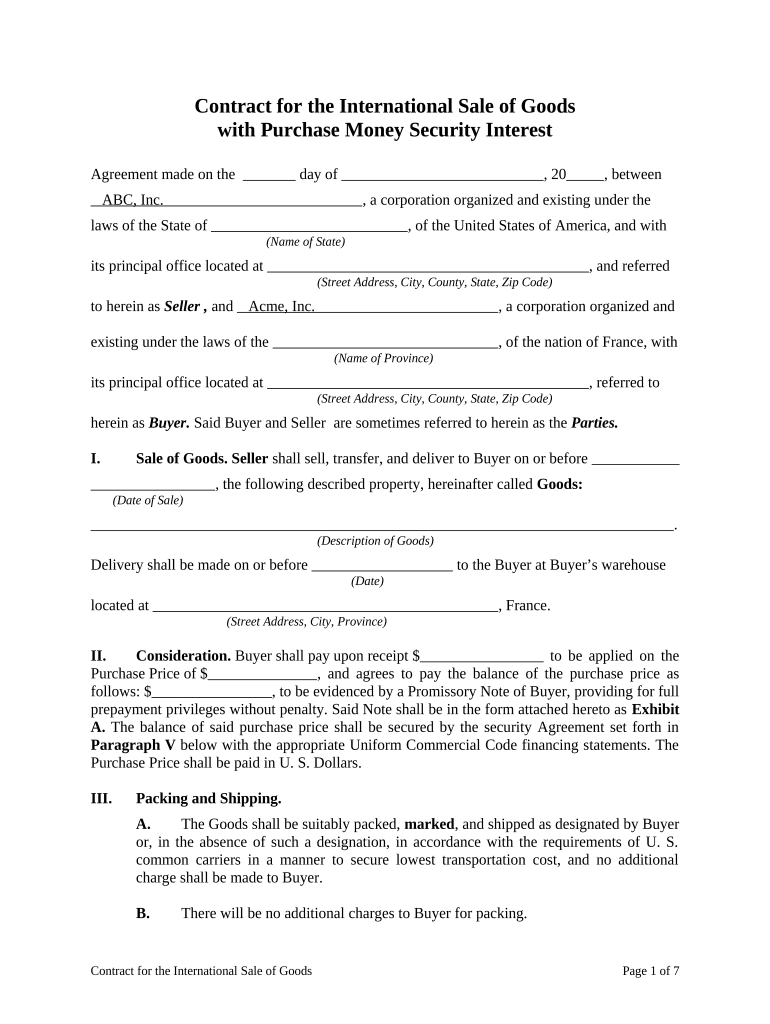
A Contract for the International Sale of Goods is a written agreement between a seller and a buyer to transfer ownership of specified goods across national borders for an agreed price. It sets essential terms including identification of parties, detailed description of goods, price and currency, delivery and Incoterms, packing, insurance, transfer of risk and title, inspection and acceptance, payment method, export/import compliance, warranties, remedies for breach, and dispute resolution. Parties often reference the UN Convention on Contracts for the International Sale of Goods (CISG) or expressly opt out and select governing law and forum.

Why a clear international sales contract matters

A well-drafted contract reduces cross-border uncertainty by allocating commercial risks, clarifying delivery and payment expectations, and minimizing disputes. It protects commercial interests by stating Incoterms, currency, customs responsibilities, and inspection procedures and by defining remedies for nonperformance.

Why a clear international sales contract matters

Who typically prepares and signs this contract

Commercial sellers, importers, exporters, trade compliance teams, and legal counsel commonly draft or review these agreements before first shipment.

  • Export Managers and Logistics Coordinators responsible for Incoterms, shipping schedules, and customs clearance coordination.
  • Procurement and Purchasing Teams who confirm pricing, inspection windows, and acceptance criteria on behalf of the buyer.
  • In-house or External Counsel who review governing law, dispute resolution clauses, and export control compliance.

Typical signatories and their responsibilities

International Seller

Chiefly responsible for accurate goods description, export compliance, providing commercial documents (invoice, packing list, export declaration), and meeting delivery obligations under chosen Incoterms; seller signs to accept payment and will usually warrant title and conformity.

Import Buyer

Responsible for payment per contract, import clearance, duties/taxes if contract so provides, and inspection/acceptance within agreed windows; buyer signs to confirm purchase and to accept remedies and dispute-resolution clauses.

Core clauses to include in a professional international sales contract

Include clear, unambiguous clauses that allocate commercial risk, define performance obligations, and provide mechanisms for inspection, claims, and dispute resolution.

Parties & Recitals

Identify full legal names, entity type, and addresses; state the contract purpose and date; include contact persons for notices and commercial communications to avoid ambiguity about who binds each party.
Goods Description

Provide precise specifications, part numbers, quantities, packaging, and acceptable tolerances; attach technical exhibits where needed to prevent inspection disputes and mismatched expectations on conformity.

Price, Currency and Payment

Specify currency, payment method (wire, letter of credit), payment schedule, late payment interest, and who bears bank charges; for letters of credit include documentary requirements and allowed discrepancies.

Delivery and Incoterms

State the agreed Incoterm (e.g., FOB, CIF) and edition, delivery dates or windows, place of delivery, and responsibilities for transport, insurance, and customs formalities to allocate risk and cost.

Risk/Title Transfer and Inspection

Define when risk passes (shipment vs. delivery), inspection rights and timeframes, rejection procedures, and who pays return shipment or storage during dispute resolution.

Governing Law & Dispute Resolution

Specify whether CISG applies or is excluded, select governing law, and choose arbitration or litigation venue, including seat of arbitration and language to ensure enforceable remedies.

Essential contract data fields at a glance

Seller Identity: Legal name and address
Buyer Identity: Legal name and address
Goods Details: Description, quantity, SKU
Price & Currency: Amount and currency
Delivery Terms: Incoterm and place
Payment Terms: Method and due date

Step-by-step to prepare and execute the contract

Follow these sequential steps to draft, approve, and execute a compliant international sales contract.

  • 01
    Draft terms: Assemble parties, goods, price, Incoterms, and key exhibits.
  • 02
    Compliance review: Run export controls, sanctions, and customs checks.
  • 03
    Internal approvals: Obtain finance, legal, and commercial sign-off per authority matrix.
  • 04
    Execute and record: Sign electronically or physically and store execution copies with audit trail.

How online completion and signature typically flows

Electronic workflows shorten execution timelines; these are the common stages from upload to completed record.

  • Upload document: Upload final contract PDF or DOCX to the signing platform.
  • Place fields: Add signature, date, initials, and conditional fields for approvals.
  • Send to signers: Email signing links or use bulk send for many counterparties.
  • Capture audit trail: Platform records IP, timestamp, and authentication method.

Typical online workflow settings for this contract type

Configure these settings to match required authentication and documentation needs for cross-border agreements.

Field Configuration
Signature Type Electronic signature with audit trail
Authentication Email link, optional SMS code or ID verification
Document Format PDF/X or DOCX preserved for archive
Retention Store signed copy and certificate of completion

Platform capabilities to support international sale contracts

Choose a platform that supports common file types, strong audit trails, and enterprise integrations to reduce manual handoffs.

  • Integrations: Salesforce, NetSuite, Microsoft 365
  • File formats: PDF, DOCX, Excel
  • Authentication: Email, SMS, ID verification

Key differences: CISG-based international contract vs domestic UCC contract

Contrast common dimensions so parties decide whether to adopt CISG rules or select domestic law and UCC remedies.

Criteria CISG Contract UCC / Domestic Contract
Scope of application applies cross-border sales applies domestic sales
Default rules uniform international defaults state-specific ucc provisions
Option to exclude parties may exclude cisg explicitly ucc not subject to exclusion
Remedies and damages internationally harmonized remedies remedies vary by state law

eSignature vendor comparison for executing international sales contracts

Basic plan pricing and common capabilities when selecting an eSignature provider for cross-border contract execution and recordkeeping.

signNow DocuSign Adobe Sign PandaDoc HelloSign
Starting Price $8/user/mo $15/user/mo $14/user/mo $19/user/mo $15/user/mo
Free Trial 7-day free trial Varies Varies Varies Varies
Bulk Send Yes (Business Premium+) Yes Yes Yes Limited
Audit Trail Yes Yes Yes Yes Yes
HIPAA Compliant Yes (BAA available) Yes Yes No No
Envelope Cap No envelope cap 100 envelopes/user/year Varies Varies Varies

Common drafting and execution mistakes to avoid

  • Failing to specify Incoterms and edition leads to disputes over who bears freight, insurance, and customs costs, often causing delivery and payment claims.
  • Not stating the currency and payment mechanism can trigger exchange-rate disputes and banking charge disagreements that delay settlement and enforcement.
  • Omitting export control or sanctions checks risks regulatory violations, shipment seizures, and heavy fines where restricted parties or destinations are involved.
  • Neglecting to exclude or adopt the CISG explicitly can cause unintended application of international default rules that differ from negotiated domestic law outcomes.

Legal consequences and commercial risks of an incomplete contract

Contract Ambiguity: Increases litigation risk
Noncompliance: May trigger fines or seizure
Payment Disputes: Risk of delayed funds
Customs Problems: Possible shipment holds
Sanctions Exposure: Regulatory penalties possible
Enforcement Difficulty: Cross-border remedies costly

Key timing elements to build into the contract

Specify measurable dates and notice periods to reduce ambiguity and create enforceable performance milestones.

Effective Date:

Date when obligations begin

Delivery Window:

Defined calendar days or specific dates

Inspection Period:

Number of days for buyer inspection (e.g., 30 days)

Payment Due Date:

Specify net days from invoice (e.g., net 30)

Breach Notice Period:

Notice and cure periods before remedies

High-level milestones from negotiation to archiving

A simple milestone view clarifies critical handoffs and ensures each stage has an accountable owner and timeline.

01

Negotiation Complete

Final terms agreed and draft approved

02

Compliance Clearance

Export, sanctions, and customs checks completed

03

Execution

Signatures collected and documents dated

04

Archive

Signed copies stored with retention metadata

Practical examples from organizations using electronic execution

Organizations using a compliant eSignature workflow report faster execution and simplified audit trails when closing international sale agreements.

Xerox — NetSuite integration

A global IT services team automated contract signing to reduce cycle time and reduce manual handling.

  • Integration point reduced manual uploads and errors.
  • "airSlate SignNow provides us with the flexibility needed to get the right signatures on the right documents, in the right formats, based on our integration with NetSuite."

Tech Data — speed to revenue

Centralized eSignature workflows replaced paper routing and sped approvals across regions.

  • Internal and external turnaround improved.
  • "Tech Data uses airSlate SignNow to improve our internal and external customer service while increasing our speed to revenue."

Frequently asked questions about validity, signing, and disputes

Answers to common practical questions on enforceability, electronic execution, and cross-border considerations for international sales contracts.


Need help? Contact support

be ready to get more
Join over 28 million airSlate SignNow users