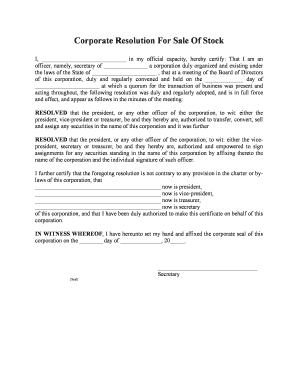
Corporate Resolution Form
What the Corporate Resolution Form Is and When It’s Used
Why a Clear Corporate Resolution Matters
A properly drafted resolution establishes legal authority, reduces disputes over who may act on behalf of the company, and meets third-party and regulatory expectations. It creates an auditable record that supports compliance, banking transactions, real estate closings, and counterparties that require proof of corporate approval.
Who creates and relies on Corporate Resolutions
Typical creators and recipients of corporate resolutions include corporate officers, directors, banks, legal counsel, and transaction counterparties; each uses the form for different verification purposes.
- Boards of directors and corporate officers: approve actions and delegate authority to sign agreements or open accounts.
- Banks and financial institutions: require certified resolutions to open accounts, establish credit, or accept electronic signatures.
- Legal and conveyancing professionals: use resolutions to confirm authority for real estate closings, mergers, or filings.
Step-by-step: completing and certifying a Corporate Resolution
-
01Draft: Write a clear statement of the action and authorized parties.
-
02Board Approval: Record approval in a meeting or unanimous written consent.
-
03Certification: Have an officer or corporate secretary sign and date the resolution.
-
04Distribute: Provide certified copies to banks, counterparties, or counsel as needed.
How to set up an online workflow for a Corporate Resolution
| Field | Configuration |
|---|---|
| Document Template | Use a fixed template with conditional text for action-specific details. |
| Signer Sequence | Route to board approver(s) then to corporate secretary for certification. |
| Authentication | Enable email + SMS code or SSO for officer authentication. |
| Retention | Automatically store signed copy and audit trail in records repository. |
Typical routing for eSigned Corporate Resolutions
-
Prepare Document: Upload and tag signature, date, and certification fields.
-
Route to Approvers: Send to directors or authorized signers in order.
-
Certify: Corporate secretary signs and attests to the resolution.
-
Distribute: Deliver certified PDF and audit trail to banks or counsel.
Digital signing and integration considerations
Choose a platform that supports secure eSignatures, audit trails, and integrations with your document repository and accounting or ERP systems.
- Integrations: Salesforce, NetSuite, Google Workspace
- Formats: PDF, DOCX, HTML
- Authentication: Email, SMS code, SSO
Common preparation mistakes to avoid
- Using an informal or ambiguous 'authorization' phrase that does not specify authority scope, dollar limits, or exact signers, leading to third-party rejection.
- Failing to match the corporate name precisely to the articles of incorporation or state registration, which causes banks and title companies to refuse acceptance.
- Skipping certification by the corporate secretary or neglecting to provide a certified copy, which often triggers additional verification requests and delays.
- Relying on unsigned meeting minutes without a signed resolution or failing to record unanimous written consent where a meeting could not be convened.
Risks of an incorrect or incomplete resolution
Timing considerations and response expectations
Immediate Requests:
Banks commonly require a certified copy before opening accounts; expect response same day to several days.
Real Estate Closings:
Lenders and title companies may request resolution days before closing to verify authority.
Board Records:
Include resolution in corporate minutes promptly after approval to preserve evidentiary chain.
Notary or RON:
Allow extra time for remote online notarization or mobile notary scheduling.
Document Retention:
Keep originals and certified copies available per your retention policy.
Real-world examples of Corporate Resolutions in practice
Optica Ventures LLC
Optica used a concise bank authorization resolution to name signers and set limits.
- It listed exact signers and dollar caps.
- The certified resolution satisfied the bank’s corporate acceptance policy and avoided additional legal review, enabling account opening within two business days.
Martin Properties
Martin Properties executed a resolution to authorize real estate closings and escrow signatories.
- It included notarized certification.
- Providing the certified resolution to the title company prevented closing delays and ensured consistent signer authority across multiple transactions.
Who typically signs and certifies a Corporate Resolution
Corporate Secretary
The corporate secretary normally certifies that the resolution was duly adopted and records it in the corporate minutes, providing the attestation and date required by banks and third parties.
President / CEO
An authorized officer such as the president or CEO commonly executes transactional authorizations and performs duties specified in the resolution, including representing the corporation to counterparties.
eSignature vendor comparison for signing Corporate Resolutions
| signNow | DocuSign | Adobe Sign | PandaDoc | HelloSign | |
|---|---|---|---|---|---|
| Starting Price | $8/user/mo | $15/user/mo | $14/user/mo | $19/user/mo | $15/user/mo |
| Free Trial | 7-day free trial | Varies by vendor | Varies by vendor | Varies by vendor | Varies by vendor |
| Bulk Send | Yes | Yes | Yes | Yes | No |
| Audit Trail | Yes | Yes | Yes | Yes | Yes |
| HIPAA Compliant | Yes | Yes | Yes | No | No |
Frequently asked questions about Corporate Resolutions
-
Is an electronic resolution legally binding?
Yes. Electronic signatures on corporate resolutions are generally enforceable under the ESIGN Act (15 U.S.C. §7001) and UETA where adopted, provided the signature meets intent, consent, attribution, and retention requirements.
-
Do I need the resolution notarized?
Not usually required by corporate law, but banks, title companies, or counterparties frequently request notarized or certified copies; follow the institution’s acceptance policy or use a notary/RON when requested.
-
Who must approve and sign the resolution?
Approval typically comes from the board of directors or by unanimous written consent; authorized officers (e.g., president, treasurer) sign as specified. Check your bylaws for delegated authority rules.
-
How can a resolution be revoked or amended?
A later board resolution rescinding or amending the prior action, recorded in minutes and distributed to affected third parties, is the standard method to revoke or change authority.
-
What supporting documents should accompany a resolution?
Attach articles of incorporation, bylaws, recent meeting minutes, officer list, and any required corporate filings to validate authority for third parties and simplify verification.
-
Can I use remote online notarization (RON)?
RON is allowed in many states with specific identity-proofing and recording requirements; verify your state’s RON rules before relying on remote notarization for certified corporate documents.